
Designing Dignity: Can Infrastructure Sustain India’s Para-Sports Surge?
India's Paralympic ambition has outpaced its infrastructure and now it's time the architecture caught up

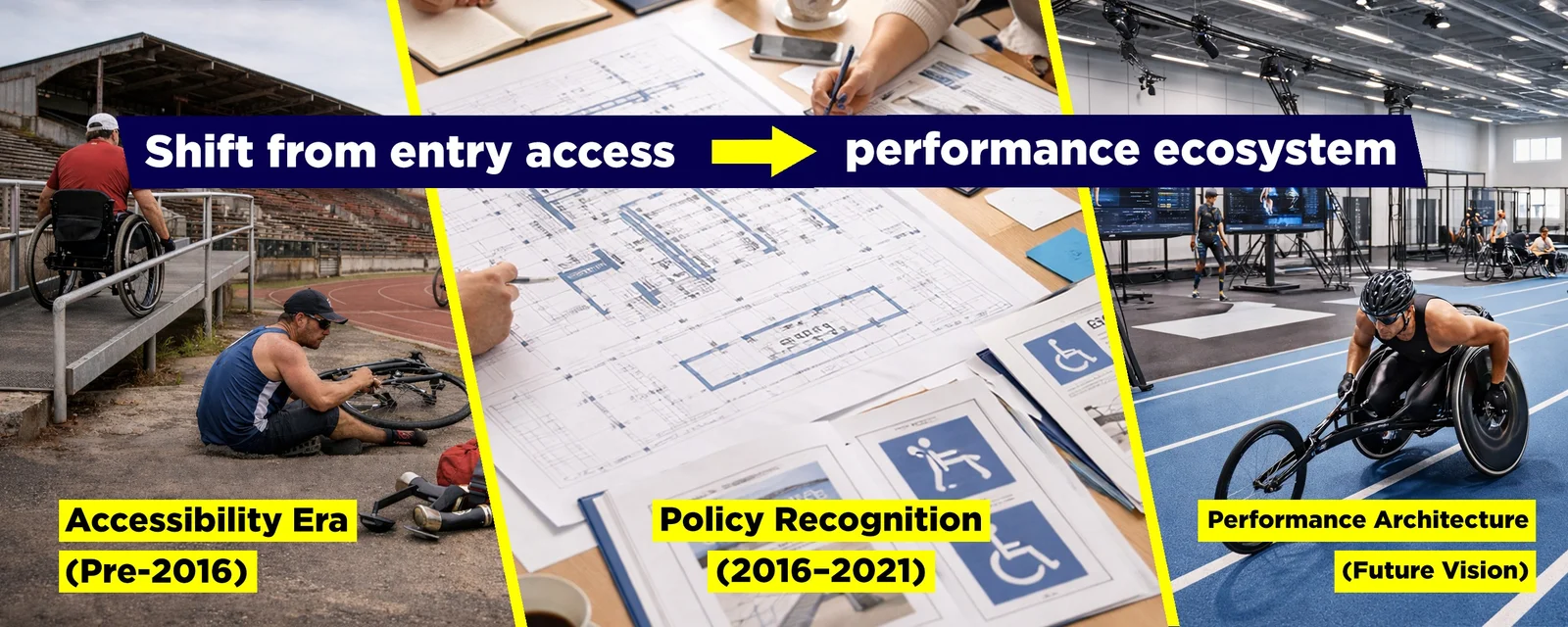
For much of Independent India’s sporting past, para-athletes were given borrowed spaces to train themselves to conquer the world, a feat no nation ever imagined. The infrastructure for mainstream sports was signing rhetorically, and everyone was fine-tuning with it, where no eyes could ever see the training of para in stadiums that were retrofitted for them. While prime-time television celebrated the perfect dive or the last-ball six under LED glare, another group of athletes trained in the shadows of the same complexes, recalibrating wheel alignments, improvising with makeshift ramps, negotiating access rather than perfecting technique.
Accessibility meant a ramp near the entrance, and performance architecture rarely entered the conversation. And when the medal came from these athletes, their conquests were told as the tales of their heroic journey rather than even uttering a word about a well-structured sporting ecosystem. But how can this tale carry the melody of memory when the structure wasn’t even pictured in the blueprints?
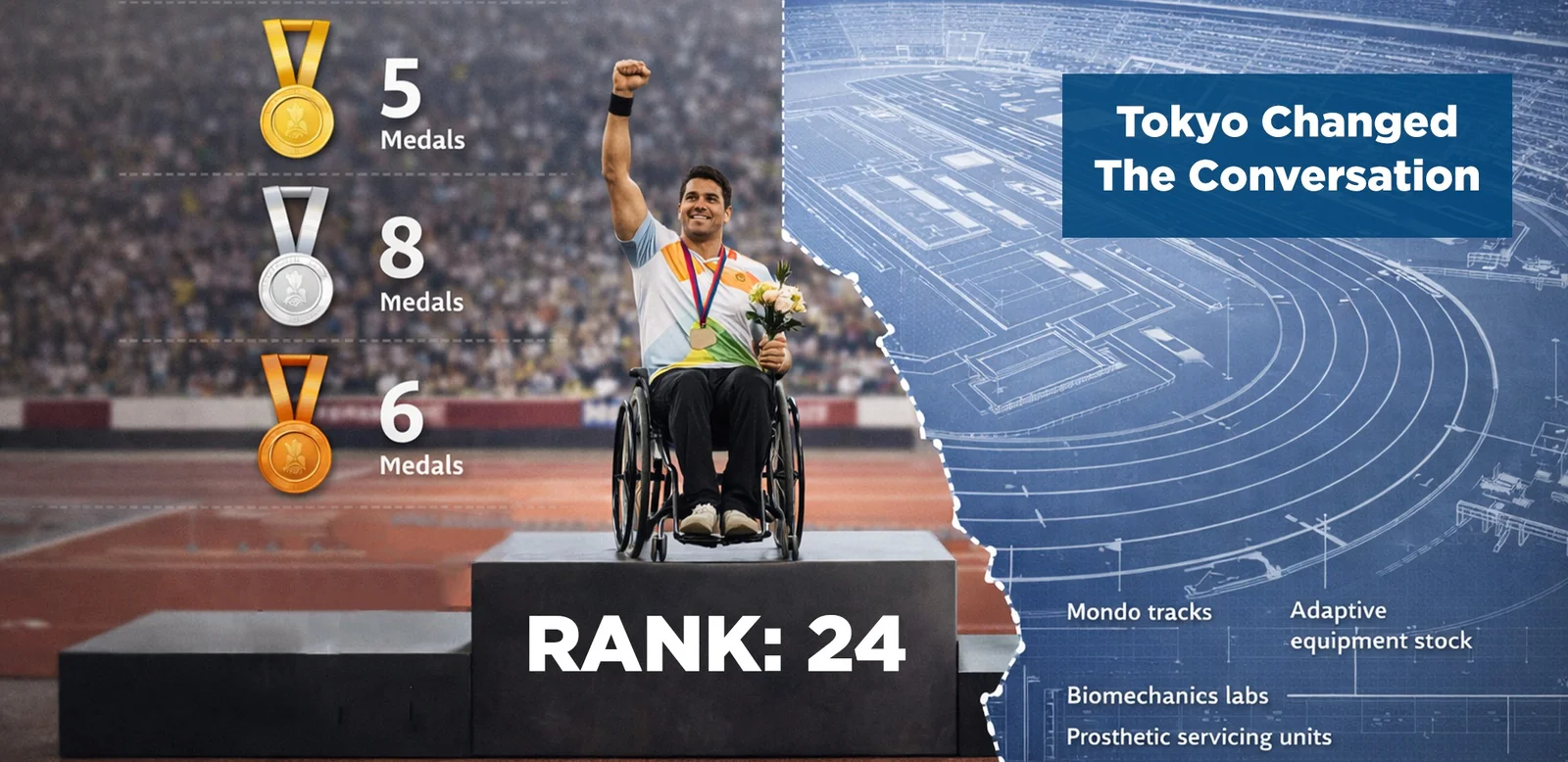
The canvas of India was filled with colors at the podium of Japan when 19 (5 gold, 8 silver, 6 bronze) medals were bagged by the nation’s Paralympic performers, placing them 24th in the overall tally. Tokyo did more than just pushing ranking of India, instead it revolutionized the perception of para-sports. Para-sports shifted itself from the margin table to the centre piece, rendering itself to be topic of public conversation. The government indulged itself, rendered support through appreciation by inclusion of the Khelo India Para Games. This posed a question whether India is capable of producing world class para- athletes and the answers by Tokyo were loud, but whether India possesses permanent, calibrated infrastructure required to sustain the glory and exemplify it?
The architecture we had yet to imagine
When Tokyo pushed India to a revelation, it also posed a mirror. It reflected the capabilities of India to summit moments, but also unveiled the infrastructural absence that was lying beneath the surface. Engineered carbon fibre frames for racing wheelchairs, throwing frames for seated javelin and shotput, etc., were rarely at ease for the athletes. Owning prosthetic blades was a matter of pride for a few elite athletes, and it felt luxury to others, when it was imperative for necessity. Majority trained with standard chairs, tracks, and wheelchairs to make themselves adapt to the equipment rather than the equipment being personalised.
Having the feet on the Mondo tracks was far fetched from reality, and players who can afford international training were able to get trained on them. Indian stadiums only had synthetic tracks with uneven lane depth. Accessibility remained the talk of the town as every athlete faced the repercussions of not having designed doorways or ramps. India adopted the Rights of Persons with Disabilities Act, 2016, which mandates accessibility across public infrastructure. The Harmonised Guidelines and Standards for Universal Accessibility in India (2021) laid down specifications for ramp gradients (1:12 slope ratio), doorway widths (minimum 900 mm), tactile pathways, handrail dimensions, and accessible restroom layouts. On paper, the blueprint existed but at stadiums execution was near to impossible.
Here arose two segments: one where accessibility was demanded, which allowed players to enter the stadium, and the other segment raised the asks for performance architecture, which determines whether the building will accelerate the athlete towards the podium.
Voices that want the arena to be reimagined
Policies only draft the blueprints, but the athletes are the ones who have to live the realities. The reality can be even harsher; it can be contemplated by the words of world champion and Arjuna Awardee Sundar Singh Gurjar, “If infrastructure is made accessible for all, it would be much better.” In his statement lies the truth that athletes faced, showcasing the reality that accessibility is not a privilege but an autonomy. It lies in the difference between entering through the main gate and searching for the side door.
The thought is also sharpened further by silver medalist Bhavina Patel, she virtues the basic necessities as a mere place of having equal hands of opportunities. In khelo india flagship program, she raises her thoughts and puts that, “An inclusive infrastructure and accessible transportation system mean more than ramps and designated spaces for a para-player; it offers us a place of equal opportunity.
Infrastructural aid also elevates the precision in performance. Where Paralympic champion shuttler Krishna Nagar speaks about the infrastructural lacks in getting the contemplated results, where he feels that he could have done better in the Para Asian Games if he had trained in Bigger halls. After games, he highlighted that, "In badminton, we need agility, speed and power and also need to be alert. It is a speed game. Most big tournaments have big halls. But a lot of the times the halls are small at the time of training (in India), which leads to a slight issue as the shuttle travels fast or just feels weird to us."
For an athlete, competing in milliseconds, having the edge of architecture is not a background, but it is a biomechanical context. Together, these voices expand the definition of infrastructure. They move the conversation beyond ramps and rails toward something more intricate: calibrated halls, seamless transport, dignified access, spatial parity.
A comparative reflection of other para systems
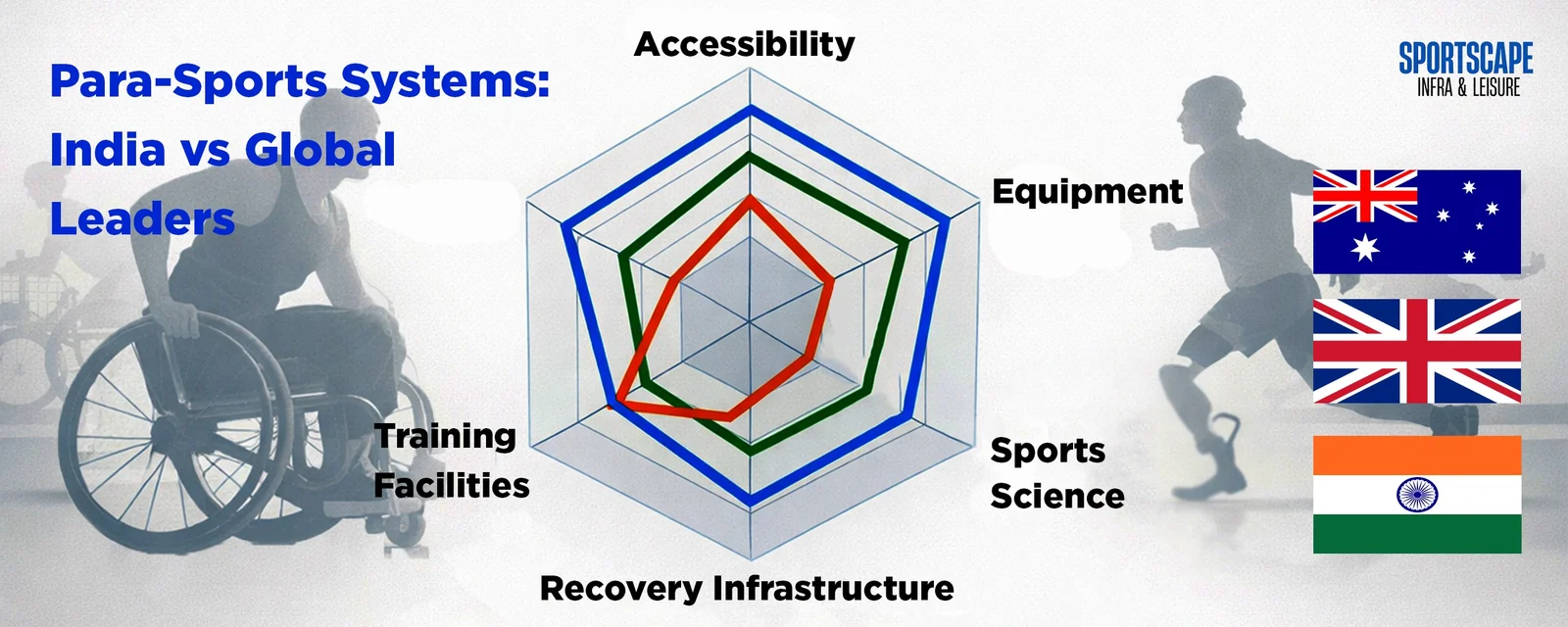
When Tokyo armoured India with the real potential, then, unknowingly, what it also served was an uncomfortable yet necessary comparison. This was posed not to draw lines between the talent but to reflect the gaps between the requisite architecture.
Great Britain concluded the Games with 124 medals, second only to China. Australia followed with 21. These numbers, recorded by the International Paralympic Committee, are not statistical accidents. They are the visible surface of invisible systems.
The British model follows the graphs made by the English Institute of Sport (EIS), where the facilities don’t differentiate between Olympic and Paralympic pathways. Their para athletes train on the Mondo grade surfaces as standard practice, biomechanic labs evidence the propulsion angles for wheelchair racers with the help of motion-analysis cameras, and force plates measure any asymmetry in blade sprinters. The ESI also caters to the athletes with Environmental chambers that simulate heat and altitude conditions months before competition. Classification-specific strength protocols are embedded into the daily regimens of the athletes.
Australian Institute of Sport (AIS) is the body for Australian athletes that works on similar structural density. They work forward with centralised athlete monitoring systems that track longitudinal performance data, having inclusion of sleep metrics, muscle loads, and recovery amongst the athletes in every changing season. ASI aids the athletes by providing recovery pools, hydrotherapy suites, and sports medicine units within the training complex. The architecture in both nations answers questions before the athlete must ask them.
But when the lens is gently turned homeward, the reality becomes a road to aspiration. India possesses ambition, glancing at the ways to expand budgets, and widening the conversation to provide inclusivity. It has National Centres of Excellence under the Sports Authority of India (SAI), and it has begun installing Mondo tracks at select flagship venues. Yet these facilities are not uniformly accessible to para-athletes year-round.
Many state centres continue to operate on older synthetic tracks without consistent rebound calibration. Biomechanics laboratories exist within certain SAI campuses, but classification-specific data modelling still seems far from racers. Adaptive equipment remains unevenly distributed. Throwing frames and racing chairs are often athlete-procured rather than institutionally stocked. Dormitories for players may exist, but pathways connecting the track to recovery zones and automated doors are not yet universal. As Krishna Nagar observed, there still remains an enormous gulf between indian badminton halls and the halls of Birmingham and sydney which offer ceiling heights and air volume that aid shuttle trajectory.
Till the time, a race for India’s ecosystem won’t expand itself to the finishing lines, these gaps will call for soaring echoes at the forefront of each competition in the world.
If the first chapter of India’s para-sport journey was written in resilience, the next must be drafted in architecture.
Amalgamation of Blueprints and Beliefs
If the first chapter of India’s journey into Para sports was built through resilience, then the next chapter must unveil the potential through exemplary architecture where personalisation isn’t forced. The nation needs to catalyse the transformation in addressing the three-fold dimensions for overall upgradation of the system.
First, the nation requires not scattered upgrades but dedicated, fully calibrated para high-performance campuses; it must be inclusive of spaces where the track does not merely meet standards but anticipates them. Competition-grade Mondo surfaces must become training realities, not event-time luxuries. Indoor arenas must mirror international ceiling heights and air volumes so that reflexes trained in Patiala or Bengaluru do not need recalibration in Paris or Los Angeles. These campuses should not function as isolated tracks with attached dormitories; they must integrate biomechanics laboratories capable of classification-specific analysis, strength and conditioning suites engineered for seated and standing variations, hydrotherapy pools, cryo-recovery units, and athlete monitoring systems that track data longitudinally, which must be demarcated season after season, not camp after camp.
Second, prosthetics and assistive technology servicing must cease to be external dependencies. A racing wheelchair awaiting part replacement is not an inconvenience; it is interrupted momentum. India must embed prosthetic engineers, wheelchair technicians, and adaptive equipment calibration units within these campuses. Just as a Formula One car is tuned trackside, so too must an athlete’s blade, throwing frame, or chair be serviced without bureaucratic delay. Institutional procurement of adaptive equipment like racing chairs, throwing frames, and tactile guidance systems should become standard inventory, reducing the burden on individual athletes.
Third, accessibility must move from compliance to conviction. The blueprint itself must assume diversity. Universal design principles such as 1:12 ramp gradients, 900 mm doorway clearances, tactile pathways that connect dormitory to dining hall to warm-up track without interruption, and automated doors calibrated to wheelchair turning radii should be embedded at the planning stage. Internal campus transport must be low-floor and seamless. Athlete housing must integrate accessible bathrooms, not as segregated units but as architectural norms.
None of these desired advancements is rhetorical ambition; instead, they are arithmetic architecture that requires dire attention by SAI to enable the para-athelete competition ready for each podium in every nation.
Converting each applause into architectural reform
India today stands not at the beginning, but at a pivot. It has been proven that its para-athletes can command the podium. It has demonstrated that it can host championships with international rigour. With the inclusion of mondo tracks in the para-athletic championship 2025, India has witnessed a shift in architecture. It is now rewriting the perception and turning the public gaze from sympathy to respect, from a margin note to a headline. But momentum, if not structured, dissolves. The next challenge is not to celebrate resilience, but to systematise it.
To ensure that calibrated tracks, integrated sports science, adaptive equipment servicing, and universally designed campuses become daily realities rather than ceremonial upgrades. To ensure that a young athlete in Guwahati or Coimbatore trains in an environment that mirrors the geometry of the Paralympic arena, not approximates it. Designing dignity is not sentiment; it is statecraft. It is the understanding that infrastructure does not merely house performance; instead, it shapes it.
When architecture begins to believe in the athlete as deeply as the athlete believes in themselves, medals will no longer arrive as heroic exceptions. They will emerge as institutional inevitabilities.
Written by

Anushka Raghav is an Editor at Sportscape Magazine, where she covers the intersection of sports business, governance, policy, technology, and infrastructure. Having written over 200 news stories and editorial features, she focuses on the ideas, institutions,…