
After the Applause: Do Mega Sporting Events Leave Economies Stronger?
The economic impact of mega events begins its quiet work, not in the roar of the crowd, but in the arithmetic that follows.
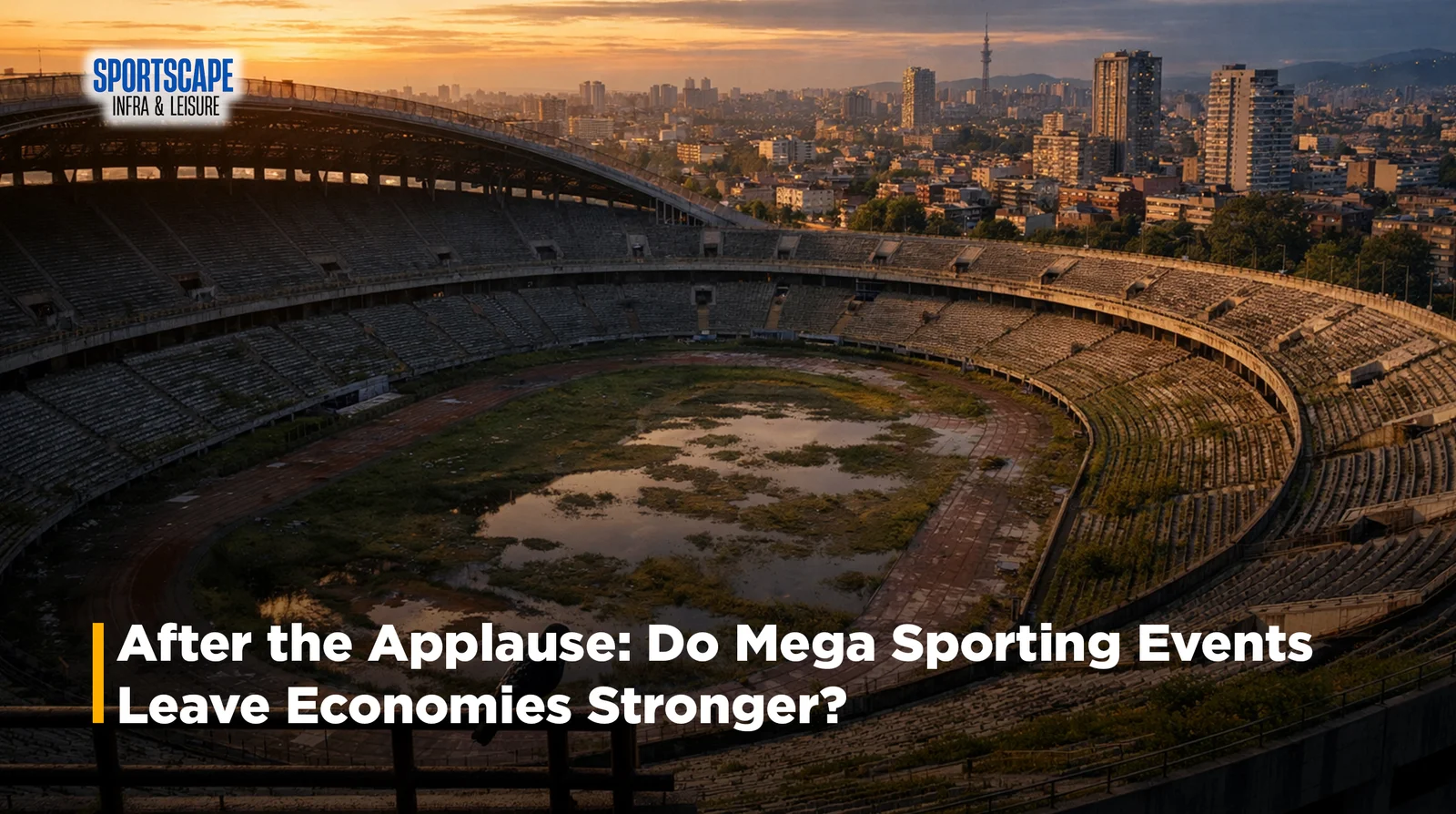
When the floodlights dim and the fireworks dissolve into smoke, a stadium does not return to silence, but they lean towards accounting. The final whistle may echo in memory, but balance sheets begin their own calculation. Steel, concrete, and glass do not retire with the athletes; instead, they remain, demanding maintenance, programming, and revenue. The opening ceremony may cost $100 million for a single night, yet the repayment cycle can stretch across decades. This is where the economic impact of mega events begins its quiet work, not in the roar of the crowd, but in the arithmetic that follows. What, then, survives when spectacle fades? Applause or amortization?
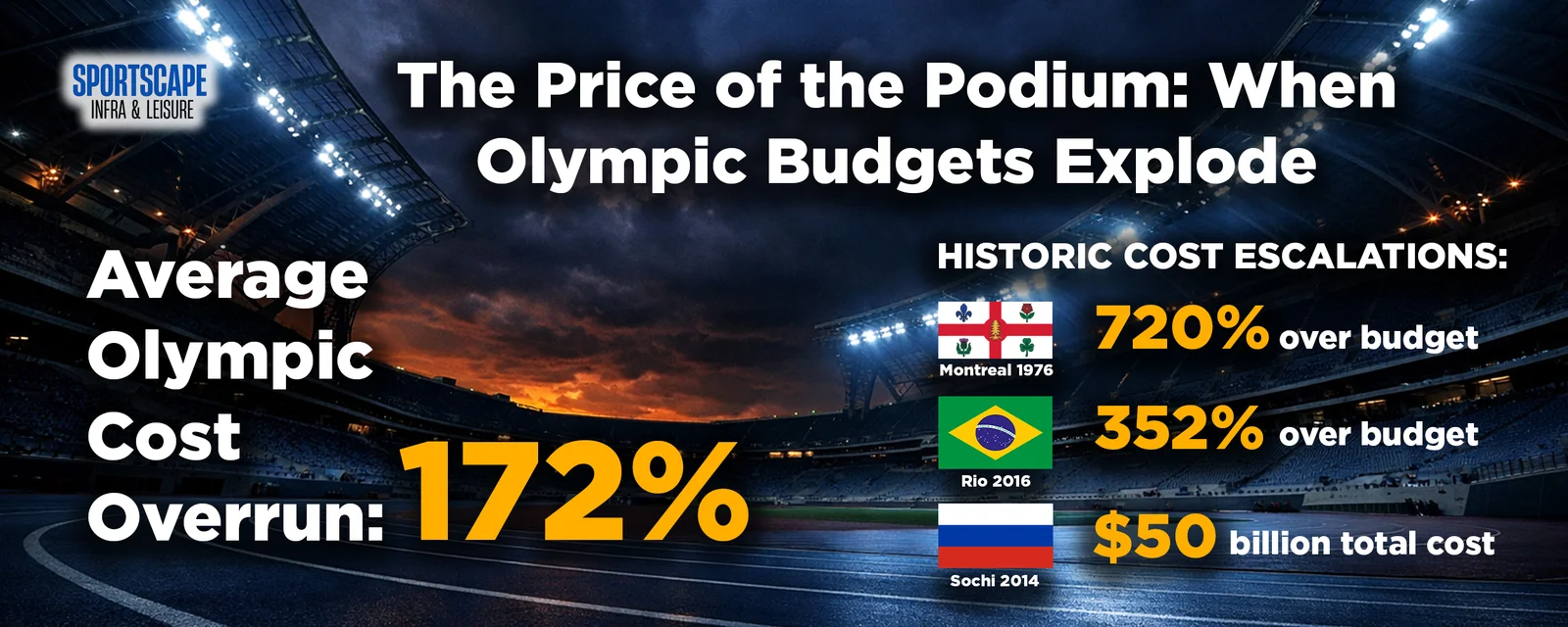
Every bidding cycle for the Olympic Games or the FIFA World Cup begins in promise. Nations frame hosting rights as geopolitical milestones, because they signal stability, capability and global relevance. Host status becomes shorthand for arrival. In the discourse of mega events and national economy, hosting is often portrayed as an accelerator of growth, a strategic leap toward infrastructure modernization and global investment confidence. But once the torch is extinguished and delegations depart, a more complex economic story unfolds. Ex-post analyses repeatedly show that projected returns rarely match optimistic forecasts. The Oxford Olympics Study found that for the summer games, the largest cost overrun was found for Montreal 1976 at 720 percent, followed by Rio 2016 at 352 percent.
This paradox projection versus outcome becomes particularly relevant for India. Having hosted the Commonwealth Games and expressing renewed Olympic ambitions, India stands at a strategic inflection point. The central question is not whether India can host. It is whether mega-events transform economies or simply accelerate spending that nations must later absorb.
The promise: why nations bid?
In bid documents, mega-events are narrated as catalysts. Tourism multipliers promise that every visiting fan generates ripple effects through hotels, restaurants, and transport networks. Governments cite employment surges during construction and hospitality expansion. Infrastructure acceleration becomes a compelling argument: metro lines built faster, airports modernised sooner, urban districts regenerated earlier than scheduled.
Ahead of Rio 2016, Brazil projected billions in tourism and infrastructure-driven growth. Prior to London 2012, UK officials predicted substantial long-term regeneration benefits for East London. These projections are not invented; they are modelled through economic impact assessments that estimate multiplier effects and demand surges.
But how do these narratives reach taxpayers? Through the language of opportunity. “Investment,” not expenditure. “Legacy,” not liability. “Catalyst,” not cost.
Yet the question remains: if benefits are so robust, why do so many host cities face fiscal stress afterward?
Shadow beneath the stadium lights
When the celebration ends, auditors arrive with spreadsheets instead of medals. Cost overruns are not rare accidents; they are recurring features of mega-events. The Council on Foreign Relations notes that the 2014 Winter Olympics ultimately cost more than $50 billion which is nearly four times the initial estimate, making it the most expensive Olympics in history. The pattern underneath this still persists, reflecting the reality where host cities routinely spend far beyond what they first promised.
The physical reminders of this overspending often stand in plain sight. In Manaus, the Arena da Amazônia, built for the 2014 FIFA World Cup at a reported cost of roughly $300 million, was envisioned as a gateway to global recognition. After the tournament, however, it struggled to attract regular high-profile fixtures. Maintenance bills did not shrink with the crowds. The stadium remained, but the demand that justified its scale did not always follow. Such venues acquire a familiar label: “white elephants”, impressive in silhouette, uncertain in utility.
Tourism, too, reveals a more complicated narrative than the glossy projections suggest. During the London 2012 Summer Olympics, official data from the UK Office for National Statistics showed that overall visitor numbers during the Olympic period dipped compared to previous trends, as regular travellers postponed trips amid higher prices and anticipated congestion. Economists call this time-switching: visitors reshuffle their calendars rather than increase total demand.
Broadcasting rights and global sponsorship deals, often the most lucrative components of a mega-event, are largely controlled by international governing bodies. Host governments finance transport upgrades, security and stadium construction, yet a significant share of commercial revenue flows elsewhere. The result is a structural asymmetry: public investment underwrites the spectacle, while commercial returns are centrally distributed.
What lingers, once the short-term stimulus fades, is a more sober reality. Infrastructure must be maintained. Debt must be serviced. The economic afterlife of a mega-event is less about fireworks and more about fiscal endurance.
India’s Economic Learning Curve: The 2010 Experience
When Delhi hosted the Commonwealth Games, the city did not merely stage an event, it reshaped itself. Roads were widened, footpaths beautified, flyovers constructed, and transport arteries rewired to carry a sudden influx of athletes, officials and international visitors. Reports from the government’s own legislative updates show that well over 170 kilometres of roads were resurfaced and strengthened, while new multi-level parking and bus priority infrastructure were fast-tracked to accommodate Games' needs.
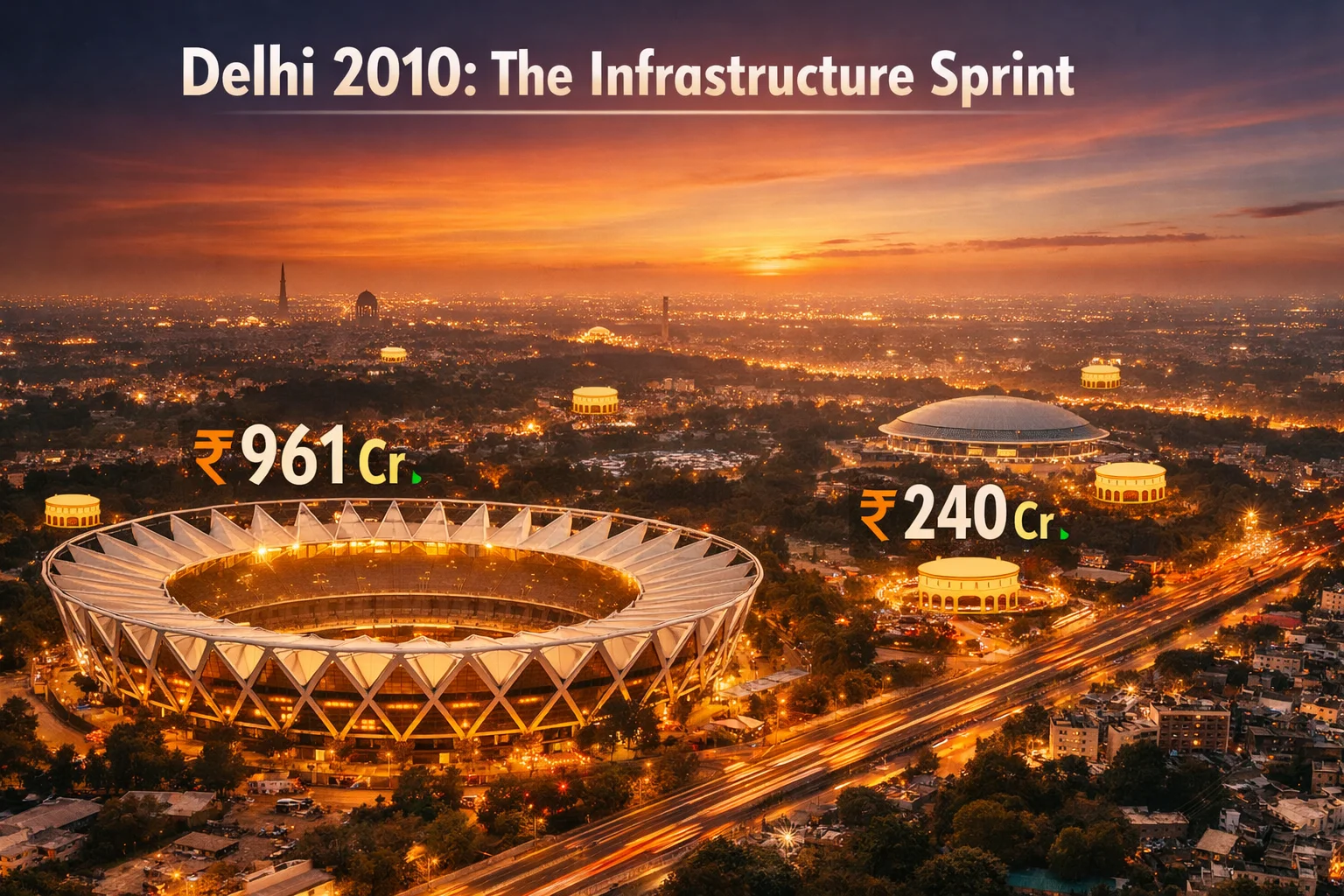
The public accounting of expenditures tells both the ambition and confusion of the process. Initial budget projections for five major stadium projects were around ₹1,000 crore but final spending ballooned to roughly ₹2,460 crore, a near 250% escalation in projected costs before the Games even began. Renovation of the Jawaharlal Nehru Stadium alone went from an estimate of ₹455 crore to nearly ₹961 crore by completion
But, does the tale hums melodious tune, highly doubted. Where Jawaharlal Nehru Stadium received international upgradation, much of the larger 102-acre complex remains underutilised, with only about 35% of the area actively programmed for sport or events. Calling out the reason for the government to transform the stadium as a sports city. The Indira Gandhi Indoor Stadium which was renovated at around ₹240 crore, has hosted select tennis and kabaddi matches, and occasional concerts, but it is far from a high-frequency, high-revenue sports venue.
The mirror that India projected after the 2010 Commonwealth is not a reflection of failure but is a stance of setting the imperative that infrastructure must be conceived with post-utility advancements.
The Numbers Behind the Noise: An International Economic Reality Check
When nations step forward to host the world’s largest sporting spectacles, they do more than organize competitions; they invite the world to witness their ambition. Yet the aftermath often reveals a different ledger, one where the cultural glow of globally broadcast ceremonies contrasts sharply with how national economies actually absorb, sustain, or struggle under the weight of these events.
At first glance, hosting promises a cascade of benefits having upgraded airports, extended metro lines, expanded hotel rooms, world-class stadiums and a yearlong lens of international tourism. These narratives are familiar, underpinned in part by industry projections that suggest infrastructure and hospitality sectors will see heightened activity. HLB Global’s review of mega-events underscores this and states that while large sporting events can catalyze tangible investment in transport and urban amenities, the long-term financial outcomes are far from guaranteed and often exceed original expectations by wide margins.
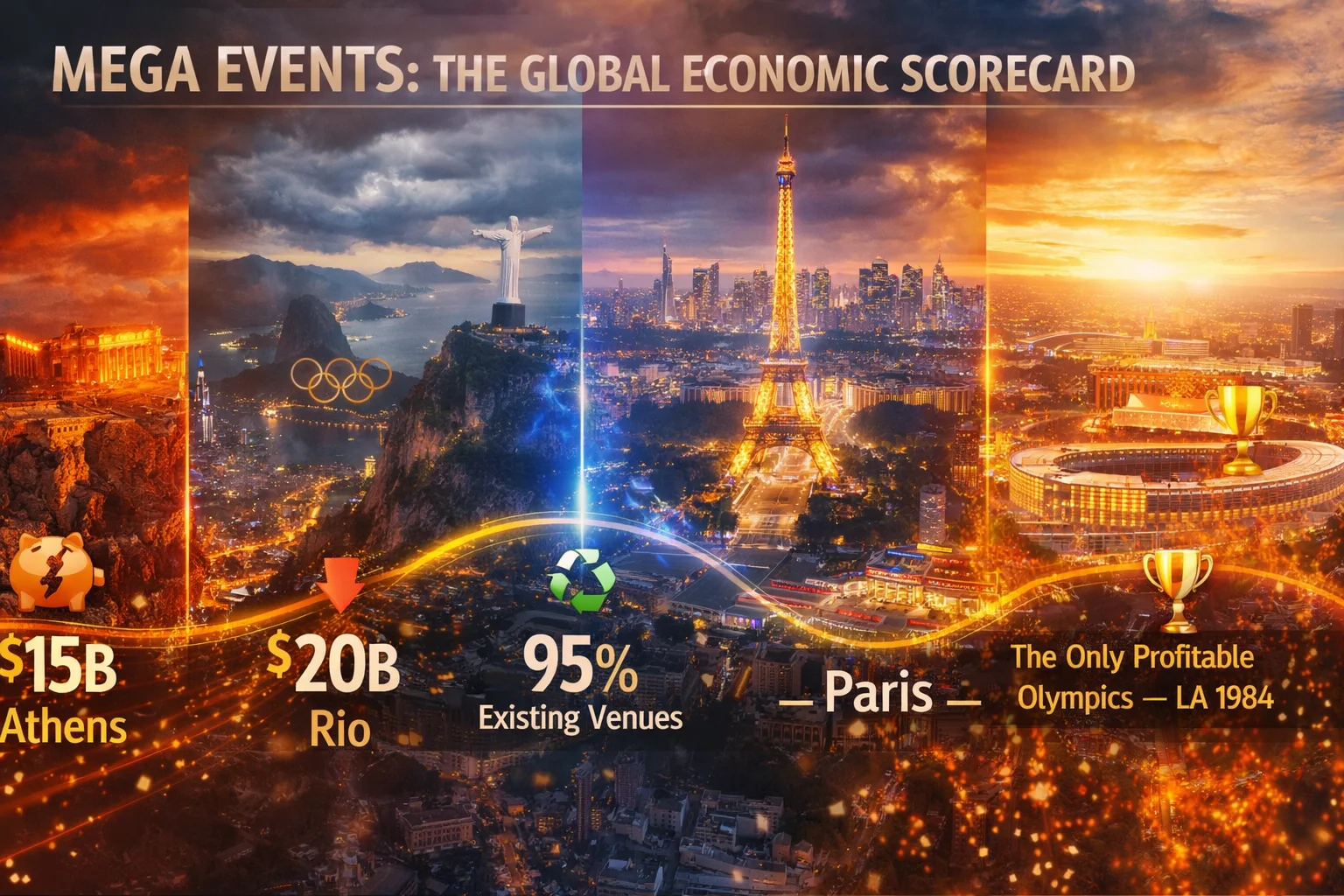
The 2016 Rio Olympics, for example, were widely reported at costs upward of $20 billion, ridden with overruns that lingered long after the athletes departed. In Brazil’s case, construction and preparation took place amid broader economic contraction, contributing to heightened public scrutiny and fiscal strain.
Similarly, the 2004 Athens Games became a cautionary chapter in economic history. While not the sole cause of Greece’s later debt crisis, the scale of investment and subsequent maintenance obligations exacerbated structural vulnerabilities, with venues and public spending weighing on a fragile post-event economy. Emerging research shows that while such events can trigger a short-term uptick in GDP growth and equity-market momentum, these gains tend to dissipate quickly once the global spotlight moves on. Hosting boosts economic indicators in the run-up years, but sustainable growth beyond the event often fails to materialize.
In contrast, Paris’s preparation for the Paris 2024 Summer Olympics adopted a more reserved and adaptive model, with roughly 95 % of venues being existing or temporary, it reflects a conscious effort to curb spending and prioritize legacy conversion over expansive new construction. Early projections suggest this approach may help balance fiscal discipline with urban renewal, yet time will tell whether the long-term economic return matches the strategic intent.
Some cities stand as outliers: the 1984 Summer Olympics remains a rare profitable case, precisely because it leaned on pre-existing infrastructure and private financing, illustrating that when planning aligns with economic reality, the outcome can be materially positive. Meanwhile, other hosts such as South Korea and Japan during the 2002 FIFA World Cup yielded mixed economic results whereSouth Korea’s direct tourism revenue was estimated at $307 million with a broader value addition approaching $1.3 billion, while Japan’s preparatory spend was much larger and its broader GDP effects more diffuse.
What emerges from this comparative view is not a simple ledger of wins and losses, but a pattern: mega-events can stimulate short-term economic momentum and urban modernization, yet they rarely guarantee enduring growth unless fiscal discipline, legacy utilisation and integration with national development strategies are meticulously planned. The economic joy of hosting must therefore be weighed against the practical realities of cost, debt and post-event utilization, not just in the weeks of competition, but in the decades that follow.
What Must Endure After the Applause
When the banners are folded and the delegations depart, what remains is not the choreography of the opening ceremony but the choreography of repayment. A mega-event is never a two-week celebration; it is a ten-year economic commitment wrapped in a fortnight-long spectacle. And history, patient and unromantic, has shown that prosperity does not automatically follow performance.
The lesson from Montreal’s 720 percent overrun, from Rio’s billion-dollar expansion during recession, from Athens’ capital intensity amid fiscal fragility, and even from London’s tourism time-switching, is not that hosting is folly. It is that hosting without discipline is drift. The difference between a catalytic event and a costly detour lies in design, sequencing and integration. Economies that treat mega-events as isolated spectacles often inherit liabilities. Economies that embed them within pre-existing development blueprints stand a greater chance of sustaining momentum.
For the starters in becoming a vigilant host, bidding must begin with restraint rather than ambition. Infrastructure proposed for a Games must already justify itself without the Games. A metro line should solve congestion before it serves a ceremony. A stadium must have a calendar before it has a roof. When 95 percent of Paris’s venues were existing or temporary, the message was not modesty; it was maturity. Hosting must accelerate plans already economically viable, not create assets in search of purpose.
Second, financial architecture must rebalance risk. If public funds underwrite construction, then revenue-sharing agreements with international governing bodies must reflect that exposure. Transparent budgeting, independent cost audits and phased construction tied to verified milestones can prevent the optimism bias that has haunted past hosts. Discipline must precede design.
Third, legacy must be operational, not rhetorical. Multi-use venue planning, modular stadium architecture and adaptive conversion strategies should be embedded at blueprint stage. A 60,000-seat arena that can contract to 25,000 after the event is not a compromise; it is economic foresight. Housing built for athletes should transition seamlessly into urban residential stock. Temporary structures should return capital rather than absorb it.
For India, and for any nation contemplating the bid book, the question is not whether the world will applaud. The world always does. The question is whether ten years later the balance sheet will echo the same pride as the podium. India has administrative experience. It has urban ambition. It has demonstrated the capacity to execute complex international events. But the next step, if taken, must be shaped not by spectacle-driven expansion, but by system-driven sustainability.
Because the real metric of success is not the brilliance of a closing ceremony, nor the volume of a cheer beneath fireworks. It is quieter than that. It is found in transport systems still functioning efficiently a decade later. In stadiums that hum with weekly activity. In public accounts that do not strain under borrowed glory.
When the floodlights dim, economies do not remember the applause. They remember the architecture of decisions. And the nations that endure are those that design for the morning after, not merely the night of celebration.
Written by

Anushka Raghav is an Editor at Sportscape Magazine, where she covers the intersection of sports business, governance, policy, technology, and infrastructure. Having written over 200 news stories and editorial features, she focuses on the ideas, institutions,…