
Fighting for the Field: 26 Years with Rahul Mehra
Inside the 26-year battle of Rahul Mehra, the one-man legal force who rewrote the rules of Indian sports governance, only to watch Parliament erase everything overnight.
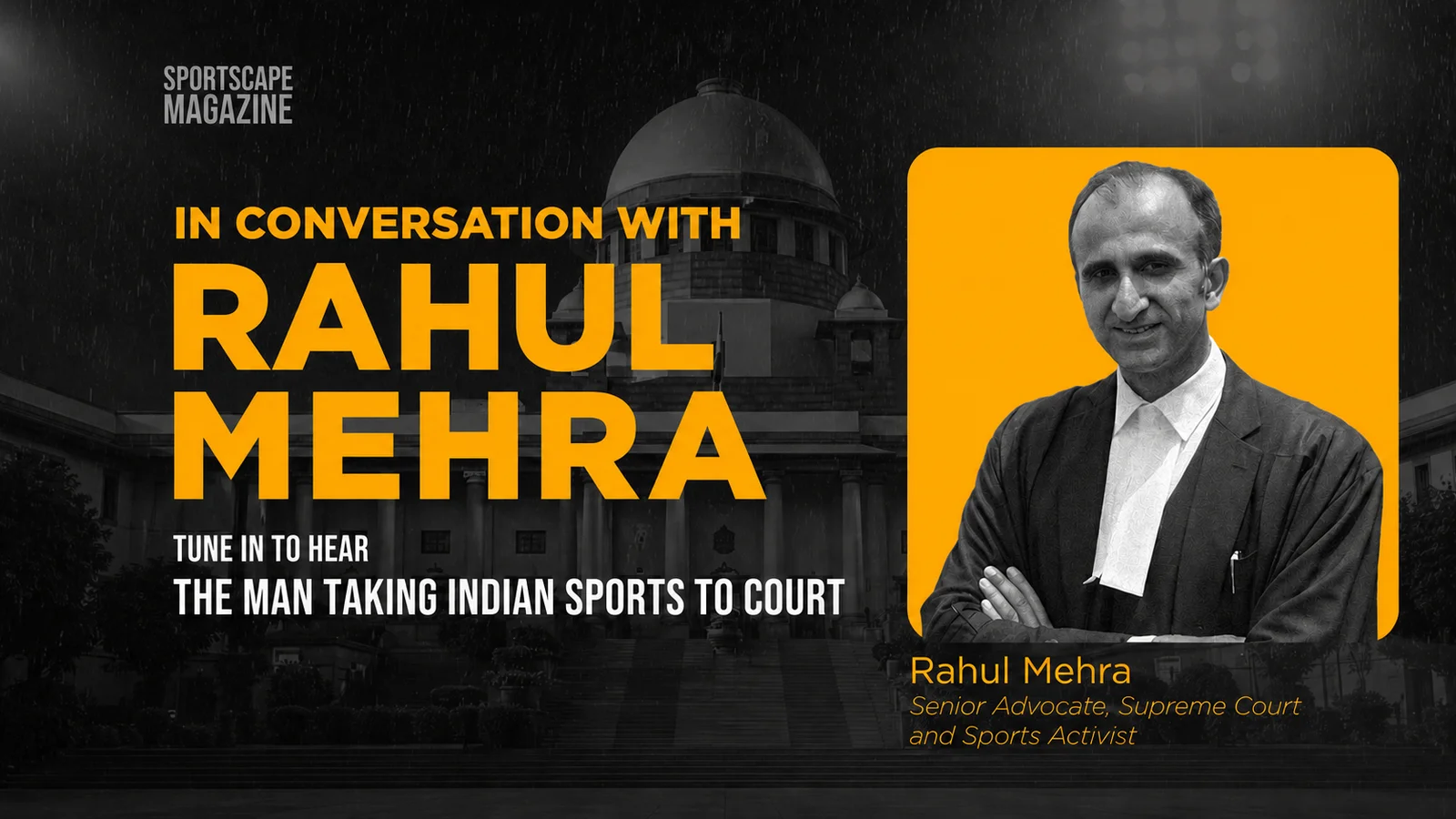
In a country where sport is often religion and cricketers are treated as demigods, it takes a particular kind of stubbornness to walk into a courtroom as a first-year lawyer and take on the most powerful cricket board in the world. Rahul Mehra, Senior Advocate of the Supreme Court of India, did exactly that in 2000, and has not stopped since.
His journey began in a moment of ordinary frustration: a series lost too comfortably, a federation secretary's prophecy that felt too convenient, and a friend who said, let's sue them. What followed has been a quarter-century of relentless public interest litigation, landmark judgments, and a one-man effort to drag Indian sports governance into the light.
His first PIL against the BCCI produced the landmark 2004 judgment establishing that a sporting body performing public functions is accountable to every citizen, not just its own members. His second PIL triggered the 2014 ruling that dislodged administrators who had held posts for decades. A third PIL produced a sweeping 2022 judgment covering 13 critical reforms extending the National Sports Code down to district associations. And in 2025, the Supreme Court approved all 13 reforms in the AIFF matter, adding that sitting ministers may not hold posts in any sports federation.
He fought individual battles across hockey, athletics, archery, badminton, and football. He got POSH committees enforced in sporting bodies where none existed. He was slapped with two criminal contempt petitions. And after what felt like final victory, he watched the government pass the National Sports Governance Act and undo much of what he had built.
Sportscape sat down with Rahul Mehra for a wide-ranging conversation covering the BCCI's secret financial books, the Vinesh Phogat episode, match-fixing, the state of Indian coaching infrastructure, and whether there is any real light at the end of the tunnel.
How It All Started: A Lost Series and a Leaked File?
Sportscape: You were barely a year and a half into your legal career when you went after the BCCI. What actually set this off?
Rahul Mehra: I was six months into my profession. I didn't know how to even stand in court. Sport was not merely a sport for me. It was much larger than that. You had your demigods, larger-than-life people you idolized. I was a very very passionate and orthodox cricket fan. If India's winning I won't get up from my seat; if India's losing I will switch positions. That was the level of superstition.
Jaywant Lele, who was the secretary of BCCI then, said in an interview that India is going to lose the Australia series 3-0. I said, what the hell. You are a secretary of a federation. Even if you know you are going to lose, you don't demoralize the team like that. The tour happened. India lost 3-0. His prophecy came true. A dear friend said let's sue them. I said, you don't sue people like this, you need evidence. I thought that would be the end of it. Next morning he said one of his uncles is in the local federation of cricket in Delhi. By that evening we were with his uncle in a club. He gave us contacts who were very powerful people in BCCI, though in the opposition at that time. They had their axe to grind with the Dalmiyas and the Leles.
Sportscape: What kind of material did those documents actually reveal?
Rahul Mehra: We had material that usually only the secretary or president would have. Financial statements, balance sheets of previous years, minutes of meetings, how much they spend on cricket and how much on non-cricketing activities. The front page of those financial books of BCCI, in red bold letters, said: Highly Confidential, Not for Publicity. That really rang a bell. What is so confidential about a federation simply running cricket in India?
In DDCA, no money was spent on even the purchase of cricket balls. How do you play a sport professionally if you don't even purchase the basic equipment? There were lakhs and lakhs being spent on meetings, tours, hotels, wining and dining, but nothing on infrastructure. It was an open and shut case. A journalist friend got me introduced to Surjit Bhalla, the economist, who summarized the financial figures in three to four pages I could explain to the court.
Sportscape: BCCI hit back with contempt petitions. How did a brand new lawyer handle that?
Rahul Mehra: I started a website, sportsplus.org, partnering with Prem Panicker, a great journalist then heading Rediff. The moment notice was issued in court, we got 200,000 hits in one day. The website crashed. I had only paid 200-300 rupees for about 100 people visiting. It became a cover story in Outlook with the punchline: The World's Richest Board Produces the World's Saddest Team.
BCCI filed criminal contempt, saying starting a website is interfering in the administration of justice. They thought, baccha hai, he'll get scared and withdraw. I requested Prashant Bhushan to take a backseat and said I will fight my own case. I went to court and said I'm sorry, I had no clue, and all they are trying to do is digress from the merits of the case. I brought the website down. Purpose had already been served. A year later they filed another contempt. By then I was slightly more seasoned. I told the Chief Justice: first send me to jail, I'll come back after two or three months, and then let's argue on merits, because they have nothing to say on merits. The bench could read that they were trying to intimidate this boy.
Sportscape: And what did the 2004 judgment ultimately establish in legal terms?
Rahul Mehra: Till then no sporting body could be sued by an individual citizen. It was a closed-door boys' club. The court said nothing doing. You discharge public functions because the government has permitted you to select Team India, which only a country can do. Therefore you are accountable to everybody under Article 226 of the Constitution. BCCI tried to say Tendulkar and Dravid play only for a BCCI XI. The court held: they play for India. It's a match between India and Australia. Don't try and fool us. The law turned on its head for the first time. It opened the floodgates for litigation in Indian sports.
The Governance Crisis Across Every Federation
Sportscape: After BCCI, you went after IOA, AIFF, BAI, Hockey India, and many more. What was the one root common to all of them?
Rahul Mehra: These bodies were ruled as fiefdoms. Everything done there was not to govern the sport but to ensure their own chair doesn't get affected. It was only politics being played. No infrastructural decisions for players. No hand-holding of individuals. Nothing for the country. A facade showing from the outside that we are doing everything for the sport and the sportsperson, and nothing was being done. Not even cricket balls were being purchased in DDCA. How do you play a sport professionally without the basic equipment?
Sportscape: And the absence of actual sportspeople inside these governing bodies, how stark was it?
Rahul Mehra: It was by and large politicians and bureaucrats heading these bodies, not a single sports person as a member. A bar council says you can be a member only if you're a lawyer. But in a sports body there's a driver, a domestic help, a lala, a lawyer, everybody sitting there, but a sports person. Is Sachin Tendulkar a member of any federation? Not at all. Is Kapil Dev? Is Abhinav Bindra? He's the gold medalist! He should be governing the Indian Olympic Association. Intelligent, educated, articulate, passionate, patriotic, achiever in the field. What else do you require?
But the qualifications out there are: you need to be corrupt, you need to be incompetent, you need to be a guy who's absolutely good for nothing in any other profession, who has been thrown away by society but lapped up by federations. That's the qualification of these guys.
Sportscape: Should there be a law by now mandating a percentage of athletes inside these governing bodies?
Rahul Mehra: The sports code already had a minimum 25% athletes quota with voting rights in the executive committee. But it was never implemented. They didn't want players because their incompetence would surface the moment somebody competent entered. My job across all these years has been to bring sunlight into these organizations. The 2022 judgment finally got that 25% actually enforced. That's how PT Usha and others started coming in.
The Long Fight: Tenure Battles, the Sports Code, and 25 Years Undone
Sportscape: Walk us through how the second PIL transformed the landscape of sports governance in India.
Rahul Mehra: After success in the BCCI I researched for about two to three years on every other federation. I took the Government of India Sports Policy of 1975, which said you can't have more than two tenures of four years each, with a four-year cooling-off period after. In 2009-10, Kalmadi, the Chautalas, Vijay Kumar Malhotra with 30-plus years in archery, were all still in power. I prepared a chart with all names, number of tenures, material backing each statement on affidavit. I said: You are political leaders. Your primary job is to serve your constituency. Even if you want to be here, come for four years and then go. Why do you stick out like fevicol?
Sportscape: What finally triggered the government to act on tenure restrictions in 2010?
Rahul Mehra: An Uma Bharti order from the NDA government had put the 1975 restriction in abeyance. I took that to court. On 1st May 2010, on a Sunday, the government filed an affidavit saying the stay is lifted and this clause is now implementable on all federations. Overnight, people who had sat there for decades had to demit. They challenged it. Courts did not find favor with them. But these are thick-skinned people. You have to throw them out.
Sportscape: And what followed is what you've called the "rabri-rization" of Indian sports. What does that mean?
Rahul Mehra: Like when Lalu Prasad had to demit from the chief minister's chair and gave it to his wife Rabri Devi, in sports these administrators started planting their sons, daughters, sons-in-law, daughters-in-law, brothers, sisters, everybody, on those positions, remote-controlled by the ones who had demitted office. Lalu goes, Rabri comes in. That was the state of Indian sports.
Sportscape: The 2022 judgment brought 13 reforms. What did those mean for athletes at the grassroots level?
Rahul Mehra: Sports is a pyramid. District, state, national. The sports code was only applicable at the national level. I argued: unless you apply best practices at the lowest level, you will have people continuing for 40 or 50 years locally. It's like cancer you're only cutting from the top. Through the 2022 judgment, the sports code must be implemented at state and district levels, pan-India. Maximum 15 office bearers in any federation instead of the earlier 40 or 50. Every elected member, not just the top three posts, hit by age and tenure restriction. All 13 issues were held in my favor. Every single federation head had to roll.
Sportscape: Then the 2025 National Sports Governance Act reversed most of it. How do you make sense of 25 years of work being undone?
Rahul Mehra: The biggest offender in the entire saga has been the Government of India. Their officers are the most compromised. They see faces and implement the law. If you are from the ruling party alliance, they behave like an ostrich. If you are from the opposition, they dislodge you and plant their own party man. This game has been going on for way too long. Earlier, Congress used to do it; now, the BJP has mastered it.
The moment the Supreme Court ruled that sitting ministers will not occupy any post in sports federations, the government woke up. Since they have a brute majority in Parliament, they passed a law contrary to every single thing I had done. We are back to square one after 25 years.
The Vinesh Phogat Case: A Miracle That Deserved Far Better
Sportscape: You were fighting in court for Vinesh Phogat when the Jantar Mantar protest was happening. What is your reading of what went wrong?
Rahul Mehra: I was fighting for Vinesh and Bajrang and others at that point. Brij Bhushan Sharan was very powerful, a local strong man of BJP for many decades, and the president of the wrestling federation. We were able to get him dislodged, but his son has taken over. So it's a sad tale.
I haven't come across, apart from Abhinav Bindra and maybe Neeraj Chopra, anybody at that stellar gold-class level as both an athlete and a person of spine. Vinesh was unshakable. She said I don't give a damn, I will take on the might. And she did.
Sportscape: Do you believe better government support could have changed the Paris outcome?
Rahul Mehra: She was fighting for her own coach and team right till the very end. She had been having dharnas at Jantar Mantar for one and a half years with the might of the government mocking her, doing everything to hijack her chances because they had an angst against her. In that environment, Vinesh reaching the final of the Olympics was itself a miracle. Yahan tak pahuch gayi, wahi ek miracle tha.
If she had the right support, if she had the coaches and the infrastructure every athlete deserves, there was no reason she wouldn't have been able to meet that weight cutoff. They had created such a non-conducive environment, so much stress, a complete lack of facilities. Is this the way you treat your best of the best? And then we say we don't win medals. God bless those who win medals in this environment.
Sportscape: Was going to the Court of Arbitration for Sport the right call, even if it came too late?
Rahul Mehra: They did file, but it was too late. In sports and Olympics at that level, even 0.01 grams they will not agree to. You have to be in that zone. Rather than immediately filing an appeal the moment it happened, there was a hue and cry, and only because of public pressure did they eventually bring in Harish Salve as her lawyer. The process failed her well before that courtroom.
Match-Fixing, Online Gaming, and the Greed That Never Ends
Sportscape: The government has cracked down on online gaming platforms like Dream11. What is your view on that?
Rahul Mehra: I think it's a great thing. There is a game of chance and there is a game of skill. They are trying to tell me all these are games of skill. Satta laga rahe ho yaar bacchon ko, bol rahe ho satta lagao. I know of kids in my own family who were hooked on it, betting on every IPL game. Thank god the government has stopped this. Otherwise every single kid in this country would be ruined. These Dream 11s are glorified by our legends who are now commercial entities. They are no more legends.
Sportscape: There are people who argue that IPL money has made match-fixing redundant now. Do you buy that?
Rahul Mehra: Have you ever seen a man who has a lot of money and doesn't need more? The more you have, the more greed you have. It is only the one who doesn't have money who is satisfied. Today we are told nothing gets fixed. I don't know whether that's true. How is fixing caught globally? Delhi Police was tapping the phone calls of gangsters who were talking about fixing. That's how it came out. It was collateral. Dawood and others were fixing matches. We haven't been able to catch Dawood. And you're telling me he's had a change of soul? Usko nirvana mil gaya hai?
Infrastructure, Doping, and What Other Nations Do Right
Sportscape: From your research inside these systems, what are countries like Australia and America doing that we simply are not?
Rahul Mehra: China you can't compare, that's a different beast. Australia, America, South Africa, New Zealand are good models. They are building at the grassroots. There is more accountability and a corporate structure within the federation. CEOs, legal managers, professional heads. Sporting decisions are taken by professionals. This is what I had suggested to BCCI in 2004-05: have a CEO. The non-sporting decisions you can do what you want, but keep the sporting decisions with professionals.
Sportscape: Coaching and athlete development, how serious is that gap?
Rahul Mehra: Where is the program of coach the coaches in this country? If we have to coach somebody we have to think of importing coaches from Australia or South Africa. As if all Indian coaches are the worst on planet Earth. Why haven't these federations, who have been taking crores and crores from the government, developed such a system? We don't even have a dietician for athletes in many disciplines. Those are the problems. You're talking about infrastructure and you don't have the most basic building block.
Sportscape: How bad is the doping situation and how complicit is NADA?
Rahul Mehra: Our NADA is the most incompetent agency on planet Earth. They don't have the wherewithal, they don't have the equipment. Just look at the large-scale doping at Khelo India events, one of the biggest frauds in India. Syringes lying openly in washrooms and dustbins. And NADA is sitting snoring at Jawaharlal Nehru Stadium. You should be 10 steps ahead of the guy you're catching, like ethical hacking. Russia doped an entire country and was banned. America dopes officially but camouflages it. China dopes majorly. And our NADA cannot even handle what's happening at a domestic youth level.
Sportscape: You also had to go to court simply to get POSH committees implemented in sporting bodies. How does that happen?
Rahul Mehra: They didn't have any committee at all. On paper their websites would show an ethics committee with members who had no women. I had to get POSH implemented through court orders. Day in and day out there is sexual harassment of girls' teams by coaches who are actually lechers, and nobody acts. This has happened to captains of our hockey team. I'm not naming them. There are enough stories from 26 years. It's a nightmare that is entirely preventable and entirely the result of bodies that were never designed to protect the people playing the sport.
Is There Light at the End of the Tunnel?
Sportscape: After 26 years, your biggest victories reversed, the government working against you, do you still believe meaningful change is possible?
Rahul Mehra: I always say this. I am the eternal optimist that you can find. 26 years. I would have packed my bags and gone to the Himalaya top if I was a pessimist, thinking iss country ka kuch ho nahi sakta. But I still have faith. Imagine, so many roadblocks, and after 25 years when I thought I've won, my shirt was taken off. And still I'm sitting here, not grudging. I still feel, nahi nahi yaar, ho jayega. All is not lost. Rome was never built in a day. The foundation has been laid.
Sportscape: What does concrete progress look like to you? Give us one example that gives you real hope.
Rahul Mehra: Look at women's cricket. Those women who used to play in the 80s, 90s, 2000s, when nobody was there. They used to go with a begging bowl. BCCI would not even allow them inside. Look at where they are today. When I took BCCI to court in 2000, in 2005 the court asked me to give suggestions. I gave 23 pages. One was: give 26% of your share from TV rights to the players. Do you know what TV rights were then? Four crores. Today? Five thousand crores. They didn't have a website. I asked for one. They didn't have a centralized academy. I asked for one. A lot has happened. But a lot needs to be done. And if you become satisfied and say bahut kar liya, ho gaya, you lose the zeal. Pagalpan hai ki theek karna hai. Hoga, nahi hoga, par karna toh hai.
How does Sportscape Magazine see all this?
Rahul Mehra does not fit any easy category. He is at once an idealist who has spent 26 years pursuing what he believes is right, and a forensically precise pragmatist who understands exactly how power operates inside Indian sport. He is not a politician and does not appear to want to be one. He is, in the most accurate sense, an independent watchdog who chose this role because, as he says, something was written in his destiny.
His track record is extraordinary. Four landmark judgments. Two decades of litigation that forced administrators out of chairs they had occupied for half their lifetimes. Athlete representation formally introduced into governing bodies. The Sports Code extended to every district-level association in the country. The ruling that sitting ministers cannot hold federation posts. These are not symbolic wins. They are structural changes.
And yet, as he acknowledges without bitterness, much of that architecture was dismantled in 2025 by the National Sports Governance Act. Whether one advocate filing PILs can sustainably hold back political patronage networks and franchise capital is a question his own story raises with uncomfortable force.
Where Sportscape would add nuance is on the limits of legislation. Sports governance is also shaped by international body politics, franchise economics, and media rights structures that court orders can only partially reach. The assumption that good law consistently enforced can fix all of it may underestimate how thoroughly these institutions are shaped by the political economy surrounding them.
That said, the core argument, that athletes deserve a real voice in how their sport is governed, and that public money used to run sport must be publicly accountable, is not complex or controversial. It is simply correct.
What makes Rahul Mehra worth listening to is the remarkable consistency of his position across 26 years. He has not switched sides, not taken institutional money, not allowed himself to be co-opted. In Indian sports, where genuine independence at that level is genuinely rare, that consistency is itself an achievement.
Written by