
From Concrete to Coding: The Rise of Smart Stadiums
Explore how smart stadiums and data-driven technologies are transforming sports infrastructure, fan experience, and event management worldwide.

Just like electricity transformed industries over a century ago, artificial intelligence (AI) is quietly rewiring how we design, build, and experience the world around us. And today, that transformation is beginning to reshape one of India’s most aspirational sectors, sports infrastructure.
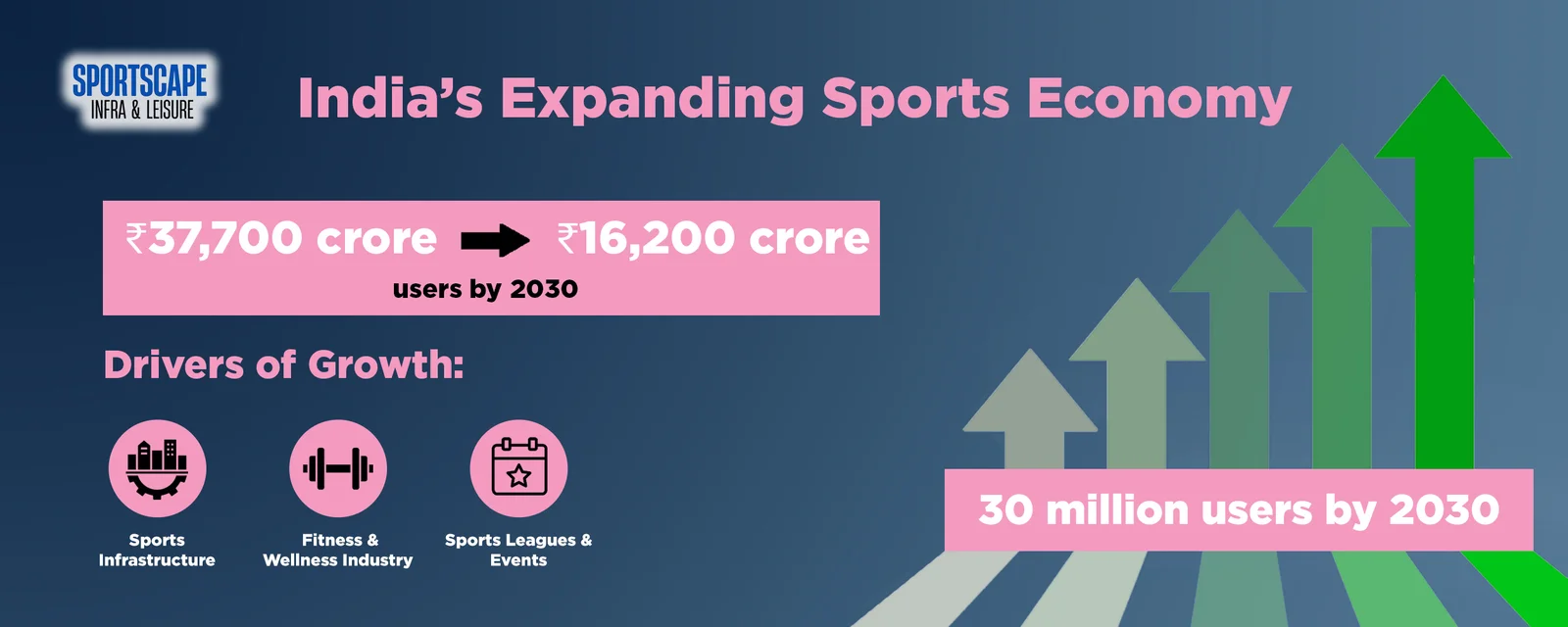
India is at a pivotal moment. With initiatives like Khelo India, ambitions of hosting the 2036 Olympics, and a rapidly expanding ₹16,200 crore fitness and sports market expected to reach ₹37,700 crore by 2030, the country is not just building stadiums; it is building an ecosystem. But as the scale grows, so do the complexities. Managing crowd safety, optimising operations, ensuring sustainability, and delivering world-class experiences are no longer optional challenges; they are expectations.
This is where AI steps in.
At forums like the AI Summit 2026, a clear message has emerged: AI is no longer a futuristic add-on; it is a foundational layer for modern infrastructure. In sports, where performance, precision, and real-time decision-making are critical, AI is fast becoming the invisible backbone of next-generation facilities.
What Does AI Mean for Sports Infrastructure?
At its core, AI in sports infrastructure is about making physical spaces intelligent. It is the integration of data analytics, machine learning, computer vision, and automation into the design, construction, and operation of sports facilities.
In simple terms, AI allows stadiums and training centres to sense, learn, and respond.
Think of a stadium that knows when crowds are about to surge at a particular gate and automatically redirects people to reduce congestion. Or a training facility where the surface conditions adjust based on athlete performance data. This is not science fiction; it is the emerging reality of performance-linked infrastructure.
The Rise of Smart Stadiums
The most visible application of AI is in smart stadiums, venues that go beyond hosting matches to delivering a seamless, data-driven experience.
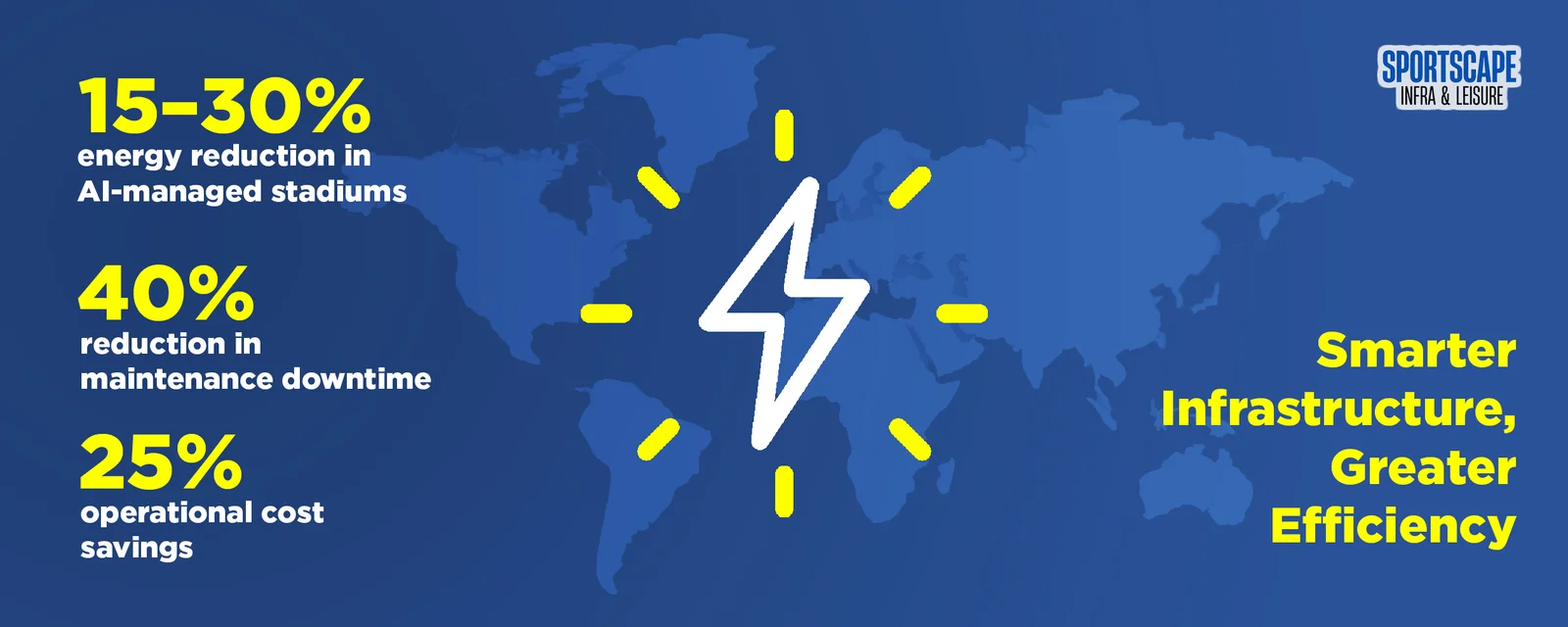
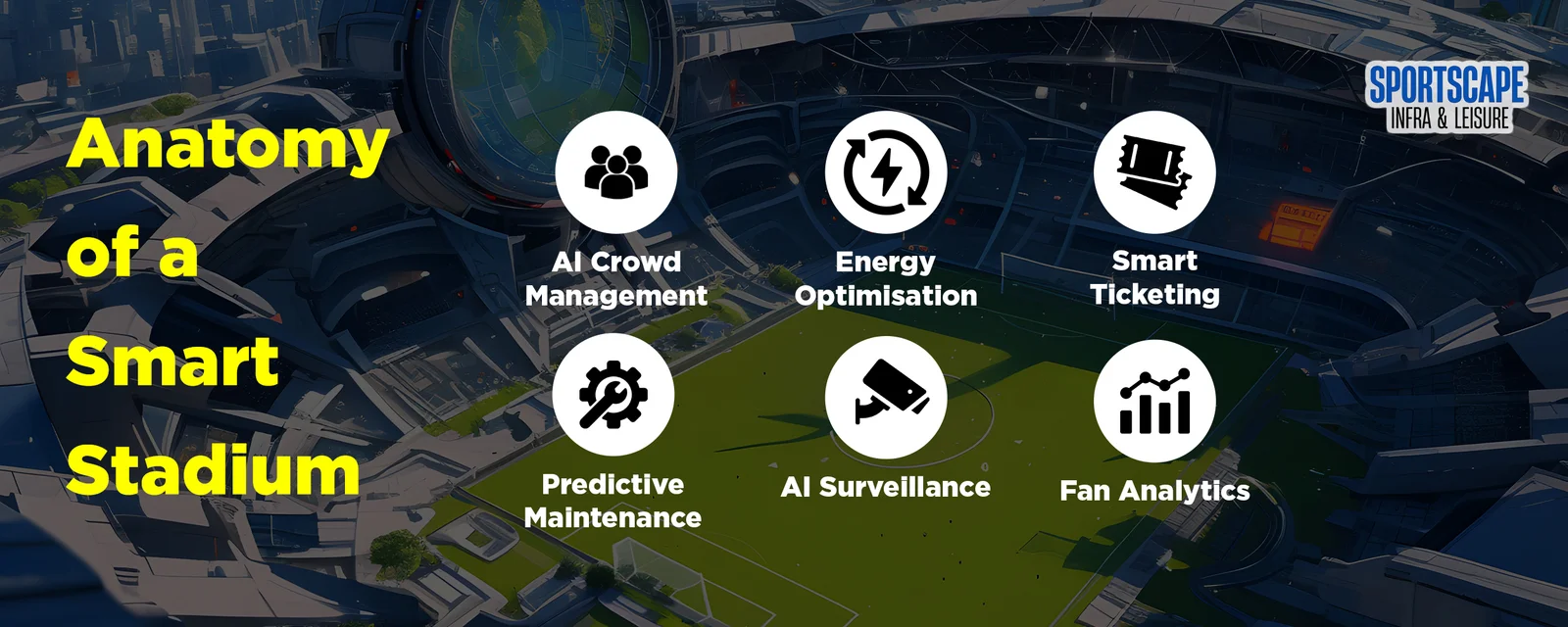
Take energy optimisation, for instance. The M. Chinnaswamy Stadium in Bengaluru, often cited as one of India’s greenest stadiums, already uses solar energy and water management systems. Now imagine layering AI on top of that, systems that predict energy demand based on match schedules, weather conditions, and attendance, and automatically optimize consumption. Globally, AI-driven energy management systems have demonstrated the potential to reduce energy consumption by 15-30%, thereby significantly lowering operational costs.
Maintenance is another area where AI is making a quiet but powerful impact. Instead of reacting to equipment failures, AI enables predictive maintenance, identifying potential issues in lighting, turf systems, or structural components before they become problems. For stadium operators, this can reduce downtime by up to 40%, while extending asset life.
Then comes smart ticketing and crowd management. AI can analyse historical attendance data, ticket sales, and even social media trends to predict crowd behaviour. This helps in better gate management, staffing, and emergency planning. In high-density venues, such predictive systems can be the difference between chaos and control.
Security is also evolving. Facial recognition, behavioural analytics, and AI-powered surveillance systems are increasingly being deployed to monitor large crowds in real time. These systems can flag unusual activity, identify risks, and alert authorities instantly, significantly improving safety in large venues.
AI in Construction & Project Management
While AI is transforming how stadiums operate, its impact begins much earlier at the construction stage.
Building a stadium or a multi-sports complex is a massive undertaking, often involving hundreds of stakeholders, tight timelines, and budgets running into hundreds of crores. Traditionally, cost overruns and delays have been common. AI is now helping address these inefficiencies.
Smarter Cost Estimation
AI-driven tools can analyse historical project data, material costs, labour trends, and even geopolitical factors to generate highly accurate cost estimates. This reduces the uncertainty that often leads to budget overruns.
The question often asked is: Does AI increase costs or reduce them? The answer is nuanced. While initial investment in AI tools can be significant, studies suggest that AI-led project management can reduce overall project costs by 10-20% by minimising errors, delays, and rework.
Optimising Large-Scale Projects
For large-scale projects like stadiums, AI can simulate different design and construction scenarios to identify the most efficient approach. From optimising seating layouts for visibility to ensuring structural efficiency, AI is becoming an integral part of design decision-making.
In countries like the UAE and Qatar, AI and digital twins were extensively used in planning sports infrastructure for mega events. India, with its increasing focus on multi-sports complexes and urban sports hubs, stands to benefit immensely from such technologies.
Aligning with India’s Infrastructure Push
India’s infrastructure development is increasingly being driven by Public-Private Partnerships (PPP). In such models, efficiency and return on investment are critical. AI can provide real-time insights into project progress, resource utilisation, and risk management, making projects more attractive to private investors.
Business Case: Why AI Matters?
Beyond technology, AI is fundamentally a business enabler for sports infrastructure.
Cost Savings & Efficiency
Operational costs are a major challenge for stadium owners. AI can significantly reduce these through:
- Energy optimisation
- Predictive maintenance
- Efficient staffing and scheduling
Globally, smart stadiums have reported operational savings of up to 25%, a figure that can dramatically improve profitability.
Higher Utilisation Rates
One of the biggest challenges in sports infrastructure is underutilisation. Many stadiums remain idle for large parts of the year. AI can help change that by analysing usage patterns and identifying opportunities for multi-purpose utilisation, from concerts and events to community sports programs.
Monetisation Opportunities
AI also opens up new revenue streams. With advanced analytics, stadium operators can better understand fan behaviour — what they buy, where they go, how long they stay. This data can be used to personalise experiences, optimise pricing, and enhance fan engagement. Globally, data-driven fan engagement has become a major revenue driver. For example, personalised offers and targeted advertising can increase per-fan spending by 15–20%. In India, where the sports economy is rapidly expanding, such monetisation opportunities can be a game changer for private developers and operators.
Global Benchmarks vs India
Globally, AI-driven sports infrastructure is already setting new benchmarks. In the United States, venues like the SoFi Stadium in Los Angeles use AI-powered systems for crowd management, security, and energy optimisation. Even specialsit have weighed in for this revolution in sports.
"I am quite confident that a team will secure a Super Bowl victory in the upcoming years by leveraging AI extensively," Ryan Paganetti, Raiders coach's AI specialist said.
In Europe, clubs like Tottenham Hotspur have built stadiums that integrate data across operations to deliver a seamless fan experience. The Middle East, particularly Qatar, has leveraged AI extensively in designing climate-controlled stadiums for the FIFA World Cup.
These are not just stadiums, they are data ecosystems.
| Country | Example | Key Technologies |
|---|---|---|
| USA | SoFi Stadium | AI crowd management, digital ticketing |
| UK | Tottenham Hotspur Stadium | integrated fan analytics |
| Qatar | World Cup stadiums | climate control + AI design |
| India | Emerging adoption | sustainability & digital pilots |
Where Does India Stand?
India is still in the early stages of this transformation. While there are examples of sustainability and digital adoption, the integration of AI into sports infrastructure is limited and fragmented. Most facilities focus on construction, with less emphasis on long-term operational intelligence. With a projected 30 million fitness users by 2030 and a rapidly growing wellness economy, India has the potential to leapfrog traditional models and adopt AI-driven infrastructure at scale. However, despite representing a massive opportunity, this gap comes with some challenges.
Challenges & Gaps
Despite its potential, the adoption of AI in sports infrastructure is not without challenges.
High Initial Costs
Implementing AI systems requires significant upfront investment in technology, sensors, and data infrastructure. For many projects, especially at the grassroots level, this can be a barrier.
Skill Gaps
AI systems are only as effective as the people managing them. India currently faces a shortage of professionals who understand both sports infrastructure and data analytics. Bridging this gap will be critical.
Data Privacy & Security
With the use of facial recognition and behavioural analytics, concerns around data privacy and surveillance are becoming increasingly important. Clear regulations and ethical frameworks will be essential to build trust.
Fragmented Ecosystem
One of the biggest challenges is the lack of integration between different stakeholders, developers, operators, technology providers, and governing bodies. Without a unified approach, the benefits of AI cannot be fully realised.
Future Outlook: The Next Decade
The future of sports infrastructure is not just about bigger stadiums; it is about smarter ecosystems.
Fully Automated Stadiums
In the coming years, we could see stadiums where most operations are conducted. From lighting and security to crowd management, everything will be automated and managed through AI systems.
Performance-Linked Infrastructure
Training facilities will increasingly integrate athlete data to optimise surfaces, equipment, and environments in real time, enhancing performance and reducing injury risks.
Integrated Digital Ecosystems
Sports venues will become part of larger digital networks, connecting fans, athletes, and operators through data-driven platforms.
Sustainable, Self-Optimising Facilities
AI will play a key role in achieving sustainability goals by optimising energy, water, and resource usage, making facilities both eco-friendly and cost-efficient.
Supporting India’s Mega-Event Ambitions
As India looks to host global events like the Olympics, the need for world-class, technology-driven infrastructure will become even more critical. AI will be central to meeting international standards and delivering seamless experiences.
Conclusion
AI is no longer a futuristic concept reserved for tech companies. It is rapidly becoming the backbone of modern infrastructure. In sports, where performance, safety, and experience converge, its impact is particularly profound. India stands at a crossroads. The country has the ambition, the market, and the momentum. What it needs now is the integration of technology into its infrastructure strategy.
Because ultimately, AI is not just enhancing sports infrastructure, it is redefining how India builds, manages, and experiences sport. The way forward will require collaboration. Technology providers, policymakers, infrastructure developers, and sports bodies must come together to create an ecosystem where AI is not an afterthought, but a foundation. Only then can India truly build not just stadiums, but smart, sustainable, and future-ready sporting ecosystems.
Written by