
Understanding Tennis Court Dimensions: Complete Guide for Players, Builders, and Coaches
Learn The Official Tennis Court Dimensions In Meters And Feet, Including Singles And Doubles Court Sizes, Net Height, Service Boxes, And Total Court Area Requirements.
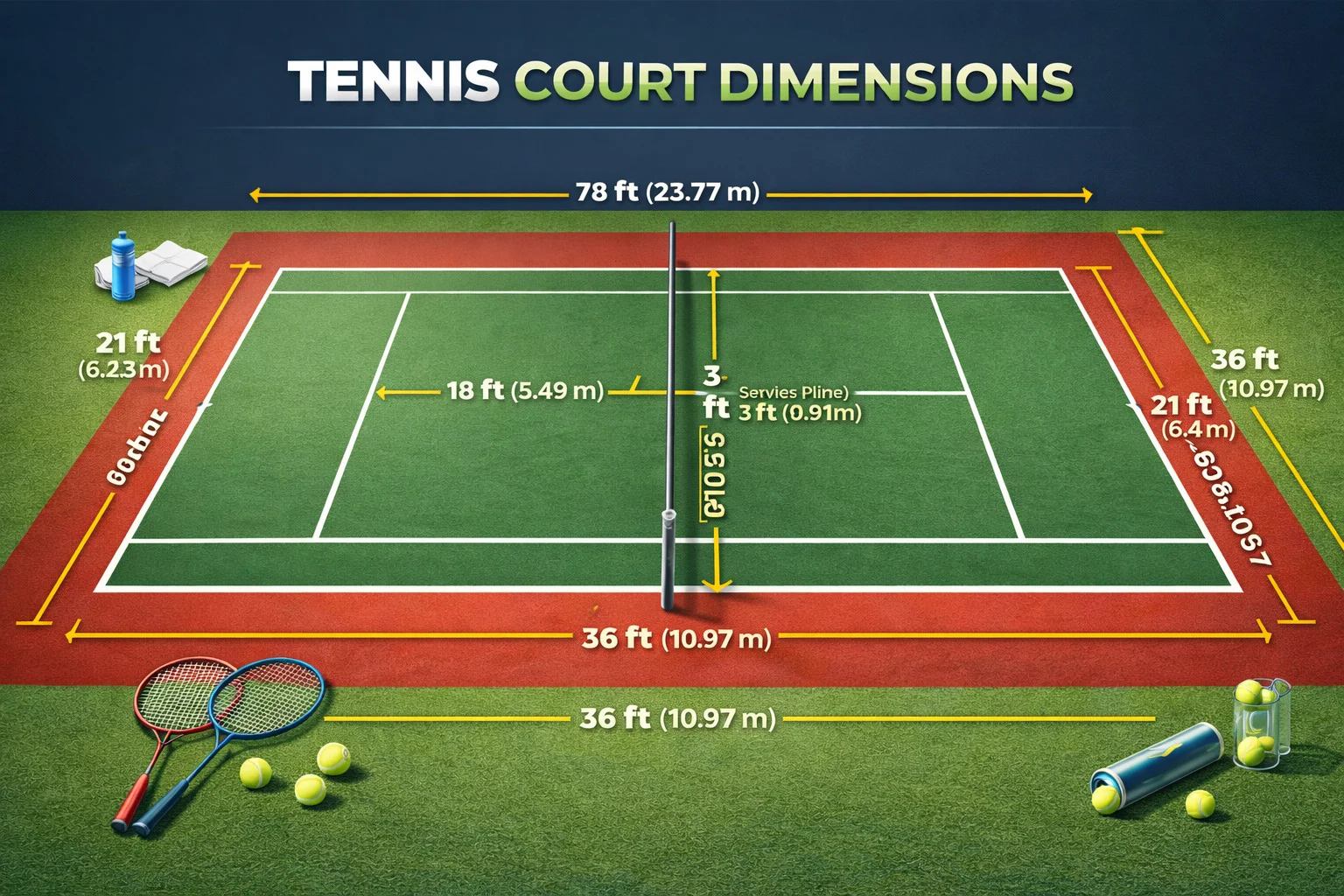
Tennis might look simple from the stands—two players, a net, and a rectangular court—but the precision behind tennis court dimensions is what keeps the sport fair, competitive, and globally standardized. Whether you’re a casual weekend player, a professional athlete, a coach, or someone planning to build a tennis court, understanding the exact measurements is essential. Even a few inches of miscalculation can affect gameplay, player positioning, and tournament compliance.
Tennis courts are governed by strict rules established by the International Tennis Federation (ITF). These rules ensure that a court in New York, London, Melbourne, or Tokyo follows the same measurement standards. This consistency allows players to compete anywhere in the world without needing to adapt to new court sizes. Imagine if basketball hoops varied in height between arenas—it would disrupt the entire sport. Tennis works the same way.
Another reason these measurements matter is player movement and strategy. The width of doubles alleys, the distance from the baseline to the service line, and the exact net height all influence how players serve, return, and position themselves. A serve that lands just inside the service box can determine the outcome of a point, so the court layout must be precise.
For builders and facility planners, understanding dimensions goes beyond the painted lines. They must also consider buffer space, fencing, lighting, drainage, and surface materials. Professional facilities often require additional clearance space around the court to ensure player safety and accommodate ball movement.
This guide breaks down every important detail—from tennis court dimensions in meters to tennis court dimensions in feet, including line markings, net height, singles vs doubles courts, and construction considerations. By the end, you'll have a complete understanding of how a tennis court is structured and why these measurements are critical for both casual play and professional competition.
Why Tennis Court Dimensions Matter in the Game
At first glance, a tennis court may appear to be just a flat rectangle divided by a net. However, each line and measurement has a purpose that directly affects how the game is played. Court dimensions influence player movement, shot selection, strategy, and even endurance during long matches. Without standardized dimensions, tennis would lose the consistency that makes competition fair across all levels.
One of the most important aspects affected by court size is player positioning. A player standing at the baseline relies on knowing exactly how far the service box extends and how much width they have to work with during rallies. For example, a cross-court shot must travel diagonally across the court and land within specific boundaries. If the dimensions were inconsistent, players would struggle to judge angles and shot placement.
The court also shapes serving strategy. Professional players spend years mastering serves that land just inside the service box, often within inches of the line. Because the service box dimensions are standardized worldwide, players can develop highly precise serving techniques that remain effective in any tournament.
Endurance and movement patterns are another reason dimensions matter. Tennis requires quick lateral movement, forward sprints, and backward recovery steps. The court width determines how far a player must run to return wide shots, while the length of the court affects baseline rallies. Over a five-set match, these distances accumulate into miles of running.
For coaches and trainers, standardized court measurements are critical when designing practice drills and training exercises. Drills that simulate match conditions rely on exact distances between lines. A slightly smaller or larger court would change the timing and difficulty of these exercises.
Court dimensions also ensure fair competition in professional tournaments. Imagine a Grand Slam match played on a court that is even a foot narrower than regulation size. Big servers might gain an unfair advantage, while defensive players might struggle to cover angles they normally could reach.
The precision of tennis court measurements guarantees that every player, from beginners at a local club to champions at Wimbledon, competes on the same stage—literally and figuratively.
Impact on Player Movement and Strategy
Tennis is often described as a game of geometry and movement, and the exact layout of the court shapes how players think, react, and strategize during every point. The distance between lines, the width of the court, and the placement of the net all combine to create the tactical framework of the sport.
One of the most obvious strategic elements is court coverage. A singles player must defend a court that is 27 feet wide, which means every wide shot forces them to move several feet laterally. This constant side-to-side movement creates opportunities for opponents to exploit open spaces. Skilled players deliberately hit angled shots to stretch their opponent beyond the sidelines, then finish the point with a shot to the opposite side.
The baseline plays a critical role in strategy as well. Players often engage in long rallies from this line, trading powerful groundstrokes while trying to push their opponent deeper behind the court. Because the baseline sits exactly 39 feet from the net, players know the precise distance required to generate depth without hitting the ball out.
Another important strategic element is the service box placement. When serving, players aim for different areas within the box to create advantages. A wide serve can pull the opponent off the court, opening space for the next shot. A serve down the middle, often called a “T serve,” targets the center line to surprise the receiver.
Net play also depends heavily on court dimensions. Players approaching the net must understand the spacing between themselves and the baseline opponent. This distance determines reaction time for volleys and overhead shots. Doubles players especially rely on quick reflexes near the net, where positioning within a few feet can decide whether they intercept a shot or miss it entirely.
Professional tennis analysts often describe matches using terms like court positioning, angles, and spacing. These concepts only work because the court dimensions remain consistent everywhere the sport is played.
Importance for Professional and Recreational Play
The standardized measurements of a tennis court are not just important for professional tournaments; they also play a crucial role in recreational play, coaching programs, and training facilities around the world. From Grand Slam arenas to neighborhood sports clubs, the consistency of tennis court dimensions ensures that every match is played under fair and familiar conditions. Whether a beginner is learning how to serve or a professional is competing in a championship, the structure of the court remains exactly the same.
Professional tennis relies heavily on this consistency. Organizations such as the International Tennis Federation (ITF), ATP, and WTA require strict adherence to official court measurements for sanctioned events. A deviation of even a few inches could influence the outcome of a match. For example, if the service box were slightly shorter than the standard length, powerful serves might land out more often, giving an unfair advantage to defensive players. These details might seem small, but in elite sports, small differences can significantly impact performance.
Recreational players benefit from standardized courts as well. Many amateur athletes practice on local courts and later participate in tournaments at regional or national levels. Because the dimensions remain consistent, players don’t need to relearn the court layout or adjust their strategies when playing in new venues. This continuity allows skills developed during practice sessions to transfer directly into competitive play.
Coaches also rely on accurate measurements when designing training drills. Exercises that focus on cross-court rallies, down-the-line shots, or serve placement depend on precise court boundaries. If the lines were inaccurate, the drills would not effectively simulate real match conditions. Proper dimensions help players develop muscle memory and spatial awareness, both of which are critical for improving performance.
Recreational facilities, schools, and community sports complexes often construct courts based on official guidelines to maintain authenticity. This approach ensures that players of all ages and skill levels experience the same game played by professionals like Novak Djokovic or Serena Williams.
Standardized court dimensions also contribute to the global popularity of tennis. A player in Europe can travel to Asia or North America and compete on a court with identical measurements. This universal structure is one reason tennis remains one of the most widely played sports in the world.
Official Tennis Court Dimensions Explained
The structure of a tennis court may appear straightforward, but its measurements are carefully regulated to maintain balance between offense and defense. Every line on the court—from the baseline to the service line—serves a specific purpose. Understanding these measurements helps players improve their positioning and allows builders to construct courts that meet official standards.
A standard tennis court has a rectangular shape divided by a net in the center. The total length of the playing area is 78 feet (23.77 meters), which remains the same for both singles and doubles matches. The width of the court varies depending on the type of match being played. Singles matches use a narrower court, while doubles matches include additional space known as doubles alleys on both sides.
The baseline marks the back boundary of the court. Players often stand behind this line while serving and during rallies. Approximately halfway between the baseline and the net lies the service line, which divides the front and back sections of the court. The area between the net and service line forms the service boxes, where serves must land to start a point.
At the center of the court is the center service line, which splits the service area into two equal boxes—one on the left and one on the right. During a match, players alternate serves between these boxes to keep the game balanced.
The sidelines define the outer edges of the court. In singles matches, the inner sidelines are used, while doubles matches extend play to the outer sidelines. This difference in width significantly changes strategy and court coverage.
Professional tournaments maintain extremely precise measurements. Court lines are typically 2 inches (5 cm) wide, except for the baseline, which may be slightly wider to improve visibility for players and line judges. These lines are carefully painted or embedded into the court surface to ensure accuracy. Understanding the official layout is essential for anyone involved in tennis, whether playing competitively, coaching athletes, or planning to build a new court.
Tennis Court Dimensions in Meters
In most countries outside the United States, tennis court measurements are commonly expressed in metric units. The tennis court dimensions in meters follow the same international standards established by the International Tennis Federation, ensuring uniformity across all professional and recreational courts.
The overall length of a tennis court is 23.77 meters, measured from baseline to baseline. This measurement remains constant regardless of whether singles or doubles matches are played. The width, however, differs depending on the format of the game. For singles matches, the court width is 8.23 meters, while doubles matches expand the playing area to 10.97 meters by including the doubles alleys.
The net divides the court into two equal halves, each measuring 11.885 meters in length. The distance from the net to the service line is 6.40 meters, creating the front portion of the court where players often approach the net for volleys and quick exchanges. The service boxes are another crucial part of the court layout. Each service box measures 6.40 meters in length and 4.115 meters in width. When serving, players must land the ball within the correct service box diagonally opposite from where they are standing. If the serve lands outside this area, it is considered a fault.
The doubles alleys add 1.37 meters of width on each side of the singles court. These narrow strips significantly influence strategy in doubles matches because they create additional angles for shots and increase the amount of ground players must cover. Builders and facility planners often consider additional space beyond the playing area when constructing courts. The recommended total area, including run-off space, can reach 36.6 meters in length and 18.3 meters in width. This extra space allows players to chase down balls safely without colliding with fences or walls.
Using metric measurements is particularly common in Europe, Asia, and Australia, making them essential for international construction projects and professional tournament facilities.
Tennis Court Dimensions in Feet
In the United States and several other countries, tennis courts are typically measured using imperial units. The tennis court dimensions in feet follow the same official standards but are expressed differently for easier understanding in regions that use the imperial system.
The full length of a tennis court is 78 feet, measured from one baseline to the other. This measurement remains constant for both singles and doubles play. The width changes depending on the type of match. A singles court measures 27 feet wide, while a doubles court expands to 36 feet wide with the inclusion of the doubles alleys. The net divides the court into two equal halves of 39 feet each. Players serve from behind the baseline and aim to land the ball within the service box on the opposite side of the net. The service line sits 21 feet away from the net, creating a clear boundary for the service boxes.
Each service box measures 21 feet long and 13.5 feet wide, giving servers a defined target area. Players alternate serves between the left and right service boxes after each point to maintain fairness in gameplay. The doubles alleys add 4.5 feet of width on each side of the singles court. These areas are only used in doubles matches and dramatically expand the angles available for shot placement. Skilled doubles teams often use the alleys strategically to pull opponents out of position.
The net height is another critical measurement. At the center of the court, the net stands 3 feet (0.91 meters) high, while the height at the posts is 3.5 feet (1.07 meters). This slight dip in the middle creates a consistent challenge for both servers and volleying players. Professional facilities typically require additional space beyond the playing lines. The recommended overall area for a full tennis court with safety margins is about 120 feet long and 60 feet wide. This extra space ensures players can move freely and safely during intense rallies.
Understanding these measurements in feet is especially useful for coaches, players, and builders in regions where the imperial system is standard.
Key Parts of a Tennis Court
A tennis court may look like a simple rectangular playing field, but every line, boundary, and marked section serves a very specific purpose. These markings guide the flow of the game, define legal play areas, and help players make quick decisions during fast-paced rallies. Understanding the key parts of a tennis court allows players to position themselves correctly, anticipate shots, and execute strategies more effectively.
The tennis court is divided into multiple sections using painted lines that must follow strict international standards. These lines include the baseline, service line, center service line, singles sidelines, doubles sidelines, and center mark. Each one defines where the ball must land for a shot to remain in play. During a match, players and line judges rely heavily on these markings to determine whether a ball is in or out.
At the back of the court lies the baseline, which marks the farthest boundary of the playing area. Players typically begin rallies and serve from behind this line. Moving forward, the service line divides the front and back halves of the court. The region between the service line and the net is often referred to as the forecourt, where volleys and quick reactions occur.
The center service line plays a key role in serving rules. It splits the service area into two equal boxes, ensuring that serves must land diagonally across the net rather than straight ahead. This rule adds complexity and fairness to the serving process.
Another important element is the distinction between singles and doubles sidelines. The inner sidelines define the narrower singles court, while the outer sidelines expand the court width for doubles matches. This design allows the same physical court to accommodate both formats without requiring different facilities.
All these elements work together to create the structure of the game. Players subconsciously rely on these lines to judge angles, control shot placement, and maintain positioning throughout a rally. Without them, tennis would lose the clarity and fairness that make it such a precise and strategic sport.
Baseline
The baseline is one of the most important boundaries on a tennis court, forming the back edge of the playing area on both sides of the net. It runs parallel to the net and marks the point beyond which the ball is considered out if it lands past it. Players spend a significant portion of a match near this line, especially during baseline rallies that dominate modern tennis.
One of the baseline’s most crucial roles is in the serving process. When serving, players must stand behind the baseline until the ball is struck. Stepping on or over the line before contact results in a fault known as a foot fault. This rule ensures fairness by preventing servers from gaining extra advantage by moving closer to the net before hitting the ball.
Baseline play is also a defining characteristic of many professional players’ styles. Some athletes are known as baseline specialists, meaning they prefer to stay near the back of the court and engage in long rallies using powerful groundstrokes. Players like Rafael Nadal and Novak Djokovic have built much of their success around dominating from the baseline, using heavy topspin and precise placement to control points.
Another reason the baseline is so important is its relationship to court depth. Players aim to hit shots that land close to the opponent’s baseline because deeper shots push opponents farther back, reducing their offensive options. When a player is forced several feet behind the baseline, it becomes harder to hit aggressive returns.
The baseline also includes a small marking called the center mark, which divides the serving area into left and right halves. This mark helps players align themselves properly when preparing to serve. Because of its central role in both defense and offense, the baseline is often where the majority of rallies begin and end. Understanding its position and strategic significance is essential for anyone looking to improve their tennis game.
Service Line
The service line is another critical component of the tennis court layout, positioned parallel to the net and located approximately halfway between the net and the baseline. Its primary function is to define the front boundary of the service boxes, which are essential during the serving phase of each point.
During a serve, the ball must land inside the service box located diagonally across the net from the server. The service line forms the back boundary of this box. If a serve lands beyond the service line, it is considered long and counts as a fault. This rule forces servers to balance power and precision, making the serve one of the most technically demanding shots in tennis.
The service line also plays an important role in court positioning and tactics. Players who move forward from the baseline often stop near the service line when transitioning to the net. From this position, they can hit approach shots or prepare for volleys. This area is sometimes referred to as the transition zone because players frequently pass through it when moving from defensive to offensive positions.
In doubles matches, the service line becomes even more significant. Net players often position themselves near this line when preparing to intercept returns or react to quick exchanges. This positioning allows them to cover both the middle of the court and potential angled shots.
From a design perspective, the service line ensures that the service boxes maintain consistent dimensions across all courts worldwide. This consistency allows players to develop serving techniques that remain effective regardless of where they compete. Because serving begins every point in tennis, the service line indirectly influences the entire rhythm of the game. Its placement determines how challenging it is to land accurate serves while still giving the receiving player a fair opportunity to return the ball.
Center Service Line
The center service line is a vertical line that runs from the service line to the net, dividing the service area into two equal halves. These halves form the left and right service boxes, which are used alternately during the serving process. Although it might seem like a simple marking, the center service line plays a vital role in ensuring fairness and structure in the game. When serving, players must aim diagonally across the court into the opponent’s service box. For example, if the server begins on the right side of the baseline (known as the deuce court), the serve must land in the opponent’s right service box on the opposite side of the net. The center service line acts as the boundary separating the two target areas.
This rule forces players to develop precision and control in their serves. Instead of simply hitting the ball straight ahead, they must adjust their angle and spin to land the ball within a specific diagonal zone. This challenge adds complexity to the serve, turning it into one of the most strategic shots in tennis. The center service line also influences returning strategy. Receivers often position themselves slightly toward the middle of the court because they know the serve must land within a specific box. This positioning allows them to react quickly to wide or central serves.
In doubles matches, the center service line helps maintain organized positioning between teammates. Since the serve must land within a defined box, both the returning player and their partner can anticipate likely serve directions and adjust their positions accordingly. Although it may appear to be just a simple line painted on the court, the center service line contributes significantly to the structure and strategy of tennis. Without it, serving rules would lack the precision that makes the game both challenging and exciting.
Singles Sideline vs Doubles Sideline
One of the most distinctive features of a tennis court is the presence of two different sets of sidelines: singles sidelines and doubles sidelines. These lines allow the same court to accommodate both singles and doubles matches without requiring separate facilities. Understanding the difference between these boundaries is essential for players and spectators alike. The singles sidelines mark the narrower playing area used during one-on-one matches. When playing singles, the ball must land within these inner sidelines to remain in play. Any shot that lands outside them is considered out, even if it lands within the wider doubles area.
The doubles sidelines, located farther apart, expand the width of the court for matches involving two players on each team. The extra space between the singles and doubles sidelines is known as the doubles alley. This additional width increases the court from 27 feet to 36 feet, significantly changing the dynamics of gameplay. Because doubles courts are wider, players can create sharper angles and exploit open spaces more easily. However, the presence of four players instead of two balances this advantage. Teammates must communicate and coordinate their movements to cover the larger area effectively.
In singles matches, the narrower court emphasizes endurance and precision. Players must rely heavily on speed and shot placement since there are fewer angles available. In doubles, teamwork and quick reflexes become more important than pure athletic endurance. This dual-line system is an elegant design solution that allows tennis courts to support multiple formats of the game. Whether hosting a singles championship or a doubles tournament, the same court can accommodate both simply by changing which lines are considered in play.
Total Tennis Court Area and Space Requirements
When discussing tennis court dimensions, many people focus only on the lines painted on the playing surface. However, the actual space required to build a proper tennis court is significantly larger than the official playing area. Beyond the baselines and sidelines, additional clearance space—often called run-off space—is necessary to ensure player safety, smooth gameplay, and compliance with professional standards. The official playing court measures 78 feet long and 36 feet wide for doubles (or 27 feet wide for singles). While these measurements define the legal boundaries of the game, players frequently run several feet beyond these lines when chasing down shots. Without adequate space around the court, athletes could collide with fences, walls, or other obstacles, increasing the risk of injury.
For this reason, tennis facility designers recommend much larger total court areas. According to the International Tennis Federation (ITF) guidelines, the recommended total area for a full-sized tennis court—including run-off space—is approximately 120 feet long and 60 feet wide. This additional space allows players to move freely during intense rallies and provides room for line judges, ball kids, and equipment during professional tournaments. Another factor affecting total space requirements is spectator seating and surrounding infrastructure. Stadium courts used in major tournaments such as Wimbledon or the US Open often include large stands, media areas, lighting structures, and broadcast equipment. These elements dramatically increase the footprint of the facility, sometimes extending hundreds of feet beyond the court itself.
The type of court surface can also influence construction planning. Clay courts, for example, require extra drainage and maintenance space around the perimeter. Hard courts often need solid foundations and protective fencing, while grass courts demand carefully managed landscaping and irrigation systems.
Builders also consider orientation and environmental factors. Ideally, tennis courts are positioned with the net running north to south so that players are not facing direct sunlight during morning or evening matches. Wind barriers and fencing are also commonly installed around courts to reduce distractions and keep balls from leaving the playing area. Planning the total space for a tennis court is about more than just measurements—it’s about creating a safe, functional, and enjoyable playing environment. Proper spacing ensures that both recreational players and professionals can perform at their best without unnecessary hazards.
Recommended Run-Off Space
Run-off space refers to the clear area surrounding the tennis court beyond the boundary lines. This space is essential for allowing players to chase balls, recover after wide shots, and maintain balance during fast-paced rallies without risking collisions with fences or walls.
In professional tennis, players frequently sprint several feet outside the sidelines or beyond the baseline while attempting to return difficult shots. Without adequate run-off space, these movements would be dangerous and limit the natural flow of the game. That’s why official guidelines recommend generous clearance zones around the court.
For recreational and club-level facilities, the minimum recommended run-off space is typically:
- 18–21 feet behind each baseline
- 10–12 feet on each side of the sidelines
This layout provides enough room for players to move safely during competitive matches. Professional tournament courts often include even more space to accommodate officials, advertising boards, and television equipment. Run-off areas also play an important role in player safety and injury prevention. Tennis involves rapid changes in direction, sudden stops, and explosive sprints. If players were forced to halt immediately at the baseline or sideline, the risk of muscle strains and collisions would increase dramatically. Extra space allows athletes to decelerate naturally.
Another benefit of proper run-off space is improved ball retrieval and gameplay efficiency. Balls that travel slightly out of bounds can be collected quickly without interrupting the rhythm of the match. In tournaments, ball kids use these areas to move around the court without interfering with players.
The surface of the run-off area is also carefully chosen. Ideally, it should match the main court surface or provide similar traction. A sudden change from hard court to slippery concrete could cause players to lose balance when running after a ball. In short, run-off space may not be part of the official playing lines, but it is an essential component of tennis court design. It ensures that players can perform at full speed while maintaining safety and comfort throughout the match.
Net Specifications and Height Requirements
The tennis net is one of the most recognizable features of the sport. Positioned at the center of the court, it divides the playing area into two equal halves and serves as the primary obstacle players must hit the ball over during every rally. Despite its simple appearance, the net follows strict specifications regarding height, width, and installation.
The net stretches across the entire width of the court and extends slightly beyond the sidelines to ensure full coverage. Its height varies slightly depending on the position along the net. At the center of the court, the net measures 3 feet (0.91 meters) high. At the net posts on each side, the height increases to 3 feet 6 inches (1.07 meters).
This slight dip in the middle of the net is intentional. It creates a balanced challenge for players, allowing them to aim lower shots toward the center while still maintaining difficulty when hitting wide angles near the posts. Many professional players intentionally target the center of the net during rallies because the lower height reduces the risk of hitting the ball into the net.
The net itself is typically made from braided nylon or polyethylene mesh, designed to be strong, weather-resistant, and durable. The top of the net is covered with a white band called the net tape, which improves visibility for players and spectators. Proper net tension is also essential. If the net is too loose, it may sag below the required height, altering gameplay. If it is too tight, the height at the center may exceed regulation limits. Tennis courts use a cable system attached to net posts to maintain the correct tension.
Net posts are positioned slightly outside the doubles sidelines to ensure that the net remains the correct height across the entire width of the playing area. This design ensures that both singles and doubles matches can be played without adjusting the main net structure. Without precise net specifications, the balance between offensive and defensive play in tennis would be disrupted. The net’s height and placement create the constant challenge that defines the sport.
Center Strap and Net Posts
Two often overlooked components of a tennis net system are the center strap and net posts. While they may seem like minor details, these elements play a crucial role in maintaining the correct net height and ensuring consistent gameplay.
The center strap is a narrow white band that connects the middle of the net to the court surface. Its primary purpose is to maintain the official center net height of 3 feet (0.91 meters). Without the center strap, the net could sag too low during play, giving players an unfair advantage when hitting shots over the middle.
This strap is anchored directly to the court using a small metal plate or anchor point. By tightening or loosening the strap, court operators can adjust the net to the exact regulation height. During professional tournaments, officials frequently measure and adjust the net before matches to ensure compliance with official standards.
The net posts are positioned on each side of the court and support the entire net structure. For doubles matches, the posts are placed 3 feet outside the doubles sidelines, ensuring the net extends across the full width of the playing area. In singles matches played on a doubles court, additional singles sticks may be used to maintain the correct net height for the narrower singles width.
Net posts are typically made from durable materials such as steel or aluminum to withstand tension from the net cable. They are securely anchored into the court surface to prevent movement during play. Together, the center strap and net posts ensure that the net maintains its proper shape and height throughout a match. These components might not receive much attention from spectators, but they are essential for maintaining fairness and accuracy in tennis competitions.
Singles Court vs Doubles Court Dimensions
Although singles and doubles matches are played on the same tennis court, the effective playing dimensions differ significantly between the two formats. This difference changes the style of play, strategy, and physical demands placed on the players. In a singles match, only the inner sidelines are considered in play. This creates a court width of 27 feet (8.23 meters) while maintaining the same length of 78 feet (23.77 meters). Because the court is narrower, players must rely heavily on endurance, speed, and precise shot placement to outmaneuver their opponent.
Doubles matches, on the other hand, use the full width of the court, including the doubles alleys. This expands the court to 36 feet (10.97 meters) wide. The extra width introduces new strategic possibilities, such as angled shots into the alleys and coordinated teamwork between partners. Another major difference lies in player positioning. In singles, each player is responsible for covering the entire court alone. This often leads to long rallies from the baseline and intense physical demands. In doubles, players typically divide responsibilities—one player covers the baseline while the other controls the net area.
The presence of four players on the court also changes the pace of the game. Doubles matches tend to feature faster exchanges and more volleys because net players can intercept shots quickly. Despite these differences, the overall court structure remains the same. This versatility allows tennis facilities to host both singles and doubles matches without altering the court itself.
Conclusion
Understanding tennis court dimensions is essential for players, coaches, and anyone involved in building or maintaining tennis facilities. The precise measurements defined by international standards ensure fairness, consistency, and high-quality gameplay across the world. From the baseline to the service boxes, every line on the court has a specific role in shaping the sport.
Knowing both tennis court dimensions in meters and tennis court dimensions in feet helps players and builders work with different measurement systems depending on their location. These standardized dimensions make it possible for tennis to remain a truly global sport, where athletes can compete anywhere under the same conditions.
Beyond the official playing area, elements such as run-off space, net height, and court layout all contribute to the overall functionality of the court. These factors ensure player safety while preserving the balance between offensive and defensive strategies.
Whether you’re learning the game, designing a new sports facility, or simply curious about how tennis courts are structured, understanding these dimensions provides valuable insight into one of the world’s most popular sports.
FAQ
What are the official tennis court dimensions?
A standard tennis court measures 78 feet (23.77 meters) long. The width is 27 feet (8.23 meters) for singles and 36 feet (10.97 meters) for doubles.
What is the height of a tennis net?
The net is 3 feet (0.91 meters) high at the center and 3 feet 6 inches (1.07 meters) high at the posts.
How big is a tennis service box?
Each service box measures 21 feet long and 13.5 feet wide. Serves must land inside the diagonally opposite service box.
How much space is needed to build a tennis court?
Including run-off areas, the recommended total space is about 120 feet by 60 feet (36.6 m by 18.3 m).
What are doubles alleys in tennis?
Doubles alleys are the areas between the singles and doubles sidelines. They are used only in doubles matches and add 4.5 feet (1.37 meters) of width on each side of the singles court.
Written by