
Payyoli to Parliament: P.T. Usha and the Making of a Sporting Nation
P.T. Usha on India's Olympic bid, sports governance, the BCCI clause, para-athletes, and what it takes to build a true multi-sport nation.
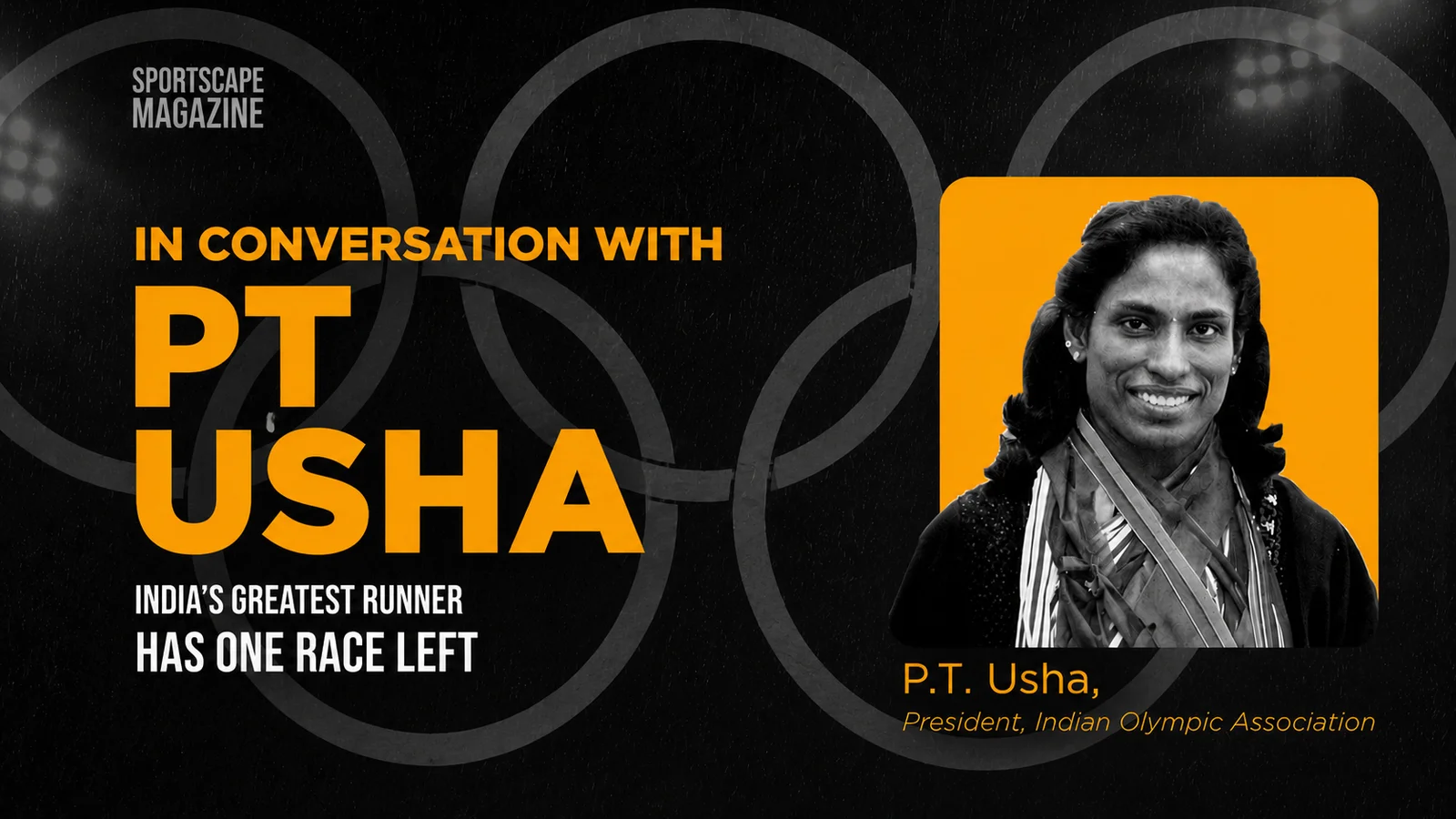
She ran barefoot on the red laterite tracks of Payyoli as a nine-year-old. She came within one-hundredth of a second of an Olympic medal. She trained generations of athletes at her own academy with her own resources. And then, in 2022, she walked into the Rajya Sabha and the Indian Olympic Association – simultaneously – carrying the credibility of a life defined entirely by sport.
P.T. Usha arrives at governance not as a political appointment or a compromise candidate, but as the logical conclusion of a career spent understanding what Indian sport demands of its people. The questions she now grapples with, why India underperforms at the Winter Olympics, whether the new National Sports Policy will outlast its predecessors, and what it truly means for para-athletes to receive equal treatment, are questions she approaches as someone who has lived inside the system she is now trying to reform.
Sportscape sat down with her for a wide-ranging conversation spanning Olympic ambitions, governance failures, sporting infrastructure, and the long road to India becoming a true multi-sport nation.
From Athlete To Administrator: A Journey Full Circle
Sportscape: You went from running in Payyoli as a nine-year-old to presiding over Indian sport from Parliament. If the young girl who first beat her school champion could see you today, what do you think would surprise her the most?
PT Usha:I think the biggest surprise for that young girl would be the scale of responsibility and the journey itself. At that age, my world was very simple — training hard, competing in school events, and dreaming of wearing the Indian jersey one day. Coming from a small town like Payyoli, I never imagined that sport would take me not only across the world but also into positions where I could contribute to shaping the future of Indian athletes.
What would probably make her happiest is not the titles or positions, but the fact that Indian sport itself has evolved so much. Today, young athletes have far greater opportunities, visibility, and support systems than we had in our time. That gives me immense satisfaction because I know how difficult the journey once was.
Sportscape: People have always admired the inclusion of former athletes in top leadership positions. Your journey from being one of India’s greatest athletes to now leading the Indian Olympic Association has been remarkable. How has your experience as an athlete shaped the way you approach sports administration today?
P.T. Usha: My experience as an athlete influences every aspect of my work as an administrator because athletes understand the system from the inside. We know the emotional and physical demands of high-performance sport. We understand what it means to train with limited resources, to compete under pressure, and to overcome setbacks.
Because of this, I strongly believe that sports administration must always remain athlete-centric. Policies and governance should ultimately improve the athlete’s daily environment — whether it is access to coaching, nutrition, recovery, international exposure, or mental support. I also feel athletes need to be heard more in decision-making because they are directly affected by these systems.
At the same time, administration requires balance and long-term vision. It is not only about immediate success but about creating structures that can consistently produce champions over many years.
Emerging Sports And The Gaps India Must Close
Sportscape: You recently returned from China after supporting Indian athletes at the 6th Asian Beach Games, held after a gap of ten years. India climbed from 16th to 6th place. What changes have helped athletes in niche sports improve so significantly?
P.T. Usha: The improvement reflects the broader transformation that Indian sport has undergone over the last decade. Earlier, many niche sports struggled because athletes lacked proper exposure, funding, coaching, and competition opportunities. Today, the ecosystem is far more structured and professional.
Athletes now benefit from sports science support, physiotherapy, nutrition planning, data analysis, and international training opportunities. Programs like TOPS have also provided financial assistance and targeted preparation for elite athletes. Another important change is that federations and authorities are now paying greater attention to disciplines beyond the traditional mainstream sports.
Most importantly, the mindset has changed. Indian athletes now enter competitions believing they can win medals at the international level. That confidence and professionalism are making a huge difference.
Sportscape: The Winter Olympics were held earlier this year in Italy, and India had only two athletes participating. In 2022 Beijing, it was just one. Why does India continue to have such low representation at winter events, and where do we still lag behind?
P.T. Usha: Winter sports development is very different from most other disciplines because it depends heavily on climate, infrastructure, and long-term specialization. Countries that consistently perform well in Winter Olympics have built ecosystems over decades with strong grassroots participation, advanced facilities, and year-round training systems.
In India, we still face limitations in areas such as ice rinks, winter training centres, coaching expertise, equipment access, and international competition exposure. Winter sports also require substantial investment from a young age, which can be challenging for many athletes and families.
However, India certainly has potential. Regions such as Jammu & Kashmir, Himachal Pradesh, and Uttarakhand naturally lend themselves to winter disciplines. With sustained investment, talent identification, and stronger partnerships with international federations, I believe India can gradually improve its presence in Winter Olympics in the coming years.
Sportscape: With the IOA conducting reconnaissance visits to Japan and your recent trip to China, what are the biggest gaps you’ve noticed between India and other developing sporting nations?
P.T. Usha: India has made significant progress, but there are still important areas where leading sporting nations are ahead. One of the biggest differences is continuity and long-term planning. Many successful nations have very strong systems connecting grassroots development, school sports, university sports, and elite performance in a seamless manner.
Another major area is coach education and sports science integration. Internationally, there is tremendous emphasis on biomechanics, recovery, injury prevention, psychology, and data-driven performance analysis. India is improving rapidly in these areas, but we still need deeper integration across all sports and regions.
I also feel that sporting culture plays a big role. In many countries, sports participation begins very early and is seen as an essential part of education and lifestyle. India is moving in that direction, but we still need to strengthen grassroots participation and awareness further.
Governance, Policy, And BCCI
Sportscape: The National Sports Policy 2025 has replaced the 2001 policy, which many feel was never fully implemented. What gives you confidence that this new policy will actually create measurable change on the ground?
P.T. Usha: The biggest difference today is the seriousness with which sport is being viewed nationally. Earlier, sports policies often lacked coordination, accountability, and long-term execution mechanisms. Today, there is much greater awareness that sport is not only about medals but also about health, youth development, education, and national identity.
The new policy focuses on measurable goals, athlete welfare, grassroots participation, sports science, governance reforms, and infrastructure development. There is also stronger collaboration between federations, government bodies, and sporting institutions than before.
Of course, implementation will always determine success. Policies alone cannot create change unless they are executed consistently at the grassroots level. But I do believe there is much stronger institutional commitment now than we saw two decades ago.
Sportscape: The BCCI appears to have been kept outside some of the stricter provisions of the new law through what many are calling a “BCCI clause.” What message does this send to athletes in non-cricket sports?
P.T. Usha: Cricket in India has evolved within a very unique structure over many decades, and naturally it operates differently from several other sports. However, I understand why athletes from non-cricket disciplines may sometimes feel there should be greater uniformity in governance standards.
Ultimately, the broader objective should always be fairness, transparency, and athlete welfare across all sports. Every athlete, regardless of discipline, should feel respected, valued, and supported equally in their pursuit of excellence. It is important that policies strengthen trust and confidence within the sporting ecosystem.
At the same time, we must remember that Indian sport as a whole benefits when all federations and sporting bodies function professionally and responsibly.
Athletics, The Sports Boom Beyond Cricket
Sportscape: Which sports in India do you believe are truly booming beyond cricket, both in participation and medal potential?
P.T. Usha: I think athletics, badminton, shooting, wrestling, boxing, hockey, and table tennis have all seen remarkable growth in recent years. These sports are now consistently producing international-level performances and inspiring young athletes across the country.
At the same time, we are also seeing encouraging progress in disciplines such as fencing, rowing, cycling, archery, and para sports. One very positive sign is that participation is expanding beyond metropolitan cities into smaller towns and rural areas. Many of India’s biggest sporting talents today are emerging from regions that previously had limited exposure.
Another major change is parental mindset. Families today are becoming more supportive of sports as a serious career option, which is extremely important for long-term development.
Sportscape: What, in your view, has athletics done right that other sports can learn from?
P.T. Usha: Athletics has benefited from a combination of grassroots development, stronger competition structures, improved coaching standards, and greater international exposure. There has also been a stronger emphasis on identifying talent at a young age and giving athletes opportunities to compete regularly.
Another important factor is professionalism. Indian athletes today are much more disciplined in areas such as training, recovery, nutrition, and mental preparation. Exposure to international competition has also helped athletes understand what is required to compete at the highest level.
Most importantly, success creates belief. When one athlete succeeds internationally, it motivates many others to believe that global medals are possible for India. That confidence is helping athletics grow rapidly.
Sportscape: The AFI has introduced qualification standards for upcoming events even tougher than Hangzhou, in some cases requiring athletes to surpass national records. Is there a risk of setting the bar so high that India ends up with a smaller or underprepared team?
P.T. Usha: High standards are important because they push athletes toward international competitiveness and ensure that those representing India are prepared for elite-level competition. In global sport, standards are continuously rising, so our athletes also need to aim higher.
At the same time, balance is very important. Qualification systems should challenge athletes without discouraging emerging talent. Federations must ensure that the standards are ambitious but also realistic and development-oriented.
The ultimate objective should not simply be the size of the team, but the quality of preparation and the ability of athletes to compete strongly on the international stage.
The 2036 Olympic Dream: Ambition, Ahmedabad, And Sustainability
Sportscape: Why do you think this is the right time for India to seriously push for hosting the Olympics?
P.T. Usha: I believe this is the right time because India today is in a very different position compared to previous decades. The country has growing economic strength, rapidly improving infrastructure, increasing global influence, and rising sporting ambitions. Indian athletes are also achieving success across multiple disciplines, which reflects the country’s evolving sporting culture.
Hosting the Olympics is not only about sport; it is also about national confidence and long-term development. It can accelerate infrastructure growth, tourism, employment, urban modernization, and youth participation in sports. Most importantly, it can inspire an entire generation to pursue fitness and excellence.
However, hosting the Olympics also comes with enormous responsibility. The focus must always remain on sustainability, legacy planning, and ensuring that infrastructure continues benefiting athletes and citizens long after the Games are over.
Sportscape: We’ve seen examples like Athens and Rio where Olympic infrastructure became a burden after the Games. How honestly prepared is India right now to host an event of that scale in a sustainable way?
P.T. Usha: Hosting the Olympics is one of the biggest responsibilities any country can undertake. It requires not only sporting infrastructure but also long-term planning in areas such as transport, housing, sustainability, security, and urban development.
India still has work to do, but I believe there is now much greater awareness about sustainability and legacy planning than in the past. We have learned valuable lessons from previous Olympic hosts around the world. The focus today is increasingly on building infrastructure that remains useful and economically viable long after the Games are over.
If approached carefully and strategically, hosting the Olympics can become a transformational opportunity for Indian sport and national development.
Sportscape: Ahmedabad is widely seen as the frontrunner city for a potential Olympics. From the world’s largest cricket stadium to the 2030 Commonwealth Games bid, what makes Ahmedabad such a preferred choice — even over the national capital?
P.T. Usha: Ahmedabad has emerged as a strong contender because it offers several advantages in terms of infrastructure development, connectivity, planning flexibility, and administrative support. The city has already demonstrated its ability to host large-scale events and execute ambitious infrastructure projects efficiently.
There is also significant investment being directed toward sports infrastructure and urban development in the region. Cities that aim to host the Olympics must think long-term, and Ahmedabad appears to be positioning itself with that vision in mind.
At the same time, hosting the Olympics would ultimately be a national effort involving multiple cities, institutions, and stakeholders across the country.
Sportscape: Beyond stadiums, what specific sports infrastructure and long-term developments are being planned in Ahmedabad to justify its image as a potential Olympic city?
P.T. Usha: The discussion today is no longer only about stadiums. Modern Olympic planning involves athlete villages, transport connectivity, sports science centres, high-performance training facilities, accommodation, medical systems, and sustainable urban infrastructure.
Any city aspiring to host the Olympics must ensure that the investments create long-term value for athletes and citizens even after the Games conclude. The focus should be on creating a sporting ecosystem that encourages grassroots participation, athlete development, tourism, and community engagement for decades.
That long-term vision is what ultimately determines whether an Olympic project becomes successful and sustainable.
Para-Athletes, Equity, And The Road To A Multi-Sport Nation
Sportscape: India’s Paralympic athletes delivered an extraordinary performance in Paris 2024 with 29 medals, yet many feel they do not receive the same recognition, financial rewards, or infrastructure support as Olympic athletes. What more needs to be done?
P.T. Usha: Our para-athletes have made the entire nation proud through their extraordinary performances and resilience. Their achievements have inspired millions of people across the country, and they absolutely deserve equal recognition, opportunity, and respect.
We still need to strengthen accessible infrastructure, specialized coaching systems, grassroots identification programs, sponsorship support, and media visibility for para sports. Awareness is also very important because recognition grows when people understand the stories and struggles behind these achievements.
I believe India has made meaningful progress in recent years, but there is still more work to do to ensure that para-athletes receive the same professional ecosystem and support that every elite athlete deserves.
Sportscape: When you look at young athletes rising today, do you believe India is on the verge of becoming a true multi-sport nation, or are we still in the early stages of that journey?
P.T. Usha: I believe India is steadily moving toward becoming a true multi-sport nation, although we are still in an important phase of development. The most encouraging change is the shift in mindset. Young athletes today are dreaming beyond cricket, and families are increasingly willing to support careers in different sports.
We are also seeing international success across multiple disciplines, which creates inspiration and confidence for the next generation. Athletes from smaller towns and rural backgrounds are now competing and succeeding at the global level, which shows how much potential exists across the country.
At the same time, sustaining this momentum will require continued investment in grassroots development, coaching, infrastructure, and education. If we remain consistent in these areas, I truly believe India can emerge as one of the world’s leading sporting nations in the years ahead.
How does Sportscape Magazine see all this?
P.T. Usha is not a conventional administrator. She did not arrive at the Indian Olympic Association via a political party or a federation network built over decades of favour-trading. She arrived as someone who ran, trained, coached, and struggled inside the system she now leads. That distinction matters.
What comes through in this conversation is a governing philosophy shaped by lived experience rather than bureaucratic instinct. Her insistence that administration must remain athlete-centric is not a slogan; it is the lesson of someone who trained with limited resources and competed without adequate support, and who understands viscerally what those deficiencies cost.
Where Sportscape would press harder is on accountability mechanisms. The National Sports Policy 2001 was also described at launch as a serious, reform-oriented document. What failed was not ambition but enforcement. The new policy will be tested not by its text but by whether it survives contact with the institutional interests that have historically absorbed and neutralised reform efforts in Indian sports governance.
On the BCCI question, Usha’s answer is measured and politically careful. But the underlying tension is real. A governance framework that applies stricter accountability to underfunded federations than to the world’s wealthiest cricket board does raise legitimate questions about whose interests sport policy ultimately serves.
On the 2036 Olympics, her optimism is genuine but the challenge is structural. Ahmedabad’s emergence as a frontrunner is also a political choice, not just a sporting one, and the history of post-Games infrastructure around the world counsels caution. The sustainability question she acknowledges in the abstract will need to be answered in considerable detail before a credible bid takes shape.
None of this diminishes what she represents. In a landscape where sports bodies have too often been captured by those with no relationship to sport, having someone at the helm of Indian Olympic governance who actually ran the race is not a small thing. The question is whether the institution she now leads will allow her to change it.
Written by
Chetan is an Editor at Sportscape Magazine, bringing over three years of experience across sports, defence, international relations, and sports law. With more than 3,500 articles to his name covering player insights, match performances, and team analysis, he…