
Sub-2 Marathon Finally Falls as Sawe Shatters Barrier, Sports Science Predictions Proven Wrong
Sabastian Sawe breaks the two hour marathon barrier in 1:59:30, defying sports science predictions and redefining endurance limits with technology and training advances.
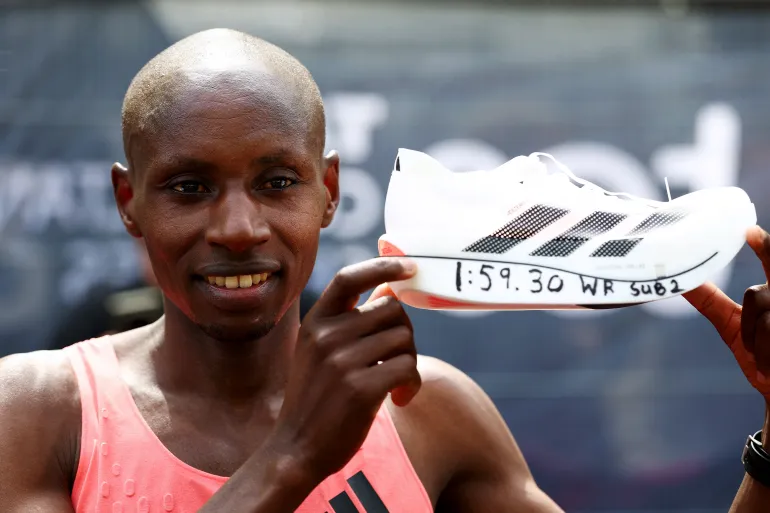
In a historic moment that has stunned the sporting world, Sabastian Sawe has become the first athlete to officially break the two-hour marathon barrier, clocking 1:59:30 at the 2026 London Marathon.
Long considered the “holy grail” of endurance sport, the sub-2 mark had remained elusive for decades, with earlier attempts either falling short or being ruled unofficial. Sawe’s run, achieved under standard race conditions, has now reset the limits of human endurance in distance running.
Science Defied: Predictions Missed the Timeline by Years
For years, sports scientists and predictive models suggested the barrier was still far away. A widely cited statistical model had projected the sub-2 marathon would likely be achieved around 2032, not in 2026.
The breakthrough has therefore outpaced scientific timelines by nearly a decade, raising questions about how accurately performance progression can be forecast. Experts now point to a combination of factors that accelerated the milestone, including advanced footwear technology, optimised pacing strategies, and data-driven training methods.
The run has drawn comparisons to historic breakthroughs like the four-minute mile, reinforcing the idea that once a barrier falls, it can quickly become repeatable.
HISTORY HAS BEEN MADE 🫨
— World Athletics (@WorldAthletics) April 26, 2026
Sabastian Sawe becomes the first person ever to break the 2-hour barrier in official race conditions, storming to a historic 1:59:30‼️@KejelchaYomif, on his marathon debut, also breaks 2 hours with a stunning 1:59:41 and @jacobkiplimo2 clocks 2:00:28,… pic.twitter.com/YN1NsdKCDo
What Enabled the Breakthrough: Tech, Training and Physiology Converge
Sports scientists now believe the sub-2 breakthrough was not a single leap, but the result of incremental gains converging at the right moment.
Recent analysis highlights the role of “super shoes” with carbon plates and energy-returning foam, which improve running efficiency and reduce fatigue over long distances. Equally critical were nutrition strategies, pacing discipline, and physiological optimisation, with Sawe maintaining a pace equivalent to elite sprint repetition over 42.2 km.
The result has forced a rethink within sports science. What was once labelled “nearly impossible” is now reality—and possibly just the beginning. With multiple runners already closing in on the mark, experts believe the next frontier may shift toward 1:58 territory, redefining endurance limits once again.
Written by

Anushka Raghav is an Editor at Sportscape Magazine, where she covers the intersection of sports business, governance, policy, technology, and infrastructure. Having written over 200 news stories and editorial features, she focuses on the ideas, institutions,…