
The architecture of convertible sports spaces
Explore the rise of convertible stadiums, from retractable roofs to AI-driven sustainability, and how India can redefine sports infrastructure for 2036

What if a stadium could transform itself as fast as the game?
In today’s high-stakes sports economy, where every square metre must justify its existence, a quiet revolution is unfolding, one that is reshaping the very DNA of arenas. Convertible sports spaces are no longer futuristic indulgences; they are strategic power plays. These dynamic venues blur the line between permanence and possibility, morphing effortlessly from open-air cauldrons of crowd energy to climate-controlled theatres of spectacle.
At their core lies a simple but urgent response: weather is unpredictable, fan expectations are evolving, and revenue can no longer be tied to a single sport or season. What emerges instead is a new architectural language, one that trades rigidity for responsiveness. Roofs glide, surfaces adapt, and entire environments recalibrate in real time, turning stadiums into living, breathing assets rather than static infrastructure.
For sports architects, this is more than innovation; it’s an invitation. A chance to reimagine arenas not as fixed monuments, but as fluid canvases where engineering meets imagination, and where every shift in structure unlocks a new layer of experience, resilience, and commercial potential.
Convertible sports arenas rewriting the economics of sports
Convertible stadiums are no longer experimental outliers, they’ve become global benchmarks of modern sports infrastructure. Their rise can be traced back to late 20th-century innovation hubs like the United States and Japan, where engineering first began to challenge the static nature of traditional arenas. The Tokyo Dome, unveiled in 1988, stands as an early milestone with its air-supported convertible design, proof that adaptability could be engineered at scale. Since then, the model has multiplied rapidly, with more than 20 major retractable-roof venues operating worldwide by 2025.
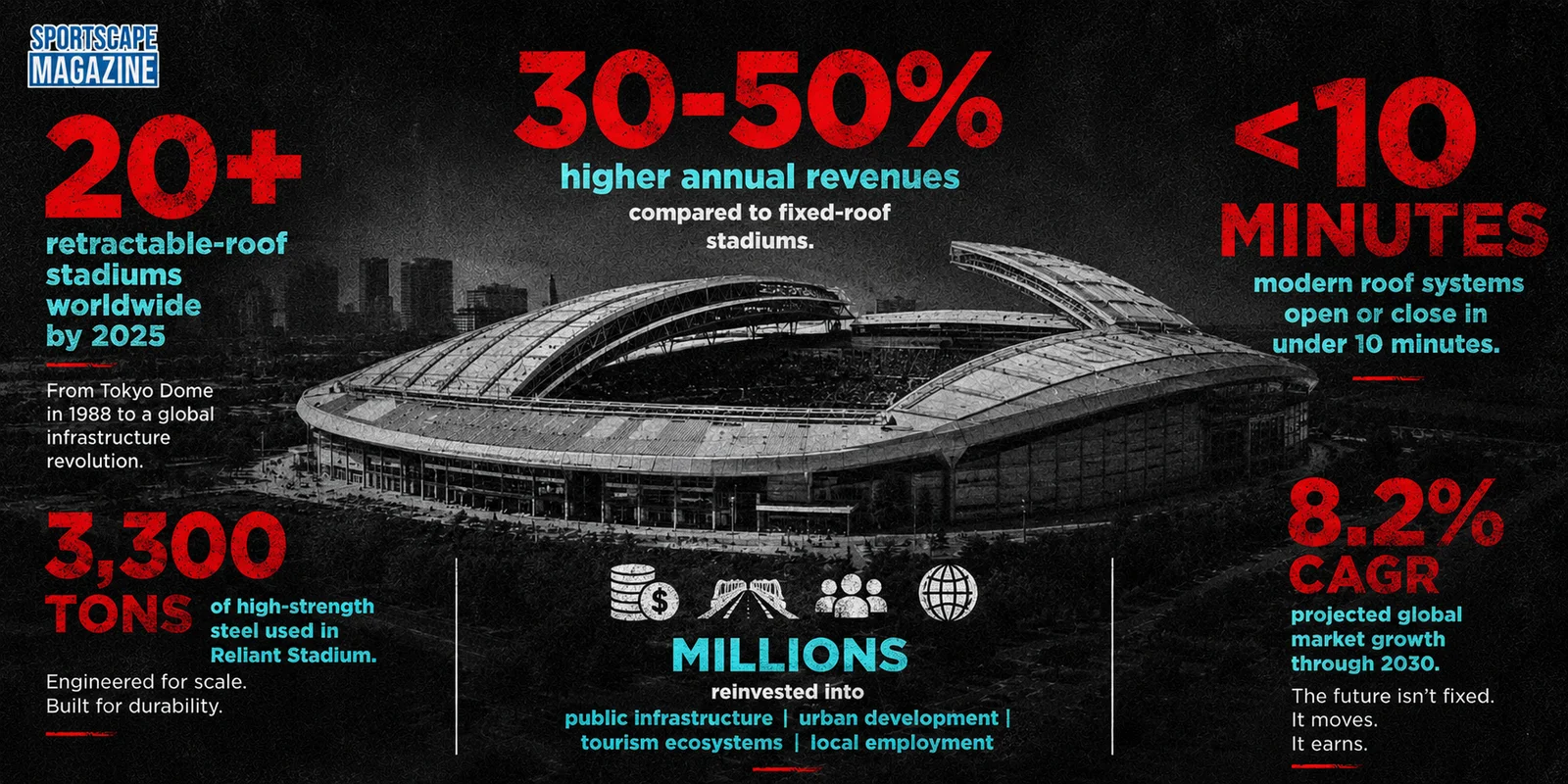
What fuels this evolution is not just ambition, but precision engineering. The largest retractable stadiums demand highly specialized materials to balance scale with efficiency. Take Reliant Stadium, where nearly 3,300 tons of A913 Grade 65 steel were deployed, a choice that trims structural weight by up to 7%, cutting construction costs while enhancing durability. It’s a quiet but powerful shift: lighter builds, longer lifespans, smarter economics.
And the payoff is unmistakable. These venues are no longer tied to a single sport or season; they are year-round revenue engines. By hosting everything from cricket matches to global concerts, convertible stadiums generate 30–50% higher annual revenues than fixed-roof counterparts. The ripple effect is significant: increased tax inflows for governments, sustained returns for investors, and far less idle time between events.
The numbers reinforce the narrative. Stadiums like Sydney Olympic Park have seen booking rates double post-conversion, channeling millions back into public infrastructure. With modular systems capable of retracting in under 10 minutes, these venues dramatically outperform traditional designs in efficiency and ROI. It’s no surprise, then, that the global convertible stadium market is projected to grow at a steady 8.2% CAGR through 2030, signaling not just a trend, but a structural shift in how the world builds for sport and spectacle.
Comparing India’s aspiration to the world
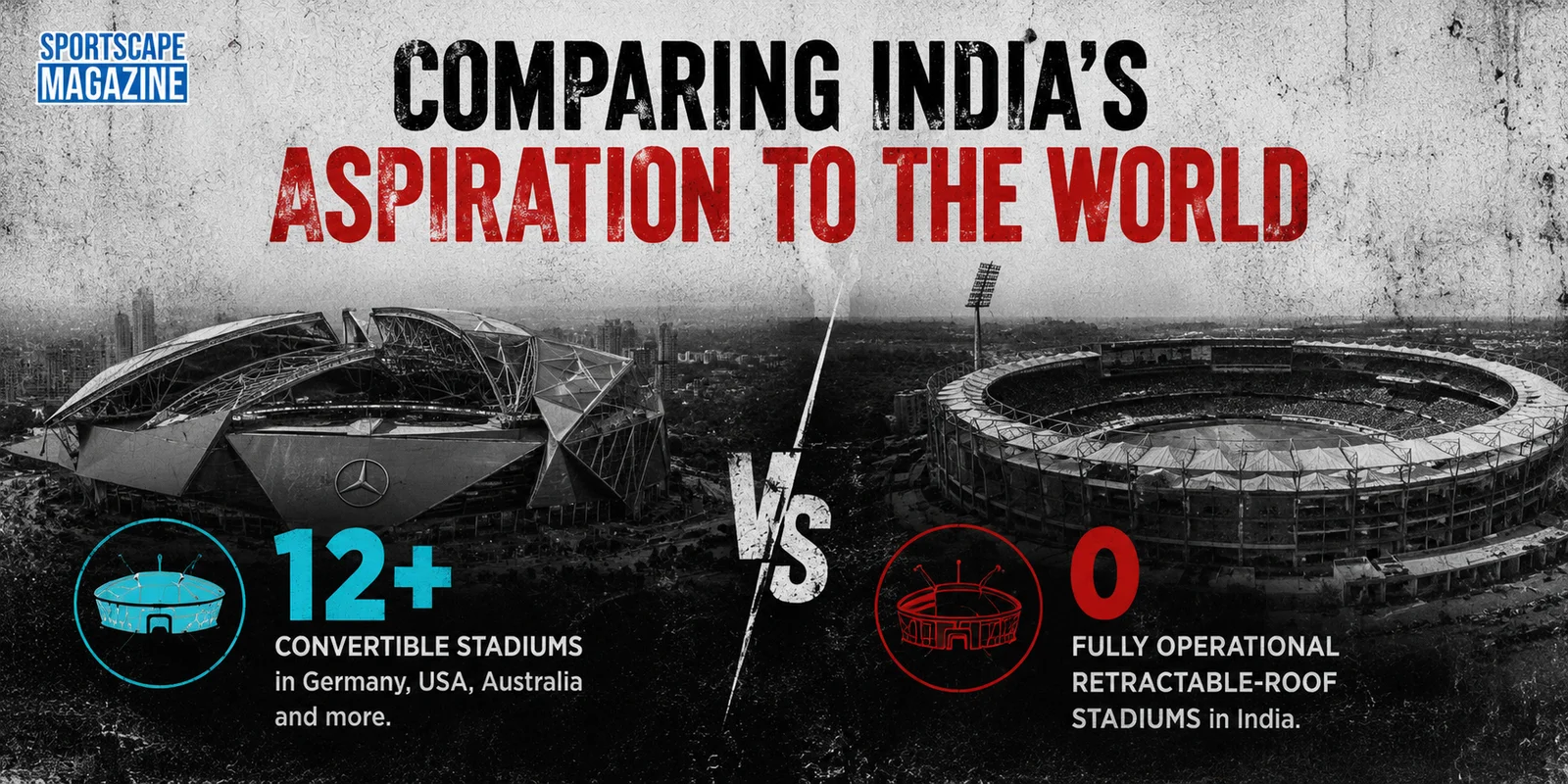
While countries like Germany, the US, and Australia have surged ahead with a dozen-plus convertible giants, India remains on the sidelines with zero fully operational retractable-roof stadiums. Icons like Munich’s Allianz Arena showcase cutting-edge ETFE panels that allow near-total light transmission, while India continues to rely on open-air colossuses such as the Narendra Modi Stadium, magnificent in scale, yet vulnerable to monsoon disruptions.
The contrast deepens in design intelligence. Global leaders are redefining spectator experience through advanced seating kinematics. Atlanta’s Mercedes-Benz Stadium features hydraulically adjustable tiers, delivering 360-degree sightlines across its 70,000-seat capacity, all reconfigurable within hours. In comparison, India’s static bleachers remain exposed to both weather and operational limitations.
Technology further widens the gap. International venues deploy LED lighting systems synced with 5G for immersive, real-time atmospheres, while high-grade materials like A913 steel ensure structural resilience, even in seismic zones. India, however, holds a clear pathway forward, retrofitting existing stadiums with modular ETFE roofing, much like New Zealand’s Forsyth Barr Stadium, where trials confirmed ETFE’s superiority for turf health over two years
Bridging this divide demands more than replication; it calls for adaptation. Integrating geofencing technologies, already used in US arenas for real-time crowd heat mapping and flow optimization, could transform safety and fan experience in India’s often flood-prone venues. Simultaneously, sourcing indigenous tensile materials similar to PTFE, seen in Argentina’s Estadio Ciudad de La Plata with its expansive 312,545-square-foot roof, can reduce import reliance while elevating performance.
The opportunity is clear: by blending global innovation with local ingenuity, India can leapfrog into a new era of stadium design, one where adaptability, resilience, and immersive experience are no longer optional, but foundational.
The sustainability technique the world is adopting
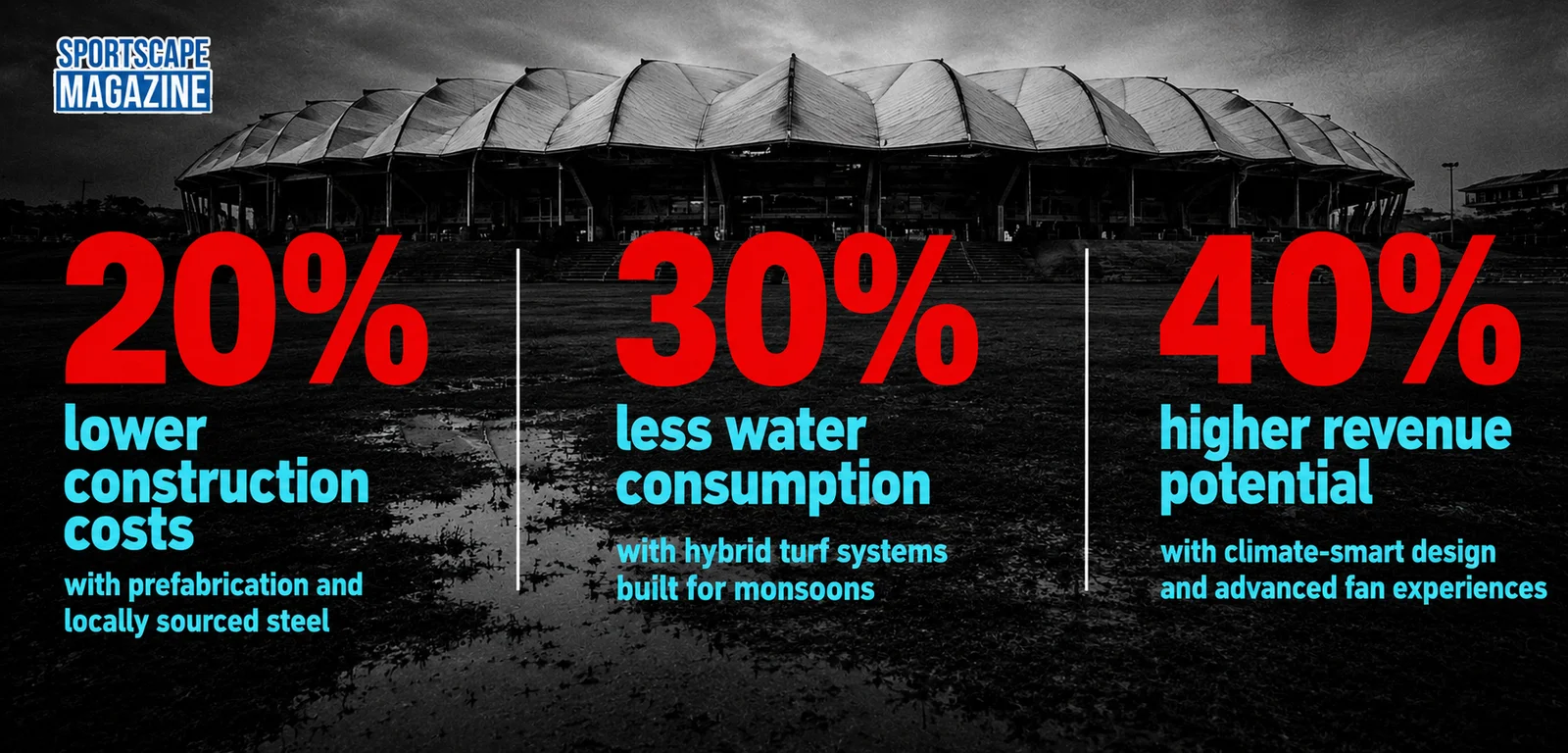
Across the globe, convertible stadiums are no longer just feats of engineering- they are blueprints of sustainable ambition. Net-zero design philosophies now sit at their core, aligning environmental responsibility with financial upside, as energy efficiencies drive savings of up to 40%. Retractable roofs embedded with solar panels, an emerging 2025 trend, transform open configurations into power-generating assets, while hybrid turf systems, consuming 30% less water than conventional grass, maintain pitch quality beneath translucent ETFE skins.
Water intelligence further sharpens this edge. At SoFi Stadium, nearly 85% of water usage is recycled through advanced greywater harvesting systems, cutting utility costs and directly strengthening operational margins. It’s sustainability not as a checkbox, but as a revenue lever.
Thermal performance is equally critical, especially for heat-intensive regions like India. Advanced insulation systems and adaptive facades are now engineered to significantly reduce air-conditioning loads and overall energy consumption, complemented by low-carbon concrete that slashes emissions by up to 50%. Material strategy plays a decisive role here, prioritizing recycled steel, as seen in projects like NRG Stadium (formerly Reliant Stadium), not only reduces embodied carbon but also lowers lifecycle costs, unlocking long-term profitability.
What ties it all together is intelligence. AI-driven ventilation systems, optimized in real time, have been shown to elevate global venue valuations by as much as 25%, proving that smart sustainability is also smart business. For India, the pathway is both clear and compelling: integrating locally sourced bamboo composites for shading and exploring tensegrity-based designs could unlock resilient, climate-responsive stadiums that are as economically viable as they are environmentally sound.
India’s Moment to Build Stadiums that Breathe, Adapt, and Outperform for Olympic Bid 2036
Indian sports architects, the runway to the 2036 Olympic ambition is not just about scale, it’s about reinvention. Imagine a stadium that doesn’t just stand, but unfolds, like a lotus at dawn, its ETFE petals parting to welcome sunlight and spectacle in equal measure. This is no longer poetic abstraction; it’s a practical blueprint. By embracing economical retrofits, solar-integrated retractable roofs built with locally sourced A913-grade steel equivalents, construction costs can be reduced by up to 20% through prefabrication. Pair that with hybrid turf systems that cut water usage by 30%, and India can engineer pitches that thrive through monsoons, not succumb to them.
But the real opportunity lies deeper. Rainwater-integrated ventilation, heat-resilient facades crafted from recycled composites, and AI-driven acoustics can transform stadiums into climate-smart, revenue-generating ecosystems, mirroring global models that deliver up to 40% higher returns. Add AR-enhanced seating into the mix, and the fan experience evolves from passive viewing to immersive participation.
As India positions itself for the 2036 Olympics, this is the moment to leapfrog, not follow. To harness tensegrity structures, net-zero systems, and intelligent design, not as borrowed ideas, but as indigenized innovations.
The canvas is vast, the timing precise. What emerges next can redefine not just how India builds stadiums, but how it stages its arrival on the world’s sporting future, profitable, sustainable, and impossible to ignore.
Written by

Anushka Raghav is an Editor at Sportscape Magazine, where she covers the intersection of sports business, governance, policy, technology, and infrastructure. Having written over 200 news stories and editorial features, she focuses on the ideas, institutions,…