
Badminton Court Dimensions Guide (2026) – Size, Lines, Net Height Explained
Learn Official Badminton Court Dimensions, Including Size, Layout, Lines, And Net Height. Complete Guide For Singles & Doubles With Easy Explanations.
What Makes a Standard Badminton Court?
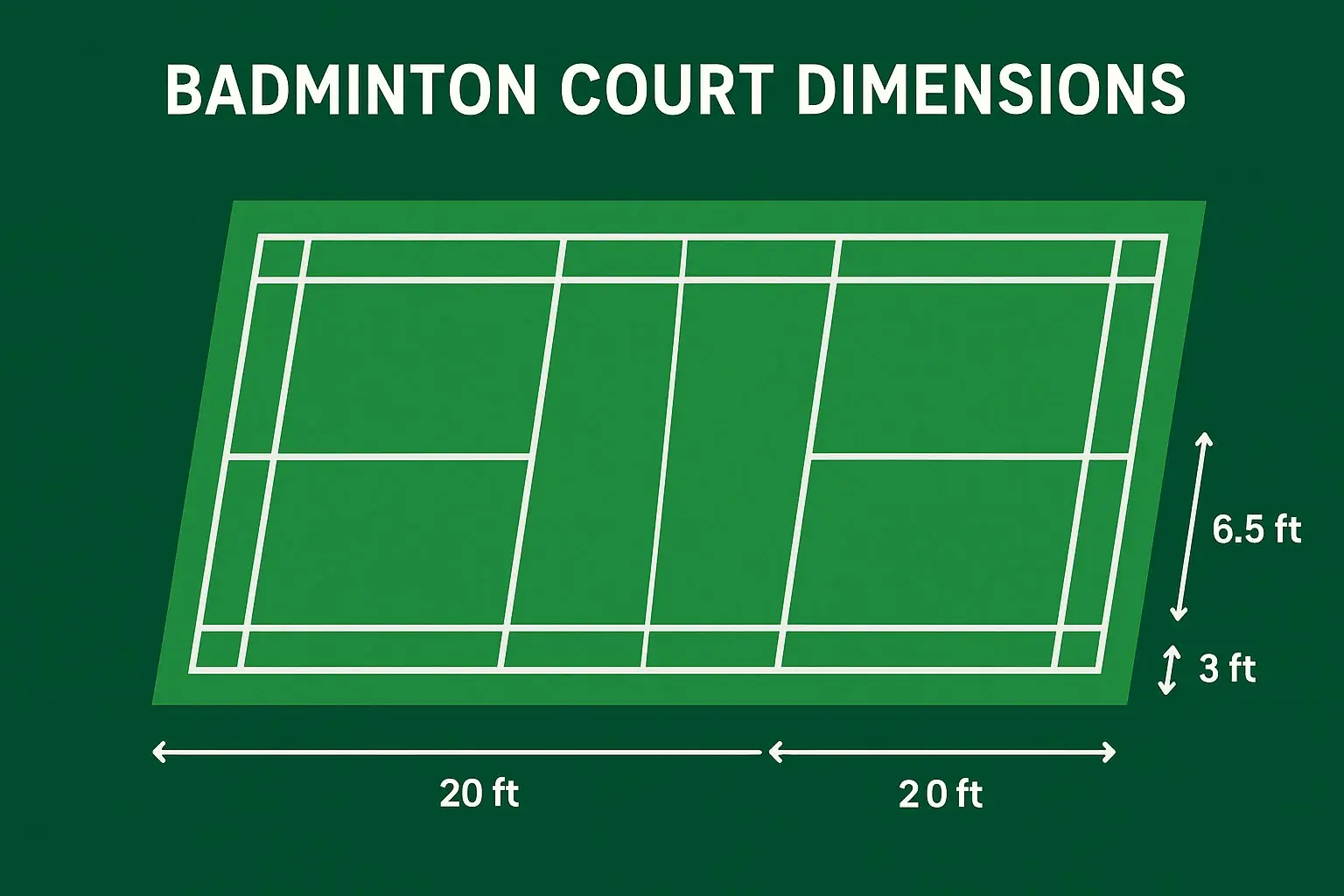
When you step onto a badminton court, it might look like a simple rectangle with a net in the middle—but there’s actually a lot more precision involved than most people realize. Badminton Court Dimensions play a crucial role in defining this space, as a standard badminton court is carefully designed according to rules set by the Badminton World Federation (BWF), ensuring fair play whether you're competing professionally or just enjoying a weekend game with friends. Every line, every inch, and every marking serves a purpose, almost like a blueprint for controlled chaos where speed, agility, and strategy collide. Think of the badminton court as a chessboard where every move depends on spatial awareness. The dimensions dictate how players position themselves, how they serve, and even how rallies unfold. Without standardized measurements, the game would lose its consistency, making it harder for players to adapt across different courts. That’s why professional tournaments across the globe—from local leagues to the Olympics—adhere strictly to these measurements. A proper badminton court is rectangular and divided into two equal halves by a net. It includes several boundary lines, service areas, and zones that determine whether a shot is in or out. While it might seem overwhelming at first glance, once you break it down, each section becomes intuitive. The beauty of badminton lies in this structure—it creates a fast-paced yet controlled environment where every inch matters. Whether you're a beginner setting up your first court or an experienced player refining your understanding, knowing what defines a standard badminton court gives you a clear advantage. It’s not just about playing the game; it’s about understanding the stage on which the game unfolds.
Importance of Proper Court Dimensions
You might wonder—does a few inches really make a difference in badminton? The answer is a resounding yes. In a sport where reaction time is measured in milliseconds and shuttle speeds can exceed 300 km/h, even the smallest deviation in court dimensions can significantly impact gameplay. Proper court measurements ensure fairness, consistency, and a level playing field for everyone involved. Imagine playing on a slightly shorter court. Smashes would become harder to return because players have less space to react. On the flip side, a wider court could make defensive play easier, altering the natural balance between offense and defense. This is why adhering to official dimensions isn’t just a formality—it’s essential for maintaining the integrity of the game. From a training perspective, practicing on a correctly measured court helps players develop accurate muscle memory. Your footwork, positioning, and shot placement all depend on spatial awareness. If you train on a misaligned court, those habits might not translate well when you step onto a professional or tournament court. It’s like practicing basketball on a hoop that’s slightly lower—you’ll feel confident until you face the real thing. There’s also a psychological aspect to consider. Players rely on visual cues from court lines to make split-second decisions. A clearly marked and properly measured court enhances confidence and reduces hesitation during rallies. It allows players to focus on strategy rather than second-guessing whether a shot is in or out. In essence, proper badminton court dimensions are the backbone of the sport. They ensure that skill—not luck or environmental inconsistencies—determines the outcome of a match. And whether you're playing casually or competitively, that consistency makes all the difference.
Official Badminton Court Measurements
Total Length and Width Explained
If you’re serious about badminton—even at a recreational level—understanding the exact court dimensions is non-negotiable. The official size of a badminton court, as defined by the Badminton World Federation (BWF), is 13.4 meters (44 feet) in length and 6.1 meters (20 feet) in width for doubles play. These measurements create a perfectly proportioned rectangular space that balances speed, agility, and tactical depth. It may look like just a rectangle on paper, but in reality, it’s a finely tuned playing field where every inch influences how rallies unfold. Now, here’s where it gets interesting. While the full width is used for doubles matches, singles matches utilize a narrower width of 5.18 meters (17 feet). This slight reduction drastically changes the dynamics of the game. In singles, players rely more on precision and endurance, covering long vertical distances. In doubles, the wider court encourages faster exchanges and lateral movement, making it a game of reflexes and teamwork. The length of the court remains constant regardless of the format, which means players must always be prepared to cover the full depth of 13.4 meters. This consistency allows players to transition between singles and doubles without relearning spatial awareness from scratch. It’s like switching between driving a sedan and an SUV—you adjust your approach, but the road rules stay the same. Another crucial aspect is the division of the court into two equal halves by the net. Each half measures 6.7 meters (22 feet) in length. This symmetry ensures fairness and balance, allowing both sides equal opportunity to attack and defend. The geometry of the court isn’t random—it’s carefully designed to create a rhythm where offense and defense constantly shift. Ultimately, these measurements aren’t just numbers—they’re the framework that shapes every serve, smash, and rally. Once you internalize them, you start to see the court not just as a space, but as a strategic map guiding your every move.
Singles vs Doubles Court Dimensions
At first glance, the difference between singles and doubles badminton courts might seem minor—but don’t be fooled. These variations fundamentally change how the game is played, turning what looks like a small adjustment into a major strategic shift. The most noticeable difference lies in the width of the court, but there’s more going on beneath the surface.
In singles, the court is narrower, using only the inner sidelines. This reduces the width to 5.18 meters, forcing players to rely heavily on precision and stamina. Because the court is tighter, players must be extremely accurate with their shots. There’s less room for error, and every rally becomes a test of endurance and tactical placement. You’re essentially playing a game of controlled precision, where every step and swing must be calculated.
Doubles, on the other hand, expands the playing area to the full 6.1-meter width, including the outer sidelines. This additional space transforms the game into a fast-paced, high-energy battle. With two players on each side, covering the court becomes a shared responsibility, allowing for more aggressive plays like smashes and quick net interceptions. Communication and teamwork become just as important as individual skill.
Another key difference lies in the service areas. In doubles, the long service line is shorter than in singles, which changes how serves are executed. This adjustment prevents serves from becoming overly dominant in doubles play, keeping rallies competitive and engaging. It’s a subtle rule, but it has a big impact on gameplay dynamics. Think of singles as a marathon and doubles as a sprint relay. Both use the same court foundation, but the way players interact with that space is entirely different. Understanding these differences not only improves your gameplay but also helps you adapt your strategy depending on the format you’re playing.
Detailed Breakdown of Court Lines
Baseline and Sidelines
The lines on a badminton court aren’t just there for decoration—they’re the silent referees of every match, determining whether a shuttlecock lands in or out. Among these, the baseline and sidelines are arguably the most crucial, as they define the outer boundaries of the playing area. Understanding their placement and purpose can significantly improve your spatial awareness during a game.
The baseline runs along the back edge of the court, marking the furthest point a shuttle can land and still be considered in play. It spans the full width of the court and is used in both singles and doubles matches. This line becomes especially important during defensive play, as players often rely on it to judge deep clears and powerful smashes. A shot landing just millimeters beyond the baseline is out, which shows how precise the game can be.
The sidelines, on the other hand, vary depending on whether you’re playing singles or doubles. The inner sidelines are used for singles matches, while the outer sidelines come into play for doubles. This dual-line system allows a single court to accommodate both formats without requiring any physical adjustments. It’s an elegant solution that keeps the game versatile and efficient.
What makes these lines particularly interesting is how they influence player behavior. In singles, players tend to focus on vertical movement, staying within the narrower boundaries. In doubles, the wider sidelines encourage more lateral movement, creating opportunities for angled shots and quick interceptions. The lines themselves are typically 40 mm (1.57 inches) thick, and they must be clearly visible, usually painted in white or yellow for contrast against the court surface. This visibility is crucial, especially during fast-paced rallies where players need to make split-second decisions. In many ways, the baseline and sidelines act like invisible walls, shaping the flow of the game. Once you start paying attention to them, you’ll notice how often they come into play—and how they can be used strategically to outmaneuver your opponent.
Center Line and Service Lines
While the outer boundaries define the limits of the court, the center line and service lines bring structure to the game, especially during serves. These lines divide the court into specific zones, ensuring that play begins in an organized and fair manner. Without them, badminton would lose much of its tactical depth right from the first shot. The center line runs perpendicular to the net, splitting each side of the court into left and right service courts. This division is essential for serving rules, as players must serve diagonally into the opponent’s corresponding service box. It might sound simple, but this rule introduces a layer of strategy right from the start of each rally. Players must think not only about where to serve but also how to position themselves for the return. Then there are the short service lines, located approximately 1.98 meters (6.5 feet) from the net. These lines mark the minimum distance a serve must travel. If the shuttle lands before crossing this line, it’s considered a fault. This prevents players from using overly short serves to gain an unfair advantage. In doubles, there’s an additional line called the long service line, which sits slightly in front of the baseline. This line limits how far a serve can go, ensuring that serves remain controlled and don’t turn into easy point-scoring opportunities. In singles, however, the baseline itself acts as the long service boundary. These lines collectively create a structured starting point for every rally. They ensure that both players or teams begin on equal footing, with no shortcuts or loopholes. More importantly, they add a strategic layer to serving—one of the most underrated aspects of badminton. Think of these lines as the opening moves in a chess game. They set the stage for everything that follows, influencing how players approach each rally. Mastering them doesn’t just improve your serves—it enhances your overall understanding of the game.
Net and Post Specifications
Standard Net Height and Width
The net in badminton isn’t just a divider—it’s the heartbeat of the game. Every rally revolves around it, every shot is judged by how it clears it, and every player instinctively measures their moves against its height. According to official BWF standards, the net stands at a height of 1.55 meters (5 feet 1 inch) at the edges and slightly dips to 1.524 meters (5 feet) at the center. That subtle dip might seem insignificant, but it adds a fascinating layer of realism to gameplay, rewarding precision and control.
The width of the net spans the entire court, measuring 6.1 meters (20 feet), ensuring it perfectly aligns with the doubles court width. Its depth, or vertical height, is typically around 760 mm (2.5 feet). Made from fine cord mesh, usually in a dark color like black or deep green, the net is designed to be both durable and highly visible. The top is edged with a white tape, about 75 mm wide, which helps players clearly judge whether their shots are clearing the net during intense rallies. What makes the badminton net unique is how it influences playing styles. Unlike sports with higher nets like volleyball, badminton’s relatively lower net height encourages a mix of delicate net shots and powerful smashes. You’ll often see players engaging in tight net duels, trying to outmaneuver each other with finesse rather than brute force. It’s a delicate balance—hit too softly, and the shuttle might not cross; hit too hard, and you risk sending it out of bounds. There’s also a psychological element at play. Players constantly gauge their shot angles in relation to the net. A well-executed drop shot that barely clears the tape can be just as effective as a thunderous smash. This constant interplay makes the net more than just a physical barrier—it becomes a strategic tool. Understanding the net’s dimensions helps players refine their techniques, especially when practicing serves, net kills, and defensive lifts. Once you internalize its height and positioning, your shots become more calculated, more confident, and ultimately more effective.
Positioning of Net Posts
While the net often steals the spotlight, the net posts quietly ensure that everything stays in place. These vertical supports might seem like minor components, but their positioning is critical for maintaining the integrity of the court. According to official regulations, net posts must be placed exactly on the doubles sidelines, even when a singles match is being played. This ensures consistency across all formats of the game. Each post stands at a height of 1.55 meters, matching the height of the net at the edges. They must be sturdy enough to keep the net taut without leaning or shifting during play. Imagine playing a fast-paced rally only to have the net sag or wobble—it would completely disrupt the flow of the game. That’s why professional courts use high-quality materials like steel or reinforced aluminum for their posts. Interestingly, the posts are not placed outside the court boundaries but directly on them. This means they’re technically part of the playing area. If a shuttle hits a post and lands in the opponent’s court, it’s still considered a valid shot. This rule adds an unpredictable twist to the game, where even the equipment can influence the outcome of a rally. The positioning of the posts also ensures that the net remains perfectly aligned with the court markings. Any misalignment could lead to unfair advantages or confusion during play. For example, a slightly tilted net could affect how players judge the trajectory of their shots. For those setting up a court at home or in a local facility, getting the post placement right is just as important as marking the lines. It’s not just about aesthetics—it’s about preserving the fairness and functionality of the game. In essence, net posts are the unsung heroes of badminton. They provide the stability needed for consistent gameplay, allowing players to focus entirely on their performance without worrying about external disruptions.
Service Court Dimensions
Right and Left Service Courts
If you’ve ever been confused about where to stand while serving in badminton, you’re not alone. The right and left service courts are essential components of the game, and understanding them can instantly elevate your performance. These service courts are created by the center line, sidelines, and service lines, dividing each half of the court into two distinct zones. Here’s how it works: when your score is even, you serve from the right service court. When your score is odd, you switch to the left service court. This alternating pattern ensures fairness and keeps players moving dynamically throughout the match. It might sound like a simple rule, but it has a profound impact on gameplay strategy. Each service court is a rectangle that players must use not only for serving but also for receiving serves. The diagonal nature of serves—where you must hit the shuttle into the opponent’s corresponding service court—adds a layer of complexity. You’re not just hitting the shuttle over the net; you’re aiming for a specific zone while anticipating your opponent’s return. In doubles, things get even more interesting. Both players must coordinate their positions based on the score and serving order. Miscommunication can lead to easy points for the विपक्ष, which is why experienced doubles teams often develop non-verbal cues and strategies to stay in sync. Think of service courts as the launchpads of every rally. They dictate where the action begins and influence how it unfolds. A well-placed serve into the correct service court can put your opponent on the defensive right from the start. By mastering the right and left service courts, you not only avoid faults but also gain a strategic edge. You start to see patterns, anticipate movements, and control the pace of the game from the very first shot.
Short Service Line and Long Service Line
The short service line and long service line are like invisible gatekeepers in badminton. They define the boundaries within which a serve must land, ensuring that every rally starts fairly. These lines might not get as much attention as the baseline or sidelines, but they play a crucial role in shaping the game. The short service line is positioned 1.98 meters (6.5 feet) from the net. When serving, the shuttle must travel beyond this line; otherwise, it’s considered a fault. This prevents players from executing overly soft serves that barely cross the net, which would make the game less competitive. It forces players to strike a balance between control and power. On the other end, the long service line varies depending on the format. In singles, the baseline acts as the long service boundary, allowing players to use the full length of the court. In doubles, however, the long service line is drawn 0.76 meters (2.5 feet) inside the baseline. This shorter boundary prevents serves from being excessively deep, keeping rallies more engaging and dynamic. These lines introduce an interesting challenge. Players must develop a feel for distance and timing, ensuring their serves land within this محدد zone. It’s not just about hitting the shuttle—it’s about placing it with precision. Over time, experienced players learn to use these lines strategically. A serve that lands just beyond the short service line can catch an opponent off guard, while a deep serve near the long service line can push them to the back of the court. These subtle variations can make a big difference in high-level play. Understanding and mastering the short and long service lines is essential for anyone looking to improve their game. They might seem like small details, but in badminton, small details often lead to big wins.
Markings and Line Thickness
Standard Line Width Rules
When you look at a badminton court from a distance, the lines may appear thin and straightforward, almost like an afterthought compared to the action happening within them. But in reality, court markings and line thickness are governed by precise rules that ensure fairness and clarity during play. According to the Badminton World Federation (BWF), all court lines must be 40 mm (1.57 inches) wide, and this measurement isn’t arbitrary—it plays a crucial role in how the game is judged and played. Here’s an important detail many beginners overlook: in badminton, the lines are considered part of the area they define. That means if the shuttlecock lands on the line—even by a fraction—it is considered “in.” This rule alone makes line thickness incredibly significant. A thicker or thinner line could alter the outcome of close calls, especially in high-stakes matches where every point counts. The color of the lines is also standardized for visibility. Typically, lines are painted in white or yellow, depending on the color of the court surface. The goal is to create a sharp contrast so players, referees, and even spectators can easily distinguish boundaries during fast-paced rallies. Imagine trying to judge a 300 km/h smash landing near a faint or poorly marked line—it would be nearly impossible without clear markings. Another subtle but important aspect is the consistency of the markings. All lines on the court—whether they are baselines, sidelines, or service lines—must have the same thickness. This uniformity ensures that players don’t subconsciously favor certain areas of the court due to visual inconsistencies. For those setting up a court, especially in a backyard or community space, it might be tempting to eyeball the lines or use whatever materials are available. But even slight inaccuracies can affect gameplay. Using proper measuring tools and marking materials can make a huge difference, transforming a casual setup into something that feels authentic and enjoyable. In essence, these lines are more than just boundaries—they’re the silent judges of the game. They ensure that every rally is fair, every point is earned, and every decision is clear.
Court Surface and Materials
Indoor vs Outdoor Court Surfaces
The surface you play on can completely change your badminton experience. While the dimensions and markings define the structure of the game, the court surface determines how it feels under your feet and how the shuttle behaves in motion. Broadly speaking, badminton courts are categorized into indoor and outdoor surfaces, and each comes with its own set of characteristics, advantages, and challenges. Professional badminton is almost exclusively played indoors, and for good reason. Indoor courts typically use wooden flooring or synthetic mats, which provide excellent grip, shock absorption, and consistent bounce. These surfaces are designed to reduce the risk of injuries, especially during quick directional changes and jumps. Think about it—badminton involves constant lunging, pivoting, and sprinting. A good surface acts like a cushion, protecting your joints while enhancing your performance. Outdoor courts, on the other hand, are more common in casual settings. They can be made of concrete, asphalt, or even grass, depending on availability. While these surfaces are convenient and cost-effective, they come with certain drawbacks. For one, they offer less grip and shock absorption, increasing the risk of slips and injuries. Additionally, environmental factors like wind can significantly affect gameplay, making it harder to control the shuttle. Another key difference lies in consistency. Indoor courts provide a controlled environment where lighting, temperature, and airflow are regulated. This allows players to focus entirely on their game without external distractions. Outdoor courts, however, introduce variables that can make the game unpredictable. A sudden gust of wind can turn a perfect shot into a missed opportunity. That said, outdoor badminton has its own charm. It’s more accessible, more social, and often more relaxed. It’s the kind of game you play at a picnic or a family gathering, where the focus is on fun rather than competition. Choosing the right surface depends on your goals. If you’re aiming for serious practice or competitive play, an indoor court is the way to go. But if you’re just looking to enjoy the game with friends, an outdoor setup works perfectly fine.
Lighting and Space Requirements
Minimum Ceiling Height and Lighting Standards
Badminton is a sport of precision, speed, and vertical play. Unlike many other sports, where the action stays mostly at ground level, badminton involves high clears and lifts that send the shuttle soaring toward the ceiling. That’s why lighting and space requirements, particularly ceiling height, are critical for a proper playing experience. According to international standards, the minimum ceiling height for a badminton court should be around 9 meters (30 feet) for recreational play, while professional venues often have ceilings exceeding 12 meters (39 feet). This vertical space ensures that players can execute high shots without obstruction. Imagine hitting a perfect clear, only to have it bounce off the ceiling—it would completely disrupt the flow of the game. Lighting is another crucial factor. A well-lit court ensures that players can track the shuttle accurately, even during fast rallies. The lighting should be evenly distributed across the court, with no shadows or glare. Typically, indoor courts use LED or fluorescent lighting systems positioned high above the playing area to minimize interference. Poor lighting can have a surprisingly big impact. It can strain your eyes, reduce reaction time, and even lead to गलत judgments during play. In competitive matches, lighting is carefully calibrated to meet specific lux levels, ensuring optimal visibility for players and officials alike. Space around the court is equally important. There should be enough clearance on all sides—usually at least 1.5 to 2 meters—to allow players to move freely without risking injury. This extra space is especially important during intense rallies where players might chase shots beyond the boundary lines. For those setting up a home or community court, these factors are often overlooked. But even small adjustments—like improving lighting or ensuring adequate overhead space—can significantly enhance the playing experience.
Common Mistakes in Court Setup
Errors That Affect Gameplay
Setting up a badminton court might seem straightforward—measure the space, draw some lines, put up a net, and you’re good to go, right? Not quite. There are several common mistakes that can creep into the process, and while they might seem minor, they can significantly affect gameplay and overall experience. One of the most frequent errors is incorrect measurements. Even a small deviation in court length or width can alter how the game is played. For example, a slightly shorter court can make smashes more dominant, while a wider court can favor defensive play. These imbalances can make the game feel off, especially for experienced players who rely on precise spatial awareness. Another common issue is improper line markings. Lines that are too thick, too thin, or unevenly drawn can create confusion during play. Since lines are considered part of the playing area, any inconsistency can lead to disputes over whether a shot is in or out. This is particularly problematic in competitive settings where accuracy is crucial. Net-related mistakes are also საკმაოდ common. A net that is too high or too low can completely बदल the dynamics of the game. Similarly, loosely tied nets or unstable posts can disrupt rallies and even pose safety risks. Lighting and surface issues also fall into this category. Poor lighting can make it difficult to track the shuttle, while uneven or slippery surfaces can increase the risk of injuries. These factors might not seem directly related to court dimensions, but they play a significant role in how the game is experienced. Avoiding these mistakes requires attention to detail and a commitment to getting things right. Whether you’re setting up a professional court or a casual one in your backyard, taking the time to measure accurately, mark clearly, and ensure proper setup can make all the difference.
Tips for Setting Up Your Own Badminton Court
DIY Court Setup at Home
Creating your own badminton court at home might sound like a big project, but it’s more achievable than you think. With a bit of planning and the right approach, you can build a कोर्ट that feels surprisingly close to a professional setup. The key lies in understanding the essentials and adapting them to your available space. Start by measuring your area carefully. Ideally, you’ll want a space that can accommodate the full 13.4 m by 6.1 m dimensions, along with some إضافي space around the edges. If space is limited, you can create a scaled-down version, but try to maintain the correct proportions to preserve the feel of the game. Next, focus on marking the lines. Use tape, chalk, or paint, depending on your surface. Make sure the lines are straight, evenly spaced, and 40 mm wide if possible. Precision here goes a long way in making your court feel authentic. For the net, you don’t necessarily need professional-grade equipment. A sturdy rope and a अच्छी quality net can work just fine, as long as you maintain the correct height of 1.55 m at the edges. Ensure the net is taut and securely fastened to avoid sagging. Surface choice is also important. If you’re indoors, consider using mats or लकड़ी flooring for better grip. Outdoors, try to choose a flat, even surface to minimize the risk of injury. Lighting and space should not be overlooked. Even a simple setup can benefit from good lighting and enough room to move freely. These elements can transform your court from a basic setup into a genuinely enjoyable playing environment. Setting up your own badminton court isn’t just about saving money—it’s about creating a space where you can practice, improve, and have fun whenever you want. It’s your personal arena, tailored to your needs and preferences.
Conclusion
Badminton court dimensions are far more than just numbers on paper—they’re the foundation of the entire game. From the precise measurements of the court to the positioning of lines, net, and posts, every detail plays a role in shaping how badminton is played and experienced. Whether you’re a beginner learning the ropes or an experienced player refining your skills, understanding these dimensions gives you a deeper appreciation of the sport. The beauty of badminton lies in its balance—between power and finesse, speed and control, simplicity and complexity. And that balance is made possible by the carefully designed court. Once you start seeing the court not just as a playing area but as a strategic map, your perspective on the game changes completely.
Written by