
A Deep Dive into the World’s Biggest Stadium and India’s Sports Architecture with Siddharth Soni, Populous
Inside the design philosophy of Populous, the global force behind landmark venues, as it reimagines India’s stadium ecosystem
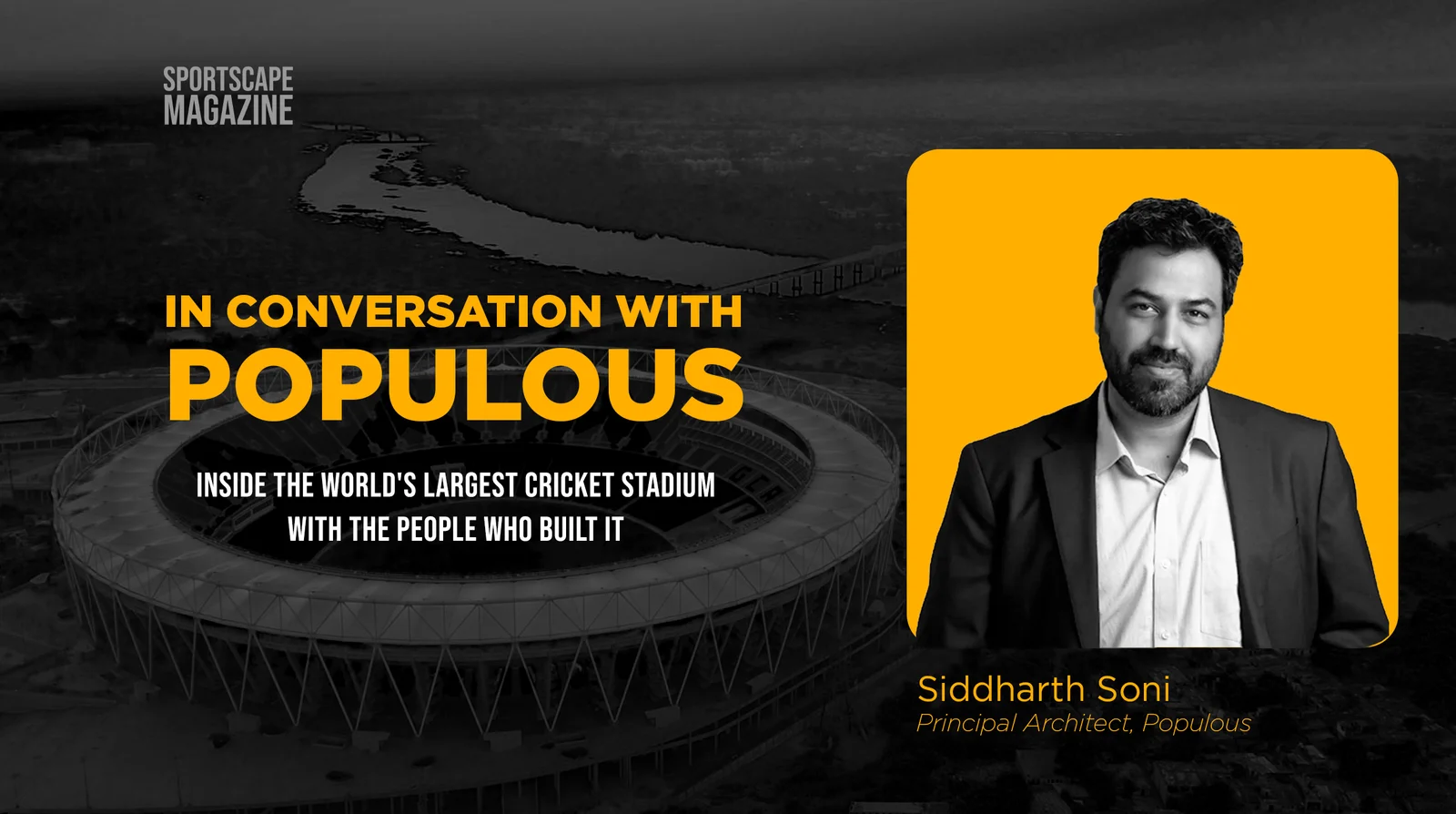
India’s sports venues are transforming at a rapid pace, expanding in scale, sharpening in design, and steadily aligning with international benchmarks of experience, safety, and performance.
At the centre of this shift are firms like Populous, whose work has come to define how modern stadiums are imagined and built across the world. Known for designing venues that go far beyond concrete bowls, Populous approaches stadiums as living systems, where crowd flow, acoustics, visibility, and emotion are all carefully orchestrated.
From globally celebrated arenas like the Tottenham Hotspur Stadium and Yankee Stadium to large-scale sporting destinations across continents, the firm has consistently shaped how sport is experienced at its highest level. In India too, its imprint is unmistakable, most notably in the Narendra Modi Stadium, a venue that redefined both scale and spectator movement, setting a new benchmark for capacity and crowd management.
At the heart of this global-local intersection is Siddharth Soni, Principal Architect at Populous India, whose work sits at the confluence of design, strategy, and cultural context. As an architect, Soni’s role extends beyond shaping physical structures, he is involved in rethinking how Indian venues function as ecosystems, from high-performance centres to community-driven sports spaces.
In an exclusive conversation with Sportscape Magazine, he speaks about the untapped potential within Indian stadium design and how populous is shaping it and gives a deeper insight on the designing of the iconic Narendra Modi Stadium in Ahmedabad. Let’s dive into the ideas shaping that journey.
Sportscape: Before we dive in, tell us a little about yourself and Populous, what the firm does, the scale at which it operates globally, and some landmark projects you’ve been involved with here in India, including the great Narendra Modi Stadium.
Siddharth Soni: “Sure, I’ve been heading the India operations for the last 7 years. We’ve not just been working on projects within India but also internationally. We are a marquee venue design firm and have delivered quite a few international landmarks which are world-famous in terms of hospitality, offerings, and fan experience, projects like the London Olympic Stadium and Tottenham Hotspur Stadium.
In India, there is a growing need, and Populous has been quite selective in the market. The projects we’ve taken on are of national importance, like the Bengaluru International Convention Center, the SVBP Sports Enclave, and of course the Narendra Modi Stadium.
We also have several other projects in the pipeline, some confidential, some set to be announced soon, and a team of about 25 people based in Delhi.
The way we work is by bringing in global experts, people who have worked on similar projects worldwide, so when we engage with clients, they’re getting that exact level of expertise. At the same time, we combine that with local understanding, because a project done in Australia or the UK needs to be adapted to the Indian context. That balance between global knowledge and local relevance is critical.”
Efficiency and construction philosophy of Narendra Modi Stadium
Sportscape: When we look at the Narendra Modi Stadium, the numbers are staggering, not just in scale, but in efficiency. Delivered in under ₹800 crore and within a tight timeline, yet matching global standards, it stands in stark contrast to many international venues. From a design standpoint, how did you achieve this level of efficiency while building one of the largest cricket stadiums in the world?
Siddharth Soni: “Yeah, I think that’s a good one because if you see, a lot of the international benchmarks, and even we were quite clear about how we go about designing the stadium. So what we did was the number of floor slabs were designed efficiently and smartly to make sure that the built-up area was minimized to the extent possible. The focus was on a compact bowl. It was a two-tier bowl as opposed to most of the other venues which go for multiple tiers.
What that did was that we could cut out a lot of extra built-up area. We could make it really compact, but without compromising on any of the match day functioning and offerings as well.
The intent was also to pay homage to the whole spirit of Ahmedabad with exposed concrete, the choice of material was very deliberate. And what we also looked at was the strength of Indian contractors from a point of view of what is really buildable and easily buildable.
If you go for a solution that’s worked outside and then try and implement that over here, it might just increase costs exponentially. So we worked backwards at what’s something that can really work very well, something that should be economical, something that’s doable, and also achieve a very stiff target in terms of the date of construction.”
Sportscape: You’ve also had a significant hand in shaping the Melbourne Cricket Ground, the second-largest cricket stadium in the world. Now, the Narendra Modi Stadium surpasses it by nearly 30% in capacity. When designing a venue at that scale, how conscious were you about making it feel distinct? What deliberate choices ensured it developed its own identity rather than echoing global templates?
Siddharth Soni: “Right, see, MCG is quite historic, as was the former Motera stadium. MCG is part of a large sports park, it sits within the Melbourne Olympic Park, which held the Olympics decades ago, so it has a very strong legacy as a historic venue.
But the redevelopment that happened at MCG was partial. It was only half of the stadium that was redeveloped. The Narendra Modi Stadium, on the other hand, was completely demolished and dismantled. While it was a brownfield project, we had the freedom to design without encumbrances. There was, of course, a temple on site which we had to respectfully design around, but otherwise it allowed us to work with a completely fresh canvas.
Sometimes it can get challenging when you’re asked to retain parts of an existing stadium and assimilate that into your design, we enjoy doing that, but when you’re building something entirely new, you have the freedom to create a different identity altogether.
Also, the contexts are completely different. MCG responds to a different climate, Australia is very different. Our fans are different, their requirements are different. The intent here was first to create a venue that is absolutely safe, and then respond to the context. The Narendra Modi Stadium is located in a much more crowded setting compared to Melbourne’s Olympic Park.
We also had to design as per Indian codes, which are quite stringent and can make the design of such venues challenging. So this is a completely fresh solution made for India. If I were to pick up a stadium from outside and transplant it here, it may not comply with the applicable rules.
So the stadium is entirely tailor-made, in compliance with Gujarat regulations and with a strong local flavour. Even in terms of design USPs, for example, we have an entire floor dedicated to toilets, because the requirement in India is significantly higher. That meant we had to plan very smartly, ensuring they are strategically located so they don’t obstruct movement or impact the experience, but are still close enough for people to access without missing out on the action.”
Hidden Design Secrets of Narendra Modi Stadium
Sportscape: Here’s something we’d love for the audience to know, beyond the obvious scale and infrastructure, is there one design feature tucked inside the Narendra Modi Stadium that most people walk past without realizing, something that’s quietly a complete game-changer? What’s that hidden gem?
Siddharth Soni: It’s more: it needs to work really well. So one of the other things that we designed was the podium. So on the podium, right now, the plan was that eventually, with all the phases coming in, the podium is supposed to have F&B kiosks, which I’m sure the Gujarat Cricket Association will build up incrementally, but also leaving spaces for temporary overlays.
So when you’re actually walking on that podium, the intent was, when you get up from your seat or you just come down, you can grab a bite. The intent was to not lose sight of the action.
So if you see, the upper bowl and the lower bowl are split, and while you’re having an F&B and you’re standing there, hanging out with your friends, you can still stay connected with the action. Because T20 is a very fast-paced game and T20 is the future.
If you get up from your seat to the point where you get F&B, you get a bite or something, you might lose an over, and a lot of fans don’t want to do that. So how do you make sure that you’re connected to the action when that’s happening.”
Sidharth Soni on Designing for Different Sporting Demands
Sportscape: Populous has worked on some of the most iconic venues across sports, from NFL stadiums to Wimbledon and top-tier football grounds. Each comes with a completely different set of architectural demands. From your experience, how different is designing a cricket stadium like the Narendra Modi Stadium compared to these global venues? What really shifts in your approach when the sport changes?
Siddharth Soni: “So it depends actually on who the client is. For us, the requirements take priority. If we’re designing for football, then we look at who the client is, what is the frequency of games that are going to be held, because those start impacting a lot of decisions, what is fixed, what is permanent, what comes in only during an event.
If we have to design for something like the English Premier League, like Tottenham, you know that Tottenham Hotspur is the anchor tenant. They’re going to be playing a certain number of games in a year, that’s their home stadium. And then NFL comes in and also takes part during mid-season breaks or when games are not happening.
In India, a cricket venue is designed as per the requirements of the Cricket Association, or the BCCI and ICC standards. And then we speak with them in terms of what are the other extra things they would like to have from a non-match day point of view.
So it really is an outcome of what the association wants and what the governing bodies want at the end of the day. For the Narendra Modi Stadium, the brief was how do you make sure that it is compliant with other sports types as well.
We were quite proud and felt validated when events like Coldplay happened; it was quite smooth to fit in that kind of crowd and have back-to-back events.
So the way we inherently start designing these venues is such that while cricket is going to be the primary focus, it should still be able to meet the requirements of other event modes to the extent possible. And usually, that brief is laid down right at the start when we sit down with the clients.”
Sportscape: The Narendra Modi Stadium doesn’t exist in isolation, it is part of the larger SVBP Sports Enclave. With Ahmedabad looking at hosting mega events like the Commonwealth Games and even the Olympics in the future, the stakes are enormous. Cricket aside, how does the current design of the stadium hold up for other sports, and how versatile can it really get?
Siddharth Soni: “100%, so while the Narendra Modi Stadium is part of the sports enclave, it is designed in a way that it integrates into the larger master plan. We at Populous also worked on the master plan for the entire enclave and continue to be involved in it.
The planning has been done in such a manner that the stadium gets assimilated into an integrated sports environment when multi-sport events like the Olympics, Commonwealth Games, or Asian Games are happening. But at the same time, it retains its own distinct boundary and character so that it can function independently once those events are over.
So what happens after these events is equally important. The Narendra Modi Stadium continues to function as the flagship venue, while the rest of the facilities also operate independently. For large-scale events, the planning ensures that movement across the site is seamless and that boundaries do not become barriers for spectators.
The stadium itself has been designed with a lot of flexibility. For events like the Commonwealth Games or Olympics, we can explore multiple ways to use the venue. Of course, cricket is the most popular sport and it will always remain a cricket-focused venue. But beyond that, it can absolutely host other formats.
Being the largest stadium, it naturally becomes the centerpiece for opening and closing ceremonies. There are also possibilities where we can insert temporary elements, for example, an athletics track, although that would not be permanent because it would impact cricketing functions.
So effectively, it will always remain a cricket stadium at its core, but with the ability to adapt for large-scale events, ceremonies, and other sporting formats when required.”
The Limits of Multi-Sport Stadiums
Sportscape: Staying on the Commonwealth Games and Olympic conversation, when you look at the SVBP Sports Enclave and the Narendra Modi Stadium specifically, what meaningful design upgrades or interventions do you envision to make them truly ready for a multi-sport spectacle at that scale?
Siddharth Soni: “I think, see, the fact that it’s a cricket stadium means that it will retain its character, and as a designer, I don’t think it lacks anything in that sense, we are quite proud of it. Of course, any venue will require upgrades by the time something like the Olympics comes along. It would already be a 10 to 15-year-old stadium by then, so there will be regular updates needed to address wear and tear and to meet evolving standards.
In terms of a multi-sport venue, I think that’s a conversation which, if not defined properly, can become a little vague. We need to be very clear about what we mean by multi-sport. A cricket field is always going to remain circular, and even if you embed something like a football field for a one-off event, it does not change the fundamental character of the bowl or the seating.
So it is essentially a cricket-first venue, and that order of priority is important. That said, there are opportunities. The undercroft areas can be used for training zones or warm-up spaces depending on the event requirements. The stadium already has indoor practice nets under the seating bowl, which work really well.
There are also possibilities to introduce temporary overlays or additional features when required for large events. But at the same time, we have to be careful not to alter the overall DNA of the stadium. It needs to be preserved as a flagship cricket venue first, unless a completely different brief is given.”
Designing Stadiums for Longevity
Sportscape: There’s a school of thought in architecture that says a stadium or arena doesn’t truly come into its own until it’s been lived in for 8 to 10 years. Do you agree with that? And more importantly, how do you design with that kind of longevity in mind? How do you future-proof something like the Narendra Modi Stadium so it stays relevant decades from now?
Siddharth Soni: “Sure, so the first part of it, you know, a stadium or arena for 8 to 10 years, I wouldn’t agree with that. Because there are examples that we know. When we design these large venues, they are part of a larger urban setting. The impact of these venues is not just limited to the site itself, it goes beyond that. It impacts the lives of people, everyday traffic, the overall policing design, and there are a lot of stakeholders involved.
So it’s not as simple as just having a piece of land and building on it. A lot of people will be visiting it day in and day out. What we have seen is that while some impacts like property values evolve over time, there are also immediate effects. For example, if you look at Tottenham, in the northern part of London, there was a noticeable upliftment of the broader region almost immediately. We’ve seen this in a few other projects as well.
So it’s not that it takes 8 to 10 years for a venue to define itself. Some venues open with strong programming and instantly become a part of the city that everyone wants to go to. But what is important is planning how the venue functions as a stand-alone attraction while the surrounding infrastructure develops. It should allow people to come, enjoy, and exit safely, even if the larger ecosystem is still catching up.
When we talk about longevity and future-proofing, the approach is rooted in flexibility. We need to make sure there is enough space and that we ask the right questions very early on. What are the must-haves and what are the good-to-haves? Some elements are non-negotiable, but others can be planned in a way that allows for change over time.
We try to carve out spaces that are flexible and can meet evolving demands. Sports themselves change. If you look back 20 to 25 years, nobody would have imagined T20. Stadiums were designed for full-day Test matches. Now games are done in a few hours and no one wants to miss even an over. Attention spans have changed, expectations have changed.
So venues need to adapt to that. We are seeing growing demand for F&B and hospitality, people are more well-travelled now. Even if the brief does not explicitly demand certain features, we still explore those possibilities and present them. The idea is to create a framework where even five or ten years later, if requirements change, you don’t have to demolish anything. You can still accommodate those changes within the existing design.”
Sportscape: Shifting gears a little, setting aside the Narendra Modi Stadium, is there any stadium or arena in India that genuinely impresses you from a purely architectural or fan experience standpoint? It doesn’t necessarily have to be cricket.
Siddharth Soni: “I think that’s a tricky question because there’s a genuine gap that I can see between the values that we see outside and what the offering is over here in terms of match day experience, convenience, comfort, safety, and access.
You’ll be surprised if I tell you the fact that a lot of our stadiums don’t really have the right balance of restrooms for women, and internationally, I think that’s a non-negotiable. But I think there is a growing acknowledgement that it’s a big gap, and based on our conversations with stakeholders, venue operators, developers, and owners, it’s quite refreshing to see that we’re moving in the right direction.
Everyone wants to understand and learn from international benchmarks, but I think there’s still some distance to go before we can really say that we are on that track. Aspirations are there and absolutely the intent is there, but I think we just need to get a move on now.”
Inside Populous’ Tech-First Approach
Sportscape: You use tools that can simulate crowd flow, plan security drills, and even allow stakeholders to visualise and experience parts of the stadium before it’s built. With India now building sports infrastructure at an unprecedented scale, how transformative can these tools be for venue operators here? Do you see them becoming the norm?
Siddharth Soni: “We use that all the time. In fact, what it does is that because in India we’ve had incidents in the past in some of our venues, unfortunate incidents which could have been avoided, it becomes even more necessary. I would say it’s not even an option.
So what we do is a lot of crowd simulation. We do that all the time. Essentially, it means using digital models to predict how thousands of people will move through a stadium, how they enter, where they gather, how they exit, so we can identify potential bottlenecks or safety risks even before the venue is built or upgrade. Some of our venues, particularly cricket ones, are surrounded by tight neighborhoods, so we need to make sure that whenever we give any recommendations, we are complying with all local norms, whether it’s fire authorities or other regulations.
At the same time, we also give clients a perspective on how these designs perform from a global standards point of view. Crowd simulation helps us predict patterns and validate our own assumptions. It tells us whether an exit width is sufficient, whether the crowd flow works, and helps us take decisions much faster.
It also plays a big role in convincing clients once they can actually see the proof. I think this should definitely become the norm. Speaking for Populous, we already do this across all our projects. That’s the standard we believe in. And I think it’s important that clients also start asking for it, because these are critical aspects. It should not become optional.”
How Populous Approaches Sustainability
Sportscape: Populous’s own sustainability research suggests that a significant chunk of emissions during mega-events comes from how people get to the venue, travel, logistics, movement. Beyond certifications, how can stadium design itself nudge more sustainable behaviour? We’ve seen this in venues like Tottenham Hotspur Stadium and even the Climate Pledge Arena. Do you see that kind of thinking taking shape in India as well? And more broadly, are sustainability measures here still treated as a checkbox, or are they becoming non-negotiable?
Siddharth Soni: “I think sustainability is a very, very important aspect to address in venues because, especially in India, match day utilization is limited. So the bigger question is, what is the venue doing on non-event days?
When we talk about sustainability, I don’t look at it only from a climate or resource point of view. I also look at it from a monetary standpoint. What is the cost of upkeep and how do you make sure that is sustainable? And also socially, how do you ensure that people are able to come and use the venue? There’s no point having a white elephant which doesn’t get used.
So from the choice of materials to the choice of infrastructure, we need to make sure that it is capital-wise sustainable, that it gives you the right return on investment, and that it can sustain its own maintenance. At the end of the day, it’s a large venue, and it should benefit the community it sits within.”
Sportscape: So do you see the government also pushing on sustainability?
Siddharth Soni: “We are seeing that quite a bit. In fact, a lot of the venues we are working on in Ahmedabad are targeting platinum ratings and even net zero. In some of the high-level discussions, we were told that this is not even an option now. If we are targeting international events which are climate neutral, then India also needs to be doing that.”
Sportscape: To what extent can sustainability be embedded directly into the design of a stadium, rather than treated as an afterthought?
Siddharth Soni: “Yes, design itself can absolutely nudge sustainability. What we have been advising clients is to focus on the choice of systems. If a venue is going to remain unused for significant periods of the year, then the choice of air conditioning systems, monitoring systems, and infrastructure like STPs becomes critical.
One of the approaches is to have two different operational modes, one for everyday use and one for match days. So you build what is necessary and operate only what is required at a given time. That’s where design starts influencing sustainability directly.”
“ Clients are becoming increasingly sensitive to this because operational costs are high. So there is a growing effort to strike the right balance between sustainable design and cost efficiency, ensuring that running costs are optimized while still meeting long-term environmental goals.”
Sportscape: India today has both a booming tech ecosystem and a rapidly expanding sports infrastructure pipeline. Do you see a genuine business opportunity for Indian tech firms to partner with, or even co-develop, tools that can transform large venues like the Narendra Modi Stadium?
Siddharth Soni: “Yeah, I think it’s coming, it’s happening big time now. A lot of people are beginning to use AI. They’re using pedestrian mapping to really understand hotspots, to see which are the spaces where people are congregating.
We’ve also seen a completely digital experience being introduced where people don’t have to queue and wait for things like security checks. In fact, in one of the venues that we are working on in India, which is confidential, we’ve completely done away with traditional door frame metal detectors. Everything is linked to your bands, right from hospitality to F&B to security.
We are also seeing that usage patterns are being mapped more closely, what kind of consumption patterns exist, what types of seats are preferred, which age groups are engaging more. All of that data is now available and it’s providing very valuable insights.
So yes, there is definitely an increased business opportunity. With the Indian Premier League and the kind of footfalls and revenues we are seeing, this space is only going to grow further, and we will see more and more innovation coming into it.”
Lessons from Chinnaswamy Stadium on Crowd Safety and Design Interventions
Sportscape: Last year, we witnessed a deeply tragic and unfortunate incident outside the M. Chinnaswamy Stadium. From a purely architectural and design standpoint, is this a solvable problem? Are there specific design interventions, crowd flow principles, or infrastructure changes that could ensure a tragedy like this never happens again, not just at one venue but across stadiums in India?
Siddharth Soni: “Look, as an architect, I’m not in a position to comment on the specific reasons behind what happened there. What happened was very unfortunate. But like I said earlier, everything is solvable. When we look at a venue and how people get in and out, there are design solutions that can be found for everything. If something requires intervention, whether it’s small or large, we can address it.
The whole idea revolves around crowd flow principles, the number of gates, where people congregate, how they are entering and exiting, and how you avoid the mixing of different crowd streams. These are critical aspects. And again, going back to my earlier point, these should become necessary rather than optional.
A stadium must first ensure that people are coming in and going out safely, enjoying the match day experience, and then wanting to return again and again. It should be something people look forward to experiencing with friends and family.
The challenge in many Indian venues is that they are located within tight urban neighborhoods. So managing ingress and egress becomes even more important.
To a large extent, at the Narendra Modi Stadium, with such a high capacity, we were very conscious about how people would move in and out. We addressed that through adequate open spaces, large podiums, and ensuring that crowds disperse in multiple directions.
These are some of the strategies that can be deployed, but at the same time, no two sites are the same. Each venue requires its own context-specific solution.”
India’s Sports Infrastructure Trajectory Through Siddharth Soni’s Lens
Sportscape: You’re working at a global scale with Populous, across multiple geographies, and also on several upcoming and confidential projects in India where new technologies are being implemented. Given the ambition, scale, and pipeline we’re seeing today, do you believe Indian sports infrastructure is on track to compete with global benchmarks, or is there still a long way to go?
Siddharth Soni: “If you had asked me this question three or four years back, my answer would have been very different. I think there’s a lot of optimism in the market now.
We can see that our infrastructure is not just geared towards hosting events, but we are building at all levels. That gives me a lot of comfort. We are getting inquiries for high-performance centres, grassroots development facilities, and of course, mega stadiums, so the entire spectrum is being covered.
We’re also seeing interest in community sports centres, which promote health and well-being for everyday people. So it’s not just about building stadiums anymore, it’s about building a full ecosystem.
Our clients today are quite demanding. They’re well-travelled, they understand global benchmarks, and the aspiration is definitely there to match, and even emulate, what exists internationally.
But if you ask me whether we are there yet, I would say we still have quite a long way to go. When it comes to aspects like hospitality, match day experience, and even acoustics, it’s still difficult to find that level of quality in India right now. And all of these things come at a cost. We are still a very cost-sensitive market.
That said, it’s not about a lack of funds. The ambition is there. It’s about bringing in the right expertise at the right time and aligning it with the right benchmarks. I believe that in the next four to five years, you will start seeing a lot more of this coming together. New standards will be set, and once that happens, the entire industry will begin to follow those benchmarks.
It’s a bright future. And it’s not just about hosting something like the Olympics. If sport becomes part of everyday culture, like it is in countries such as Australia, then everything else follows naturally.
As Abhinav Bindra once said, the Olympics is not every four years, it’s every day. So the real question is, how do you design not just for an event, but for an ecosystem that sustains excellence every single day.
We are on that trajectory. But yes, there is still some distance to cover.”
There was Siddharth Soni on invisible design decisions that keep fans glued to the game, on a podium you walk past but never truly notice, on crowd flows that quietly choreograph 100,000 people without chaos, on technology that predicts behaviour before it unfolds, and on sustainability that goes far beyond checklists into economics, culture, and everyday use.
There was Soni on ambition, on India’s rising curve, on the gaps that still exist, and on the belief that the next leap won’t just match global standards, it will redefine them in an Indian context.
And somewhere between all of that lies the real reveal: the future of Indian stadiums isn’t just about how they look when they’re full, but how they work when you don’t even realize they are.
Written by

Anushka Raghav is an Editor at Sportscape Magazine, where she covers the intersection of sports business, governance, policy, technology, and infrastructure. Having written over 200 news stories and editorial features, she focuses on the ideas, institutions,…