
The Silent Expense Of War: Sports Infrastructure Damage And Restroration
Explore the effect of war on sports infrastructure, from Gaza to Ukraine, and the hidden human and economic cost behind the ruins.
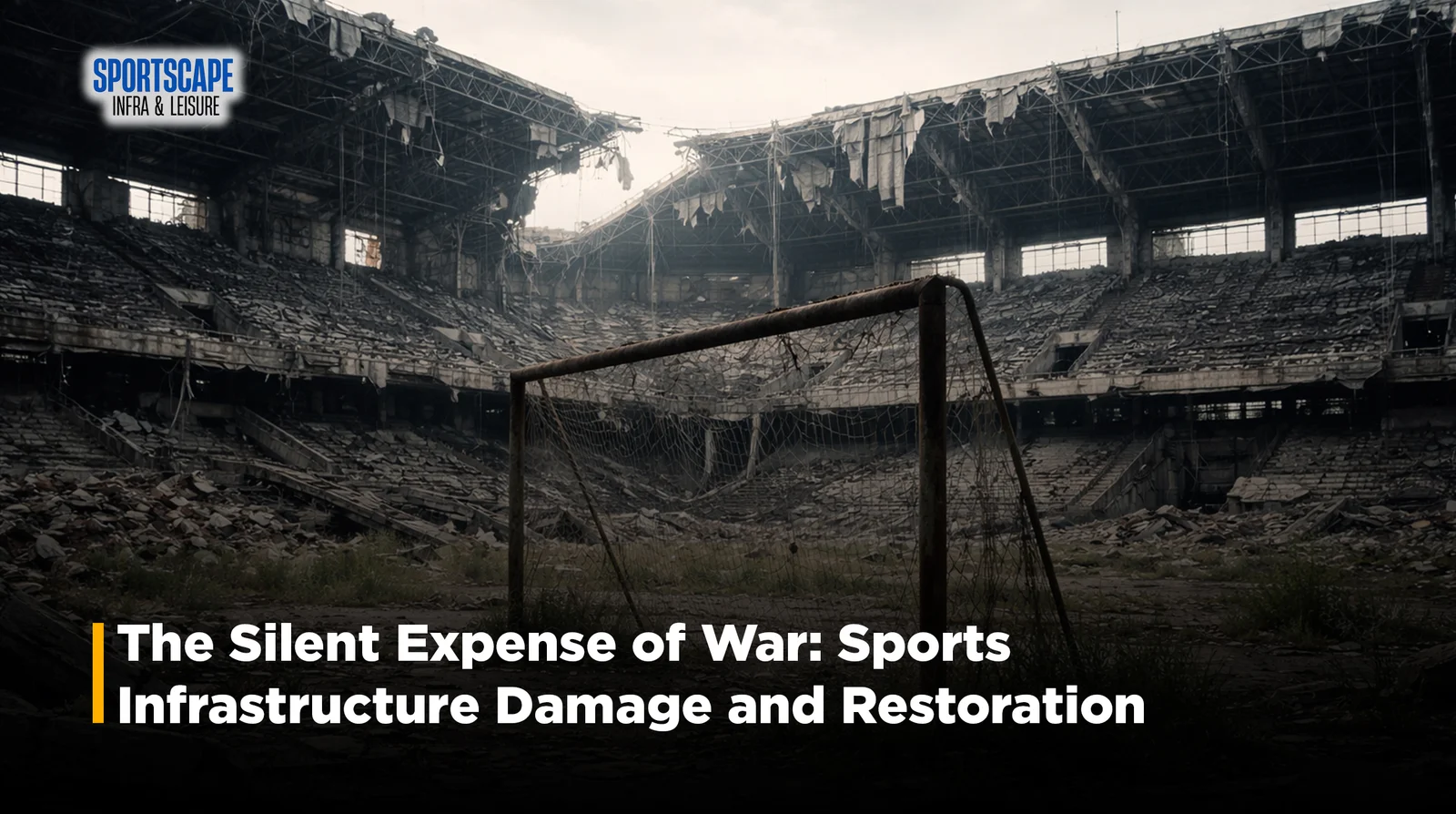
The Russia-Ukraine War has now stepped into its fifth year, and for the first time, there’s a flicker of hope. Soldiers’ remains are being exchanged, two rounds of peace talks are done, and a third round is reportedly on the table. It almost feels like the world might finally be inching towards a pause. But the geopolitics hardly sticks to just one script. Does it? While one conflict seeks closure, another is exploding into focus. Donald “Deal Maker” Trump is back in the White House and has entered the rink with a tag team partner, Israel, in a 2 vs 1 handicapped match against Iran. The result? Oil refineries are burning, tankers are being targeted, cities are absorbing shockwaves, and early strikes have rattled Tehran’s top leadership. But beyond these missiles and headlines, there’s a casualty list growing quietly. It's the stadiums that go dark, sports complexes left half-built, and training grounds that one echoed with cheers now go with sirens.
Actually, sport isn’t just a game. It never was. Long before sport became a source of entertainment, it was training. Wrestling and boxing were initially hand-to-hand training practices in ancient Rome and Greece. The pentathlon that we see today was designed by Napoleon to test the ideal cavalry soldier (riding, fencing, shooting, swimming, running). Even the origins of niche sports like biathlon are anything but peaceful. It developed directly from Scandinavian military training practices, where Norwegian and Swedish soldiers were evaluated on their ability to ski across terrain and shoot accurately, skills essential for survival in Arctic warfare. Since their origin, the sports have come a long way. But today, in this era of flexing military might and firepower, the structures of these sports are left in ruins, and people have nothing but grief.
Do you remember the photograph that surfaced online where children were sitting in the rubble of Yarmouk Stadium in Gaza, one of the oldest and most beloved sports venues in Palestine, founded in 1952? They’re not crying. They’re just sitting, staring at the crumbled stands around them, at the pitch that is now a makeshift cemetery. Behind them, Israeli flags hang from the torn goal posts. Above them, nothing but open sky where the stadium roof used to be.
Photographs like this tell you a different story. A story that shouts, “sports infrastructure is being erased at a scale that the future seems blurry for them.”
The Scoreboard of Destruction: Sports Infrastructure Under Fire
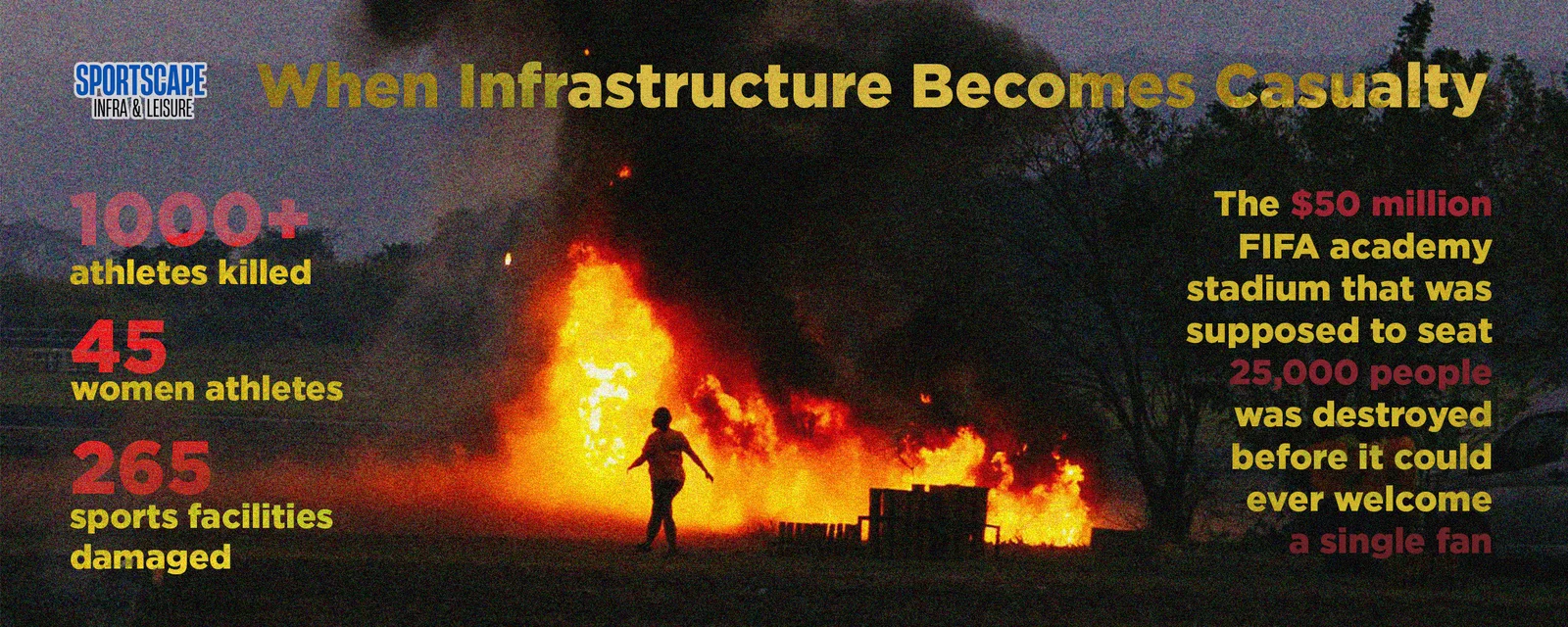
The numbers from Gaza are staggering, and they are not abstract. According to the Gaza Sports Federation, over 1000 athletes have been killed since October 2023, including a large number of children, 45 of whom were women. According to Asaad Al-Majdalawi, the Palestinian Olympic Committee’s vice president, 265 sports facilities across the Gaza Strip were damaged, including 184 destroyed completely and 81 others partially damaged.
Then there is the Palestine Stadium in Al-Rimal, the regular home ground of the Palestinian national team, located in what was once Gaza's most affluent neighbourhood. FIFA pledged $50 million for a new stadium holding between 20,000 and 25,000 spectators, and said it would build a $15 million FIFA academy. The organisation also promised to spend an additional $2.5 million for 50 "arena mini pitches," or soccer fields, and five full-sized fields costing $1 million each.
"We don't have to just rebuild houses or schools or hospitals or roads," said FIFA president Gianni Infantino. "We also have to rebuild and build people, emotion, hope and trust. And this is what football, my sport, is about."
Now see, there are around 40 wars taking place globally, some with other countries and some struggling with terrorist insurgency and civil wars within the country. Despite different struggles, most of these fight a similar battle: Sports infrastructure ends up suffering too.
Ukraine's story is one of slow, grinding loss. In Bakhmut, satellite analysis confirmed that almost all social, cultural, and sporting facilities were destroyed or damaged, including stadiums, youth sports centres, children's athletics clubs, and everything. Mariupol, Kharkiv, Irpin, Sievierodonetsk, city after city has seen its sporting identity stripped away by artillery and air strikes.
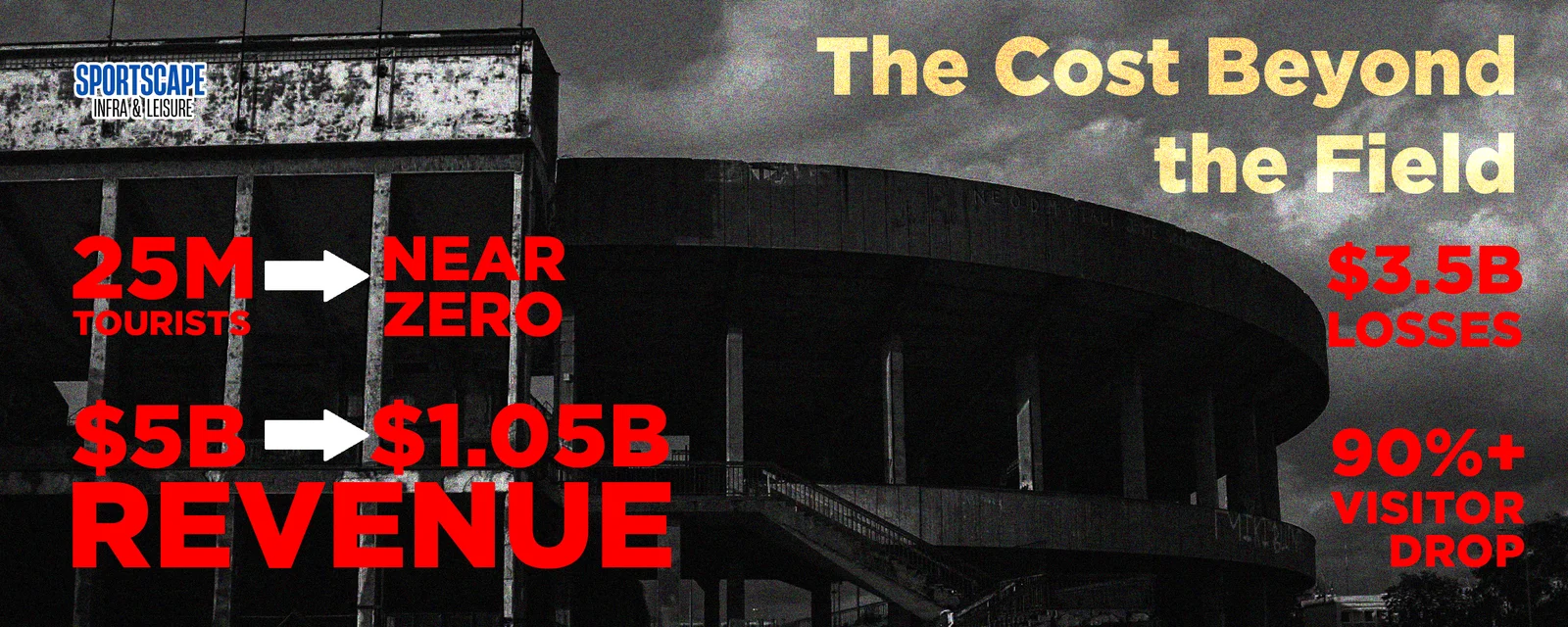
This matters in ways that go beyond sport itself. Ukraine's tourism sector, which contributed roughly 7% of GDP and sustained 1.2 million jobs before the war, has experienced a near-total collapse. In 2013, the country welcomed nearly 25 million foreign tourists and earned over $5 billion in tourism revenue. Since the full-scale escalation in 2022, international visitor numbers have declined by more than 90%, effectively reaching negligible levels. By 2024, tourism revenue had fallen to around $1.05 billion, still well below the pre-war baseline. UNESCO's February 2024 assessment put the total physical damage to Ukraine's culture and tourism sectors at nearly $3.5 billion, a figure that had already jumped 40% in a single year.
Culturally, the losses are even harder to quantify. As UNESCO noted, 4,779 cultural and tourist assets have been reported damaged, including sporting sites that hold the living memory of communities. They are not just buildings. They are where people become who they are.
The Middle East's cascading conflicts have taken their own toll on sporting life. Iran's escalating tensions, culminating in Israel's June 2025 Operation Rising Lion and subsequent strikes, have disrupted civilian infrastructure broadly, with internet connectivity in Iran dropping to 4% of normal levels during the peak of hostilities. The ripple effects on civil society, including sports, have been profound. Regional airspace closures disrupted international sporting events, and the psychological weight of the ongoing conflict has pushed normal life, including athletic competition, to the margins.
For Gaza specifically, the destruction isn't just physical. It's a systematic targeting of the spaces where sport happens. "The Israeli occupation is targeting Palestinian youth and their dreams by destroying stadiums, sports, and entertainment facilities," said Abdel Salam Haniyeh, Secretary-General of the Supreme Council for Youth and Sports. "These systematic attacks aim to change the face of life in Gaza."
The Economic Ripple: What Destruction Really Costs
Rebuilding a stadium sounds straightforward until you start counting. The USAID-funded Gaza Sports Club cost over half a million dollars to complete, and it was the investment of years of planning, community consultation, and international partnership. Its destruction did not just eliminate a building. It wiped out years of economic activity, hundreds of jobs, and the future sports careers of thousands of young Palestinians it was meant to serve.
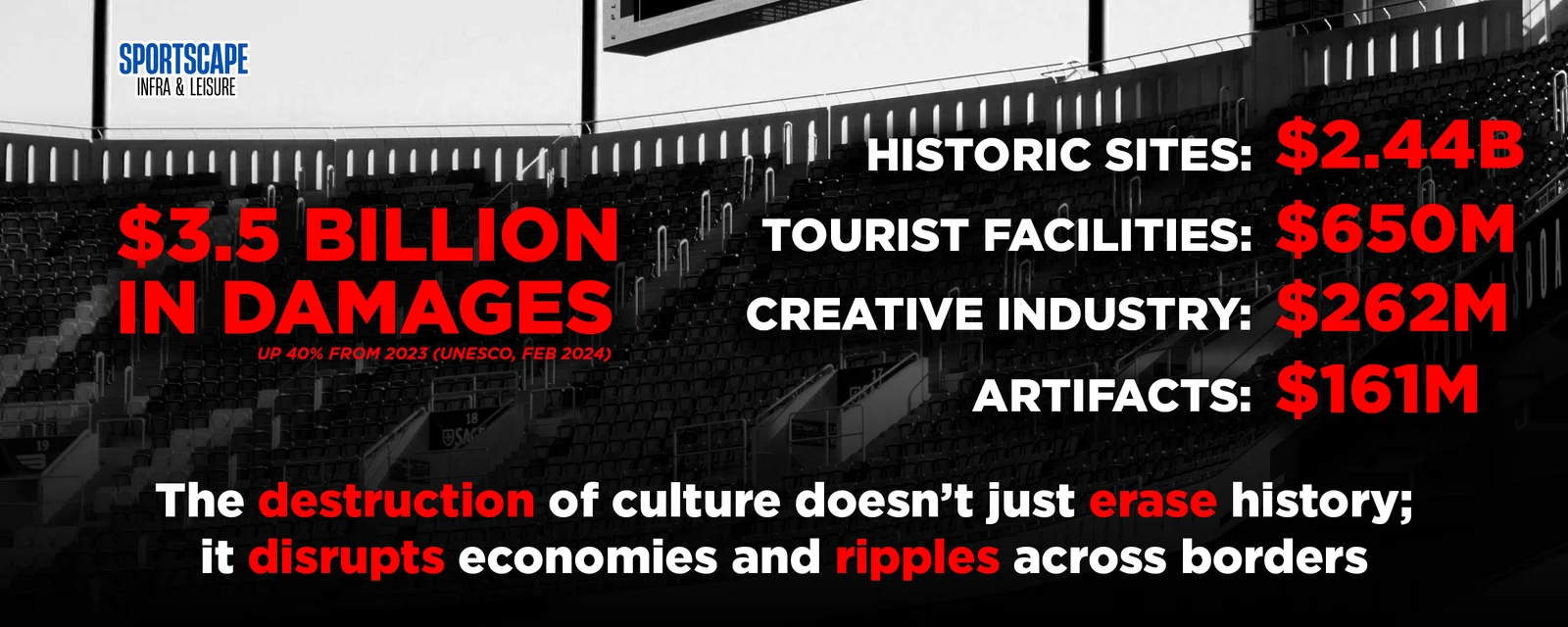
In February 2024, UNESCO released a report revealing that total damages had climbed to nearly $3.5 billion, a 40% increase compared to 2023. According to the detailed findings, sites of historic significance suffered losses of about $2.441 billion. Historical artifacts accounted for $161 million in damage, while buildings and workshops tied to the cultural and creative industries saw nearly $262 million in losses. Tourist facilities were also heavily impacted, with damages approaching $650 million. This knock-out effect has reached the neighbours too.
In March 2022, the Net Sentiment Score (NSS), a measure used to track public attitudes toward specific issues, released a report examining how people felt about traveling to Europe. The findings showed that overall perceptions of European destinations had fallen by 15 points. Estonia, Poland, and Lithuania were viewed as the most risky places to visit that year, while Greece stood out with the most positive rating, emerging as a preferred choice for tourists.
Rebuilding Hope: To Restore or to Build Anew? The Great Debate
When the guns eventually fall silent, and they always do, eventually, the question of rebuilding becomes urgent and complicated. In post-conflict communities, debates over what to rebuild first are never just logistical. They are deeply political, emotional, and identity-laden.
Should a bombed historic stadium be faithfully restored, even at enormous cost, to preserve the cultural memory it embodies? Or should the community seize the moment to build something entirely new, better designed, more accessible, more modern, that creates a forward-looking identity rather than mourning the past? There are no universally right answers. After the 2012 bombing of the Palestine Stadium, FIFA's instinct was to rebuild what had been there before. But some Palestinian voices have argued that rebuilding identical structures in the same vulnerable locations, without addressing the underlying conditions of conflict, simply recreates targets.
The debate echoes in Ukraine too, where UNESCO and the World Bank are carefully weighing which heritage sites merit faithful restoration versus which locations require fundamentally new approaches. The choice reflects not just engineering or economics, but philosophy: what does this community want to remember, and what does it want to become?
Written by
Chetan is an Editor at Sportscape Magazine, bringing over three years of experience across sports, defence, international relations, and sports law. With more than 3,500 articles to his name covering player insights, match performances, and team analysis, he…