
Stadiums, Steel, and Balance Sheets: Can Sports Infrastructure of India Become the Next Asset Class?
Can India’s sports infrastructure evolve into a viable asset class? Explore investment potential, revenue models, and the future of stadium-led economic growth.
On a humid evening in India, when the floodlights ignite and the stadium roars, it is easy to believe that sport is only about the drama on the field, a last-minute goal, a thunderous six, a medal lifted toward the sky. But beneath the chants and camera flashes, another game is quietly unfolding. It is a game played not by athletes but by architects, investors, governments, and entrepreneurs; it is a game of land, capital, and long-term bets on the future of sports infrastructure in India.
For decades, stadiums in the country were built like monuments, reflecting the nation’s pride but staying mostly silent when the tournaments ended. Concrete rose, crowds came, trophies were lifted, and then the gates closed again. But something has shifted in the past decade. India’s sporting culture is expanding at a pace no one predicted: leagues are multiplying, fans are younger and more digital, and cities are beginning to imagine stadiums not just as arenas but as ecosystems.
This is where the conversation around sports infrastructure development India begins to feel less like policy jargon and more like the opening chapter of an economic transformation. Because today, a stadium is no longer just a place where matches happen. It is a potential entertainment district, a concert venue, a tourism magnet, a retail hub, and sometimes even the heartbeat of an entire urban economy.
India’s sports industry is already accelerating. Reports suggest the sector is growing at double-digit rates, powered by broadcast rights, sponsorships, digital engagement, and the rise of professional leagues. As the country dreams bigger from expanding domestic leagues to bidding for global mega-events like the Olympics, the demand for world-class sporting venues is climbing rapidly. But here is the real twist in the story. Around the world, stadiums have quietly evolved into something investors love: an asset class. In cities across the United States and Europe, sports venues generate revenue year-round through concerts, retail districts, naming rights, and entertainment experiences that extend far beyond match day.
India now stands at the edge of that possibility. The cranes are already rising, the leagues are expanding, and policymakers are speaking the language of infrastructure. The question is no longer whether the country will build more stadiums.
The real question, the one echoing across boardrooms, ministries, and investment funds, is far more intriguing: Can the future of sports infrastructure in India turn stadiums from public expenditure into profitable, long-term economic assets?
Beyond the Final Whistle: The Quiet Economics Behind Sports Infrastructure Development in India
A stadium, if you watch closely, lives two very different lives. On match day, it is thunder and theatre where flags are waving, drums are echoing, and thousands of voices are folding into a single roar that rises above the floodlights. But on most other days, the stadium becomes something quieter: a massive piece of urban real estate waiting to justify its existence. The true test of sports infrastructure development in India therefore, begins not during the tournament, but long after the final whistle fades into the night.
For decades, India built sporting venues with the singular goal of hosting events. The stadium opened, the crowd arrived, medals were awarded, and then the gates were closed again until the next tournament. But the philosophy behind sports infrastructure is now slowly evolving. Policymakers and planners are beginning to imagine stadiums not as episodic venues but as year-round economic ecosystems capable of generating continuous revenue.
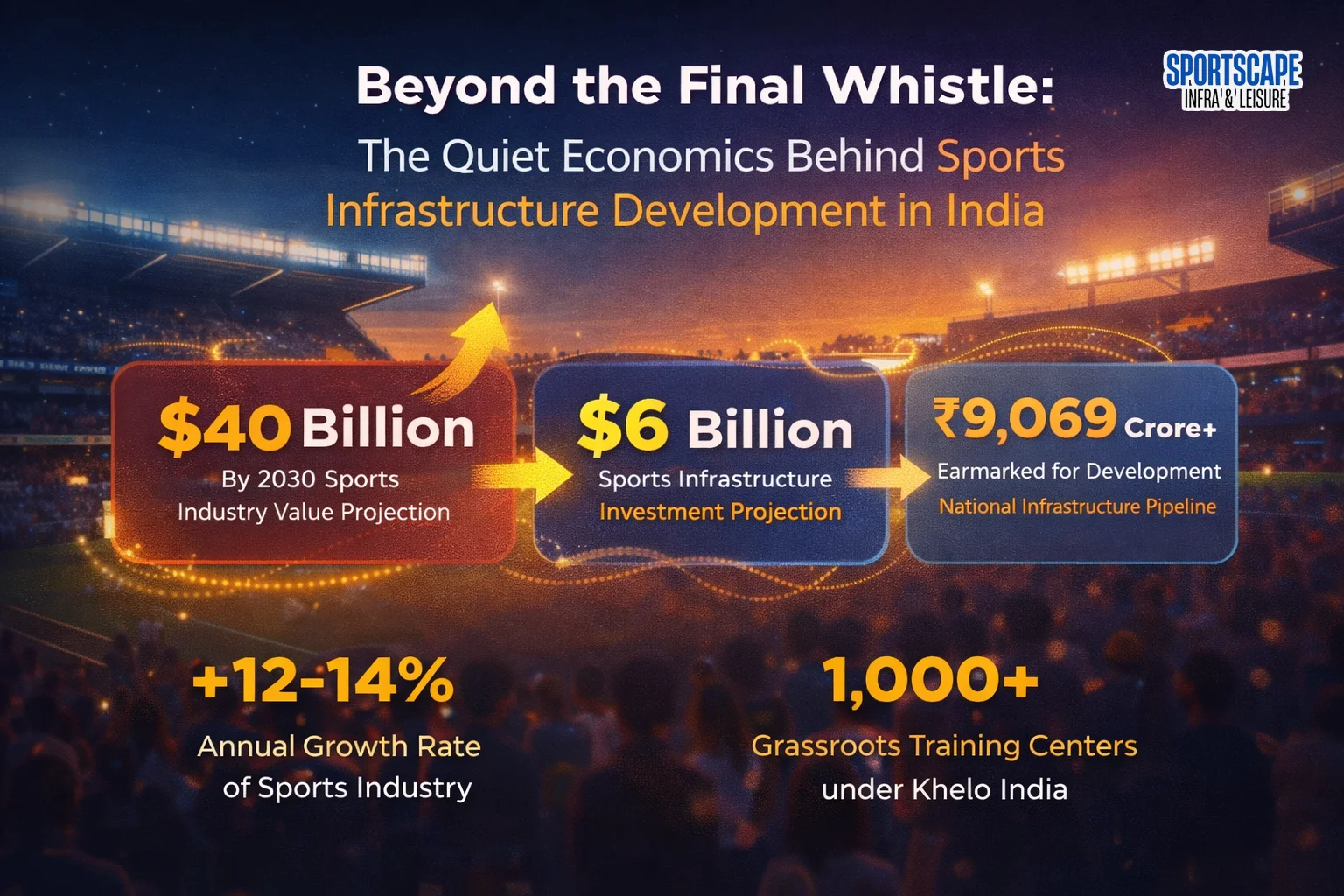
The scale of this shift is visible in the numbers. According to a recent industry assessment, India’s sports industry is currently valued at around $19 billion and is projected to reach $40 billion by 2030, growing at an annual rate of nearly 12–14%. Alongside this expansion, sports infrastructure investment currently stands at about $2.7 billion and is expected to rise to nearly $6 billion by the end of the decade, driven by new stadium projects, sports academies, and digital-enabled venues. The government’s push is visible on the ground as well. Under the National Infrastructure Pipeline, more than ₹9,069 crore has been earmarked for sports infrastructure, including stadium upgrades, training facilities, and multi-purpose arenas. At the same time, initiatives such as the Khelo India programme have already established over 1,000 training centres across the country, designed to nurture grassroots talent while also expanding the physical footprint of sporting facilities.
Yet the real evolution lies not only in building more venues but in rethinking how they function. Around the world, modern stadiums are engineered as multi-purpose economic engines, places where sport is merely the anchor around which entertainment, retail, tourism, and hospitality revolve. Concerts, corporate events, esports tournaments, fitness festivals, and community leagues ensure that these arenas rarely fall silent.
India is slowly absorbing that lesson. New stadium proposals increasingly include commercial complexes, fan zones, hospitality suites, and entertainment districts within their master plans. A venue that once hosted a handful of matches a year is now being imagined as a space capable of generating revenue every week, sometimes every day.
The League Effect: How India’s New Sporting Fever Is Rewriting the Blueprint of Infrastructure
If the story of Indian sports infrastructure once revolved around stadium construction, the last decade has rewritten the script entirely. Today, the real architects of sports infrastructure development in India are not just planners or policymakers; they are leagues. Fast, colourful, television-friendly leagues that have turned traditional games and emerging sports into nationwide spectacles, quietly reshaping how and where India builds its sporting spaces.
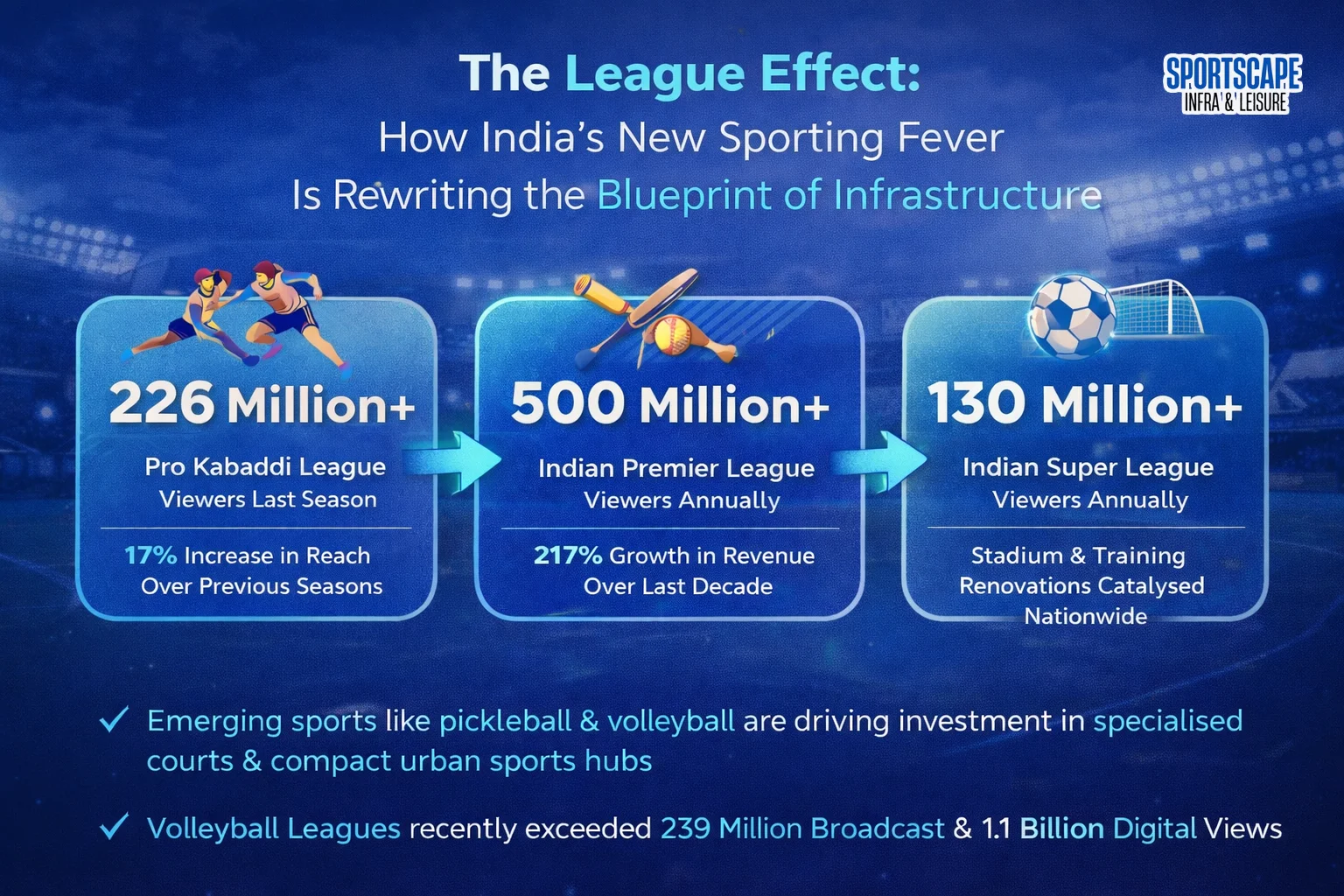
The transformation began with the franchise league revolution. Cricket’s Indian Premier League demonstrated how sport could become a festival of entertainment, drawing over 500 million viewers on television alone, a scale of engagement that redefined the commercial possibilities of Indian sport. But the deeper shift came when other sports began following the same template.
Consider the rise of the Pro Kabaddi League (PKL), perhaps the most striking example of how a league can reshape infrastructure and audience behaviour simultaneously. When PKL launched in 2014, kabaddi was largely seen as a rural pastime played on dusty village grounds. Within a decade, the sport had moved onto brightly lit indoor arenas, broadcast across the country with sophisticated production. The league now attracts over 226 million viewers, marking a 17 per cent increase in reach compared to earlier seasons, making kabaddi the most-watched sport in India after cricket.
This surge in viewership did more than revive a traditional sport; it triggered investment in indoor arenas, kabaddi training academies, and mat-based competition infrastructure across multiple states. What was once played in mud courts is now performed on professional mats inside climate-controlled venues. Football followed a similar arc. The Indian Super League (ISL) has expanded the sport’s reach to around 130 million viewers globally, catalysing the renovation of several football stadiums and training facilities across cities such as Goa, Kochi, and Guwahati.
Each new franchise city demanded modern training complexes, upgraded stadium seating, broadcast infrastructure, and fan engagement zones, slowly stitching together a new geography of sports infrastructure across India.
And the story does not end with traditional leagues. India’s sporting map is now expanding into disciplines that barely existed a decade ago. Pickleball, padel, and recreational racket sports are witnessing rapid adoption in urban India, prompting private investors and real-estate developers to build specialised courts within clubs, residential complexes, and sports parks. Meanwhile, leagues such as the Prime Volleyball League have demonstrated the appetite for new sporting entertainment, drawing over 239 million live broadcast views and more than 1.1 billion total digital views in recent seasons.
Each of these leagues carries its own infrastructural ripple effect. Kabaddi needs indoor arenas; volleyball demands broadcast-ready indoor courts; pickleball and padel are creating compact urban sports hubs inside residential communities and commercial clubs. In other words, leagues are no longer just competitions; they are demand engines for infrastructure.
The Empty Arena Problem: High Costs, Low Utilisation
There is a strange silence that settles over many stadiums in India once the floodlights switch off. The stands that once carried the thunder of thousands become still, the corridors echo only with maintenance footsteps, and the enormous structure, built with ambition and public funds, waits for the next event that might justify its existence.
The financial reality behind this silence is hard to ignore. Building a modern stadium is an expensive undertaking; analysts estimate that the construction cost per seat in India can range between ₹1.2 lakh and ₹1.5 lakh, meaning that large venues often demand investments running into hundreds or even thousands of crores. For example, upgrades to the Kalinga Stadium ecosystem and the construction of the new international hockey stadium in Rourkela saw project costs rise from ₹432 crore to nearly ₹875 crore within a year, illustrating how rapidly sports infrastructure expenditure can escalate.
Yet the more pressing challenge begins after construction is complete. Utilisation levels of many public sporting venues remain limited because tournaments and leagues occupy only a fraction of the calendar. Some estimates suggest that India has nearly 37,000 government sports facilities that remain underused or inaccessible to the public, reflecting a broader structural issue in the management and activation of sports infrastructure.
The consequences are visible across the country. Several stadiums struggle to host enough events to offset operational expenses such as turf maintenance, lighting systems, staff salaries, and security infrastructure. The Rajiv Gandhi International Cricket Stadium in Dehradun, for instance, has faced maintenance challenges due to limited high-profile matches and the high costs required to operate and sustain the facility.
This imbalance between investment and utilisation has created what many analysts quietly call the “empty arena problem.” Stadiums rise as symbols of ambition, but without consistent programming. And so across India, a paradox lingers beneath the optimism surrounding sports infrastructure expansion. The country is building more arenas than ever before, but many of them still struggle with the same fundamental challenge: how to transform occasional spectacles into sustained economic activity.
From Dallas to Tottenham: How Global Stadiums Became Billion-Dollar Assets
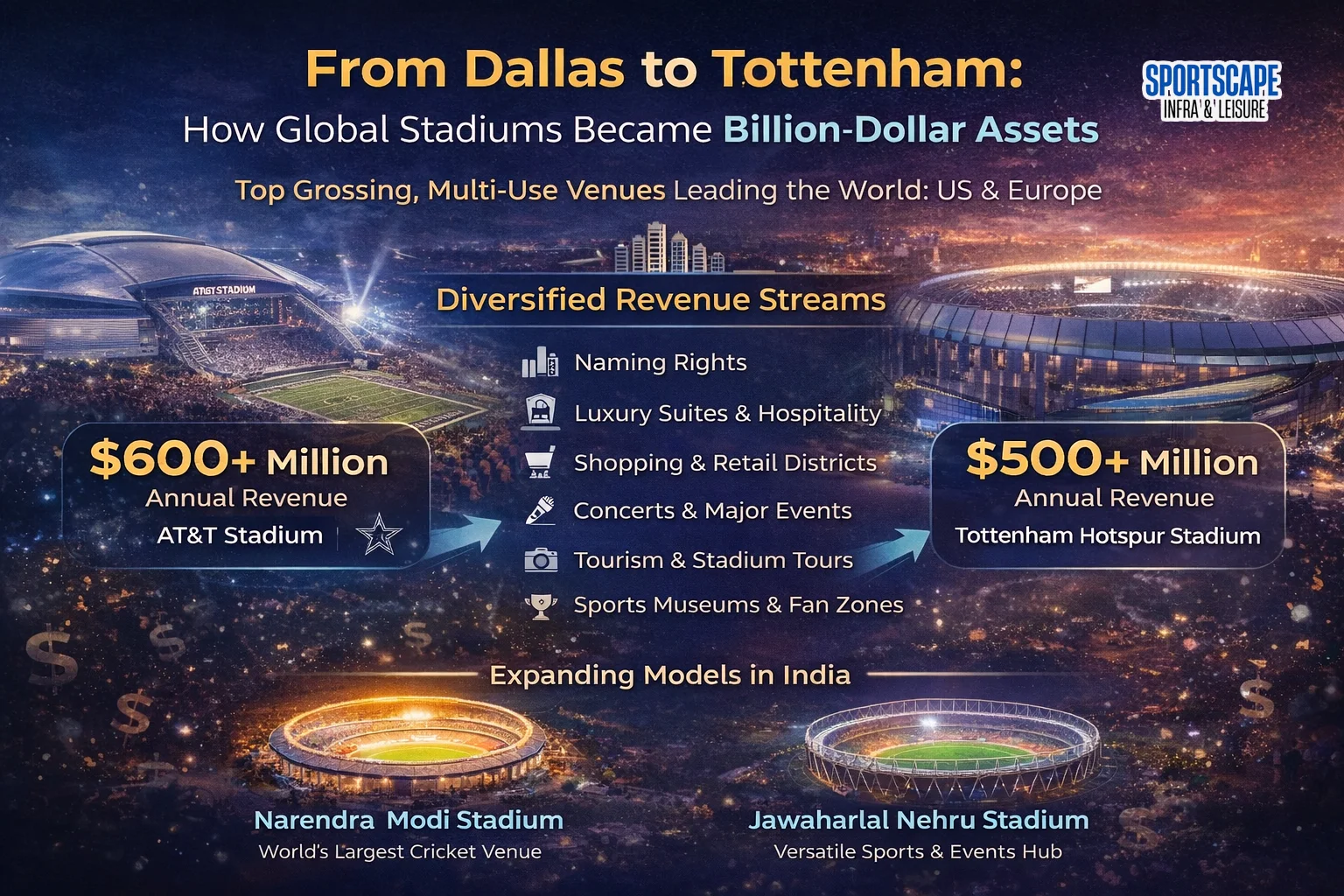
If one want to see sports infrastructure functioning as a true asset class, look at the stadiums of the United States and Europe. Take AT&T Stadium, home of the Dallas Cowboys. The venue generates hundreds of millions of dollars annually not only from NFL games but also from concerts, conventions, and large entertainment events, making it one of the most profitable stadiums in the world. Similarly, Tottenham Hotspur Stadium in London has been designed as a multi-purpose entertainment arena, hosting NFL games, concerts, esports tournaments, and hospitality events. The stadium’s retractable pitch allows rapid conversion between sports formats, dramatically increasing utilisation.
The revenue streams of these stadiums extend far beyond match tickets:
- Naming rights deals
- Luxury hospitality suites
- Retail districts and restaurants
- Concert and event hosting
- Tourism and stadium tours
- Sports museums and fan zones
Many venues are integrated into entire entertainment districts, often called sports cities. India is beginning to experiment with similar models.
One example is the Narendra Modi Stadium in Ahmedabad, the world’s largest cricket stadium, which has the capacity to host over 132,000 spectators and is increasingly used for large concerts, cultural events, and international tournaments.
Another emerging model is the Jawaharlal Nehru Stadium complex in Delhi, where athletics events, football matches, concerts, and community activities coexist. These examples show the direction India must move toward. But whether this transformation can turn sports infrastructure into a true investment asset class remains an open question.
The Entrepreneurial Playbook: Building the Next Generation of Sports Infrastructure
If the first era of Indian sports infrastructure was about building stadiums, the next may be about building ecosystems. Across the world, entrepreneurs are quietly redesigning what a sports facility looks like, smaller, smarter, technologically wired, and constantly active. For India, where the sports industry is projected to reach nearly $40 billion by 2030, the opportunity lies not just in constructing venues but in creating infrastructure models that function like sustainable businesses.
One emerging model is the rise of urban micro-sports hubs, compact complexes housing pickleball, padel, futsal, and climbing facilities inside dense city neighbourhoods. Operated through app-based booking systems and IoT-enabled court management, these spaces function almost like fitness coworking hubs, ensuring courts remain active from morning to night. Parallel to this is the idea of mixed-use sports districts or sports cities, where stadiums anchor hotels, retail zones, sports science centres, and entertainment venues, turning matchday destinations into year-round economic districts.
Technology is also beginning to reshape stadium economics. Globally, smart stadiums powered by 5G networks, AI crowd analytics, facial-recognition ticketing, and augmented-reality fan experiences are turning arenas into digital platforms that monetise data as much as ticket sales. At the same time, architects are experimenting with climate-controlled indoor arenas and modular stadium structures, allowing venues to quickly convert between sports events, concerts, exhibitions, and esports competitions.
Perhaps the most futuristic addition is the rise of dedicated esports arenas and sports-science campuses equipped with motion-capture analytics, wearable athlete sensors, and high-performance training labs. India’s esports market alone is expected to approach $3 billion in the coming years, signalling an entirely new category of infrastructure demand.
Add to this renewable-energy stadium designs, solar roofs, and portable prefabricated seating systems, and the blueprint begins to change. The next generation of sports infrastructure will not merely host tournaments; it will host communities, technologies, and businesses, quietly turning sport into a living economic ecosystem.
Asset or Expense? The Critical Test for India’s Stadium Economy
For infrastructure to qualify as an asset class, it must satisfy a simple financial principle: predictable long-term revenue streams capable of attracting private capital. Airports, highways, and renewable energy projects meet this criterion. Investors can forecast traffic, toll revenue, or power sales. Sports infrastructure, however, remains more unpredictable.
India’s sports economy is clearly expanding. Participation is rising, leagues are multiplying, and the government’s Olympic ambitions are creating new momentum. Reports suggest the sports industry could employ over 2.5 million people by 2025, highlighting its growing economic footprint.
But turning stadiums into a viable asset class requires structural shifts:
- Public-private partnerships for stadium development
- Integrated sports districts combining retail, hospitality, and entertainment
- Year-round programming beyond sports
- Professional venue management
- Data-driven fan engagement and digital monetisation
In other words, stadiums must stop behaving like monuments and start behaving like business ecosystems. India’s moment may be arriving at the perfect time.
A young population, expanding sports fandom, rising digital media, and the possibility of hosting mega-events could push the country into a new era of sports infrastructure development. The question is no longer whether India will build more stadiums.
The real question is whether these stadiums will remain echoing arenas of occasional tournaments or evolve into living economic engines, the kind investors place alongside airports, highways, and renewable energy portfolios.
If India gets that equation right, the next great asset class might not be found in Silicon Valley or financial markets. It might be sitting quietly under floodlights, waiting for the crowd, the concert, and the capital to arrive.
Written by