
The Ultimate Crossover: Football Borrows Cricket’s Best Tech as 'Snicko' Makes a Jaw-Dropping Debut at the FIFA 2026 World Cup
Cricket fans, you are seeing this right! The famous "Snicko" technology has officially crossed over to football, making a stunning and decisive debut at the FIFA 2026 World Cup.
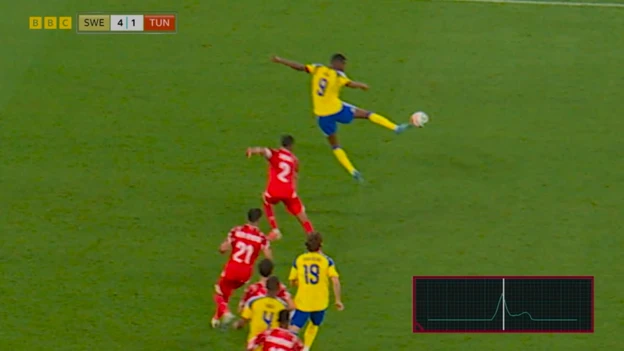
If you were to tune into a FIFA World Cup 2026 match featuring Sweden and Tunisia, you would likely do a double-take to see if you have the right channel. In a startling example of the convergence of two of the most popular sporting codes, the groundbreaking snickometer from cricket has now made its way into football – and it's revolutionising the sport in the process!
It is common for those watching a cricket game using the Decision Review System to hear the expression "check the Snicko." But imagine seeing a similar snickometer-style graph while watching a World Cup match in football! Football found its own solution to its problems by taking some tips from cricket.
Let's go through all the ins and outs of why and how the cricket edge-detection technology played an important role in the football match between Sweden and Tunisia.
The Turning Point: Sweden vs Tunisia
This particular cross-over occurred in the closing seconds of a comprehensive 5-1 win by Sweden against Tunisia.
After a period of chaos and confusion in the box, the substitute striker Mattias Svanberg scored, only for his celebration to be abruptly halted by a hand from the assistant referee, calling him offside. The protests by Sweden started right away, as they contended that their key forward Alexander Isak had flicked the ball just slightly before the attack began, meaning the player was not offside.
However, the touch looked barely noticeable to any human eye. This is where "Snicko" comes in. The VAR team used the new connected ball technology. And sure enough, on all the television screens, spectators around the world witnessed an image that many already knew well. As the ball passed by Isak’s foot, an enormous spike appeared on the screen.
What Exactly is Snicko?
To see just how groundbreaking this innovation is, one needs to examine the history of its development. Originally conceived in the 1990s by English computer scientist Allan Plaskett, the Snickometer (also commonly referred to as UltraEdge nowadays) is meant to address cricket's most controversial disputes – the faint edges.
How it works in Cricket:
- The Set-Up: Extremely sensitive microphones are placed directly within the wooden blocks around the cricket field.
- The Process: The technology integrates a split-second video replay of the ball flying past the batsman with an oscilloscope showing the sound waves.
- The Result: When the leather ball touches the wooden bat, it makes a sudden and clear sound. This sound is recorded by the microphone and shows up as a spike in the sound wave image.
It is the ultimate lie-detector for caught-behind and Leg Before Wicket (LBW) appeals.
From the Pitch to the Pitch: Snicko in Football
But then, how will we convert the concept of "stump" microphones into that of a 100-yard football field? This is done through the very ball that plays football!
As part of its "Snicko," FIFA has employed a technology known as "connected ball technology." This technology involves a sensor being placed within the football, thus making it "football-specific."
How it is implemented in Football:
- The Hardware: An exceptionally small and extremely light 500Hz IMU microchip floats perfectly at the centre of the official Adidas match ball.
- The Data: The microchip continuously records the ball’s movements, acceleration, and points of impact an astounding 500 times per second.
- The Result: Every time a player impacts the ball, no matter how incredibly small this impact might be, the device immediately sends a signal to the VAR room, creating the “spike” similar to cricket on the monitors.
Why Football Desperately Needs This
Ghost touches have haunted football officials for many years now. Through borrowing the genius idea of ghost touches from cricket, FIFA intends to banish the most controversial and subjective calls in football. The technology is mainly applied to:
- Offside Resolution: Like in the case of Isak, identifying the precise millisecond when a pass was delivered is vital for semi-automated offside detection.
- Handball Identification: The ball touched the defender's fingers while in the penalty area? Snicko will give us an instant answer via his spike.
- Foul Detection: Assisting referees to determine whether the defender really took possession of the ball or kicked the attacker's leg.
Sportscape thinks that purists might contend that using technology extensively will interfere with the rhythm of the game. Still, the spectacular introduction of Snicko in the FIFA World Cup 2026 is evidence of one thing: Guesswork is history! The game of football just got much more accurate, and it is fantastic to see both sports using the same winning formula!
Written by