
The Public Private Partnership (PPP) Playbook: Financing India’s Next Generation of Sports Infrastructure
Public Vision, Private Precision and the Business Case for PPP in India is the future for Sports
India has heavily invested in road infrastructure through Public-Private Partnership (PPP) models, achieving remarkable feats like four Guinness World Records set by the National Highways Authority of India (NHAI) in early 2026 during the construction of the Bengaluru-Kadapa-Vijayawada Economic Corridor on NH-544G. NHAI, in association with the concessionaire M/s Rajpath Infracon Private Limited, achieved this historic feat by deploying state-of-the-art construction equipment and machinery comprising 70 tippers, five hot mix plants, one paver, and 17 rollers. The project also includes continuous paving of 156 lane km and laying 57,500 metric tonnes of bituminous concrete. In contrast to India's road sector, which thrives under PPP, with projects like the Bengaluru corridor showcasing efficiency and private sector speed, sports, however, still lag due to chronic underfunding.
Sports infrastructure receives minimal funding, with the Ministry of Youth Affairs and Sports allocated just ₹3,794 crore in the 2025-26 Union Budget, about 0.07% of the total ₹50.65 lakh crore expenditure, highlighting sports as an untapped domain. The 2025-26 sports budget rose to ₹3,794 crore, but Khelo India alone took ₹1,000 crore, leaving grassroots facilities starved. This disparity stems from roads' economic priority over sports' niche status, despite India's sports market projected at $130 billion, driven by IPL's $9.5 billion revenue.
Why a New Model for Sports Infrastructure?
Budget constraints plague sports development. With fiscal pressures mounting, India's overall infrastructure spend hit ₹11 lakh crore in 2025, yet sports receive a fraction of that, and governments struggle to build and maintain facilities. The Khelo India scheme, while promising ₹1,800 crore annually, covers just 1,000 facilities nationwide, leaving rural areas underserved. Still, the sports' commercial value is exploding.
The Indian Premier League (IPL) generated ₹11,769 crore in revenue in 2025, drawing ₹8,000 crore in sponsorships from brands like Tata and MyCircle. Indigenous sports are booming: Pro Kabaddi League (PKL) earned ₹600 crore in 2024, while Kho-Kho's Ultimate Kho Kho league secured ₹150 crore in investments. Kabaddi viewership hit 300 million in 2025, per Broadcast Audience Research Council (BARC). Entertainment-sports fusion, like the Indian Street Premier League, added ₹500 crore in media rights. These leagues highlight untapped revenue, global sports markets project India's share at $10 billion by 2030.
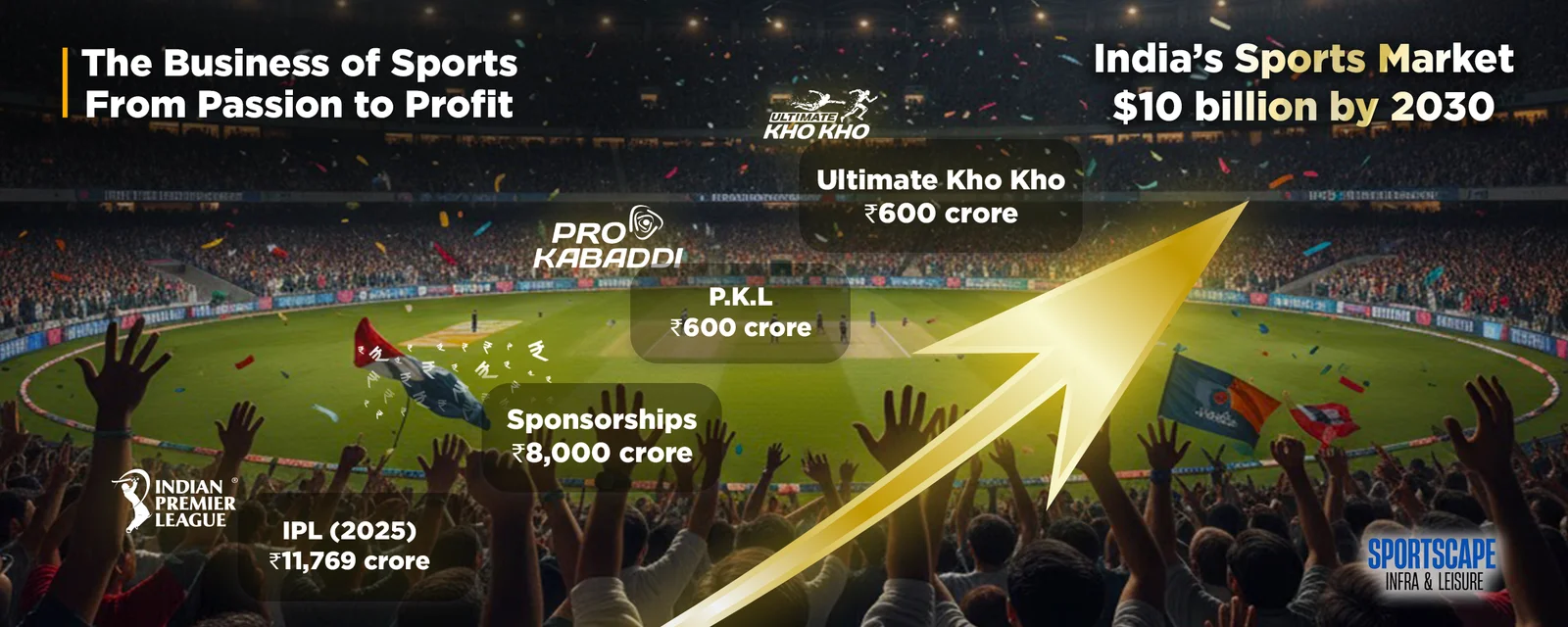
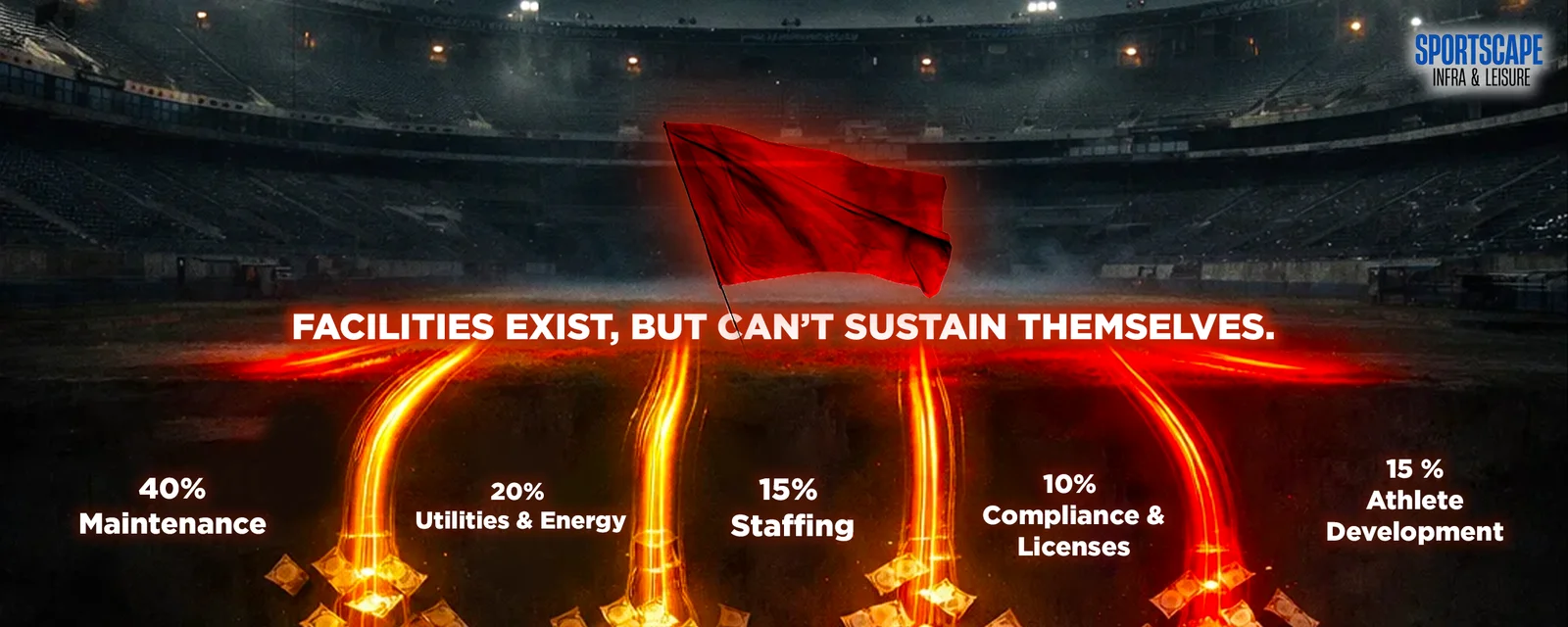
But sustaining this growth demands more than ad-hoc funding. Leagues require world-class stadiums, training centers, and grassroots venues, but maintenance costs eat 40% of budgets. Especially after India gaining the hosting rights for the Commonwealth Games 2030 and itching to host the 2036 Olympics, a new structure of reforms has become more necessary than ever. The PPP model for sports can be a game-changer, teasing sustainable partnerships between government vision and private efficiency, as explored ahead. Even our former finance minister and late president, Pranab Mukharjee advocated for this model more than a decade back.
“With their growing numbers and size, PPPs are now an important pillar of our strategy for infrastructure development. This is the first conclave organized by the Ministry of Finance on PPPs, and is testimony to the importance placed by us on PPPs as an instrument to deliver high-quality infrastructure services to citizens. I am thankful to my colleagues on the dais, and to representatives of the government and private sector, for being here today and adding value to the conclave’s deliberations,” Mukharjee said at the PPP Conclave-2010.
“For the benefit of the younger audience in this room, let me recount that we opened the doors for private participation in infrastructure in the early 1990s, as part of a wider economic liberalisation effort. Since then, successive Governments have put together a variety of policies and support mechanisms to attract the private sector. Private players, in turn, enthusiastically responded to the call and joined hands with the government in several mutually rewarding partnerships. Along the way, they honed their skills and built stronger financial muscle to develop larger and more complex projects. On the part of the Government, as we gathered more experience and new insights, we have revised or fine-tuned our infrastructure policy and institutional frameworks,” he added.
Understanding the PPP Model
PPPs trace back to the Roman Empire, which built postal stations and aqueducts via private tax farmers funding public works in exchange for tolls, a proto-PPP thriving for centuries. Modern iterations surged post-1990s privatization waves.
Globally, governments embrace PPPs for efficiency. Australia has delivered 30% of its infrastructure via PPPs since 2000, including Sydney's desalination plant. The US boasts 2,500+ PPP projects worth $300 billion, like Indiana's I-90 toll road. In Asia, South Korea's Incheon Airport and high-speed rail exemplify success, generating $50 billion in economic value. China leads with 15,000 PPPs by 2025, including Beijing's Olympic venues, blending state control with private ops.
India pioneered large-scale PPPs in roads, with Adani Enterprises bidding for 11 airports in 2024 under a hybrid model, investing ₹1 lakh crore. By 2025, PPPs span 1,200 projects worth ₹20 lakh crore, per Ministry of Finance data, proving private capital's prowess in high-risk sectors.
How PPP Fits Indian Sports Infrastructure
PPPs align perfectly with India's sports needs, leveraging private expertise for public good. Recent stadiums showcase this: Jawaharlal Nehru Stadium (JLN) in Delhi underwent PPP renovation in 2023, hosting Asian Games trials with ₹500 crore private infusion for modern tracks. DY Patil Stadium in Navi Mumbai, privately owned since 2008, hosted the 2023 Women's Premier League (WPL) and Women's World Cup matches. Ranked 6th best globally by Britain's Architects Journal in 2010 (post-inauguration accolades persist), it offers tickets at ₹500-2,000 (30% below IPL averages), drawing 35,000 fans per game.
With 63% rural population (Census 2021 update: 65% in 2025 projections), PPPs excel at grassroots facilities. Odisha's model shines: In 2024, the state partnered with JSW Group for a ₹1,200 crore PPP to build 50 rural sports complexes under Khelo India. Bhubaneswar's Kalabhairava Stadium, a PPP venture, features floodlit fields and academies, serving 5 lakh rural athletes annually. Odisha hosted the 2023 Men's Hockey World Cup successfully, with PPP-maintained venues generating ₹300 crore revenue.
In states like Maharashtra, the administration has been rooting for the PPP model for quite some time now. Even in 2020 itself, the then sports minister, Sunil Kedar, expressed his desire to work and take steps to work on the welfare and promote sporting culture within the state.
"I have already made a project in my constituency -- Savner -- with the JSW Group. I have signed an MOU with them for the stadium and badminton (court). Games like cricket, hockey and football are played in the stadium and I personally feel this (PPP) is the workable model and we should go along with that," Kedar told reporters here.
"Land and some financial aid for infrastructure development can be given by the government and recurring expenditure for maintenance, for sports activity and coaches... the financial and technical support will be (provided) by (private) person who will enter the partnership," the minister added.
India's sports fervor is budding with a 1.4 billion population, 400 million youth under 25, and 2025 viewership spikes post-Paris Olympics (India won 6 medals). Yet, only 1 stadium exists per 10 lakh people, versus China's 1 per 1 lakh. PPPs reduce state capital burden: Private players fund 70% upfront, recovering via naming rights and events.
Delhi's Thyagraj Stadium, renovated via PPP in 2024 with green tech, cuts energy costs 40% using solar panels. Bengaluru's M. Chinnaswamy Stadium, upgraded by Royal Challengers Bangalore (RCB) in 2023, boasts solar power generating 2 MW, India's first fully solar IPL venue, hosting 50 events yearly with zero emissions.
Risks and Challenges in Sports PPPs
Despite the promise, PPPs face hurdles, demanding focused mitigation.
Legal and Regulatory Framework: Sports fall under state lists (Entry 33, Constitution), complicating national models. The Renovate-Modernize-Operate (RMO) model dominates for assets over 5 years old, like Mumbai's Wankhede Stadium (RMO since 2011, hosting IPL finals). It succeeded in Kerala’s Greenfield Stadium (RMO ops generating ₹100 crore revenue). Yet, Build-Operate-Own (BOO) thrives in Tamil Nadu's MA Chidambaram Stadium (private ownership since the 2010s), and Build-Operate-Transfer (BOT) in Gujarat's Motera (Narendra Modi Stadium, BOT-renovated 2020 for ₹800 crore, world's largest). Uniform laws, like a proposed National Sports PPP Policy 2026, are needed.
Cost Overruns: Inflation and delays inflate bills. Delhi's DND Flyway, estimated at ₹250 crore in 2001, ballooned to ₹408 crore by 2008 due to land disputes. Jaipur's 2023 metro PPP extension jumped 25% from ₹4,000 crore to ₹5,000 crore amid material hikes. And if this wasn’t all, DY Patil's initial ₹200 crore rose 15% via add-ons.
Time Delays: Tendering drags, comprehensive docs (EOIs, RFPs) take 6-12 months. Bengaluru's 2024 highway PPP took 8 months of pre-bid scrutiny.
Institutional Gaps: Every state has a PPP Cell (e.g., Maharashtra's since 2005), but undefined powers spark rifts. UP's PPP Cell stalled a 2024 stadium project over authority disputes. Capacity building, training 5,000 officials by 2026, is vital.
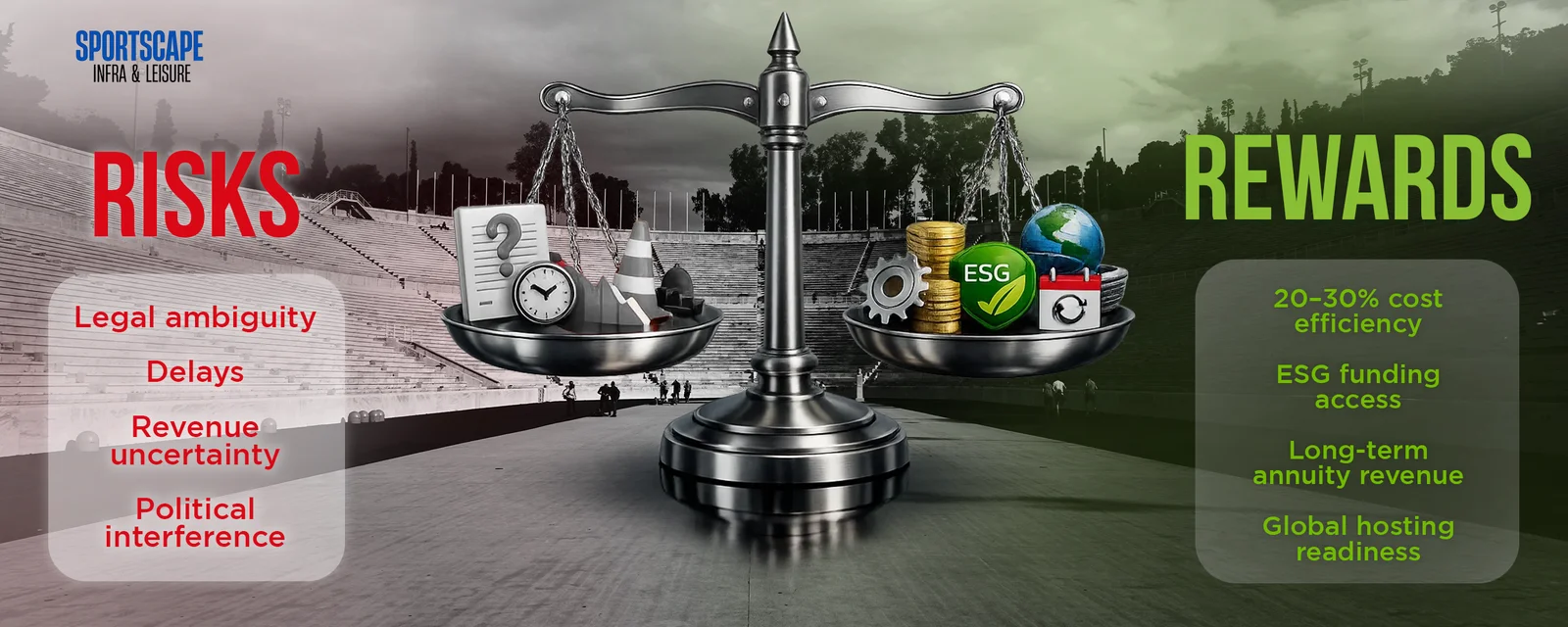
Other risks include revenue shortfalls (stadiums idle 80% time) and political interference, as in Punjab's abandoned Mohali upgrades.
Future Prospects and Business Opportunities
PPPs' future hinges on refined designs. Third-party evaluators, like KPMG in road projects, ensure accountability and extend to sports for transparent audits.
Government support is key: KMP Expressway delays (2012-2018) cost ₹2,000 crore extra due to poor coordination. This is where government can step in. Sports need Viability Gap Funding (VGF), 20% equity grants, as in 2025's ₹500 crore sports VGF pilot.
NITI Aayog emphasizes PPPs to encourage private investment in the construction and upgradation of facilities. Madhya Pradesh government's initiative describes PPP as enabling "high-quality training facilities, better infrastructure, and opportunities for athletes to compete at a global level." Andhra Pradesh leverages PPP for flexibility, allowing the government focus on training while private players handle revenue.
Risk-sharing frameworks optimize: Governments handle land (80% acquisition delays) and clearances; private players own construction/quality (90% overruns). Financially, PPPs outperform: Private ops cut costs 20-30% via efficiency. Policy risks stay governmental; revenue shared via 60:40 splits (e.g., PKL stadium deals).
Cost-optimization unlocks underuse: Subsidized off-peak access (e.g., ₹50/hour community slots) aids recovery. Small firms falter, litigation hit 15% of PPPs in 2024, so anchor investors like Reliance (IPL owners) pair with SMEs.
Business prospects gleam: India's sports infra market hits ₹50,000 crore by 2030 (FICCI-EY report). PPPs could build 1,000 stadiums and create 5 million jobs. Green incentives, solar mandates, draw ESG funds ($10 billion inflows 2025). Tech integration (AI analytics, VR training) boosts ROI 25%.
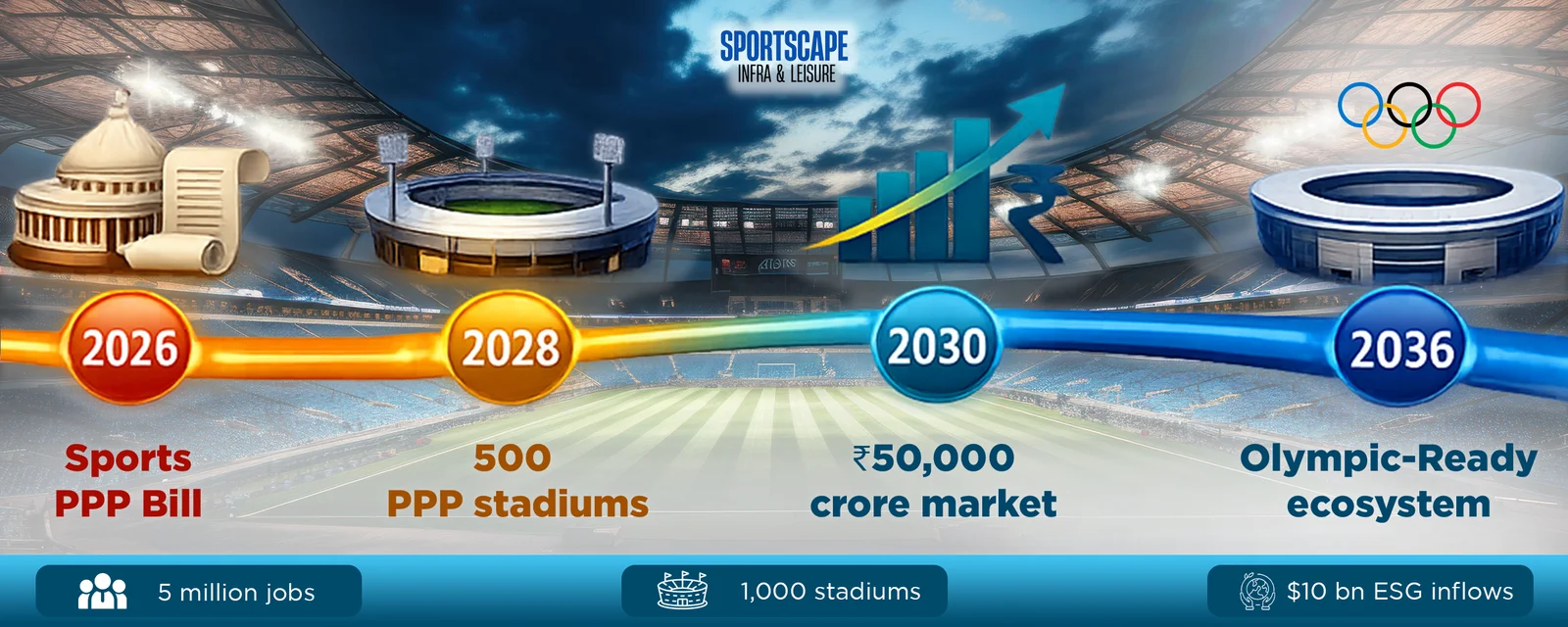
With Odisha's success scaling nationally and a 2026 Sports PPP Bill looming, India can rival China's Olympic infra. Private giants like Adani (eyeing sports cities) signal momentum. Balanced risks yield a fitter, wealthier nation.
Written by