
Women Coaches and India’s Sports Economy: The Silent Architects of Victory
Explore how women coaches in India are transforming sports culture, talent pipelines, and economic growth while navigating systemic underrepresentation.
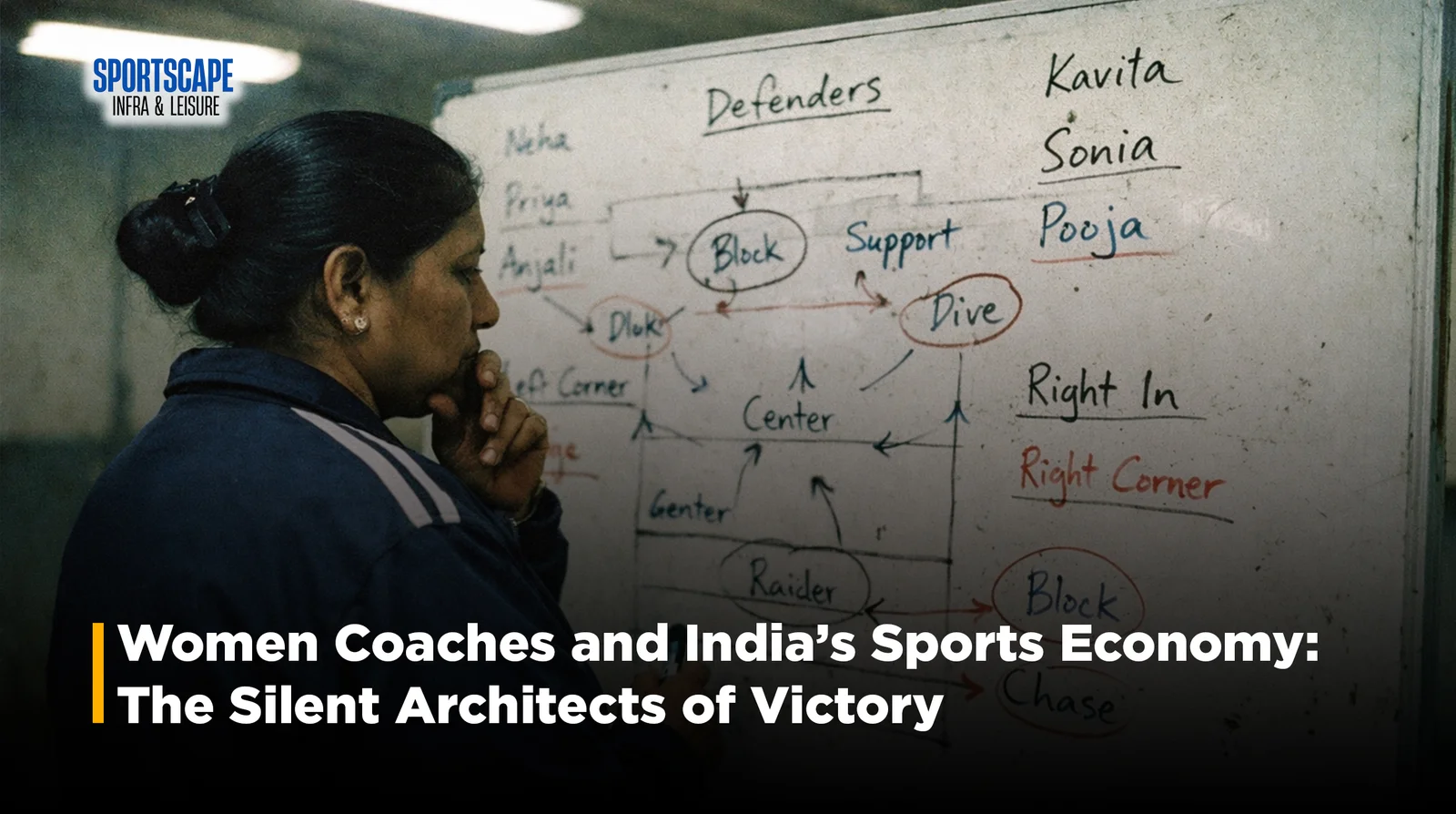
In the crisp chill of an early morning in Bengaluru’s Kanteerava Stadium, a whistle pierces the quiet. A group of young hockey players dart across the turf in disciplined formation, their sticks flashing under the pale sun. At the edge of the field stands a woman, arms folded, gaze unwavering. She interrupts the drill with a precise correction: timing, positioning, rhythm. This is Janek Schopman, the Dutch head coach who guided India’s women’s hockey team through one of its most remarkable Olympic campaigns in Tokyo 2020, where the team finished fourth, which is the best result in decades. For many observers, the moment symbolised the ascent of Indian women athletes. Yet, the deeper truth lay elsewhere: the woman on the sidelines.
Across India’s stadiums, training grounds, and athletics tracks, women sports coaches are slowly emerging as architects of performance, culture, and economic value in sport. Their presence is rewriting narratives once dominated by men. However, beneath this surface lies a stark imbalance. While women athletes have begun claiming podiums, women coaches in India remain dramatically underrepresented in India’s sports economy, excluded from decision-making, underfunded, and frequently overlooked. The question confronting Indian sport today is not merely whether women can coach, but whether the sports economy is willing to recognize their value.
The Numbers Behind the Sidelines: A Stark Gender Gap in Coaching
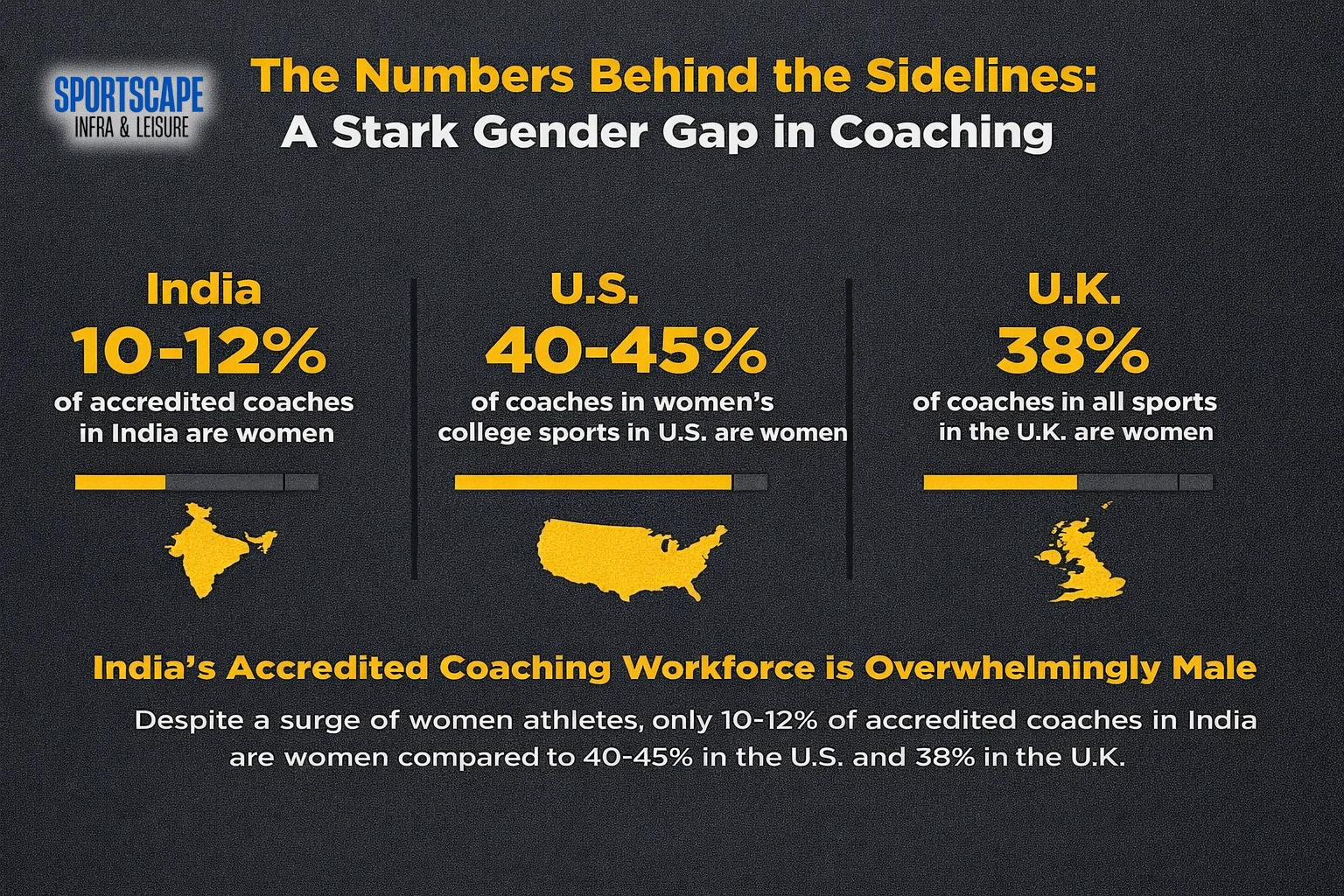
The global sports industry has long struggled with gender imbalance in coaching leadership, but India’s figures are particularly revealing. Despite women forming alliances in a rapidly growing proportion of athletes in many disciplines, but still the footprints of women coaches remain sunken upto 10-12% accredited coaches in India. The disparity becomes even sharper when viewed through the institutional lens. Data from the Sports Authority of India (SAI) indicates that the majority of certified national-level coaches remain male, particularly in high-investment sports such as athletics, wrestling, and football.
Globally, the contrast is striking. According to the Women’s Sports Foundation, women represent around 40–45% of coaches in women’s college sports in the United States, a figure that is still debated but far higher than India’s single-digit estimates. Similarly, the UK Coaching Workforce Survey reports that around 38% of female coaches in sports in the United Kingdom are women, with targeted policy initiatives designed to increase representation.
These figures highlight an uncomfortable reality: India’s sports economy continues to treat coaching as a male domain. The consequences ripple far beyond employment statistics. Coaches shape talent pipelines, athlete psychology, training culture, and ultimately performance outcomes. Excluding women from these roles narrows the diversity of expertise within the system. Ironically, the country has witnessed an unprecedented surge of women athletes, from P.V. Sindhu, Mary Kom, and Hima Das to the new generation emerging from Khelo India programs. Yet the leadership structures surrounding them remain disproportionately male. As a result, India risks celebrating female athletes without building the ecosystem that sustains them.
Winning From the Sidelines: Women Coaches Who Changed the Game
On the margins of the field, where whistles replace spotlights and strategy quietly shapes outcomes, women coaches are steadily altering the rhythm of Indian sport. Their impact rarely arrives with spectacle; it unfolds in quieter forms of leadership: refining a technique, rebuilding an athlete’s confidence, or designing a training ecosystem that outlives a single tournament. In these measured interventions lies a transformative force within the Sports Coaching in India and the sports ecosystem.
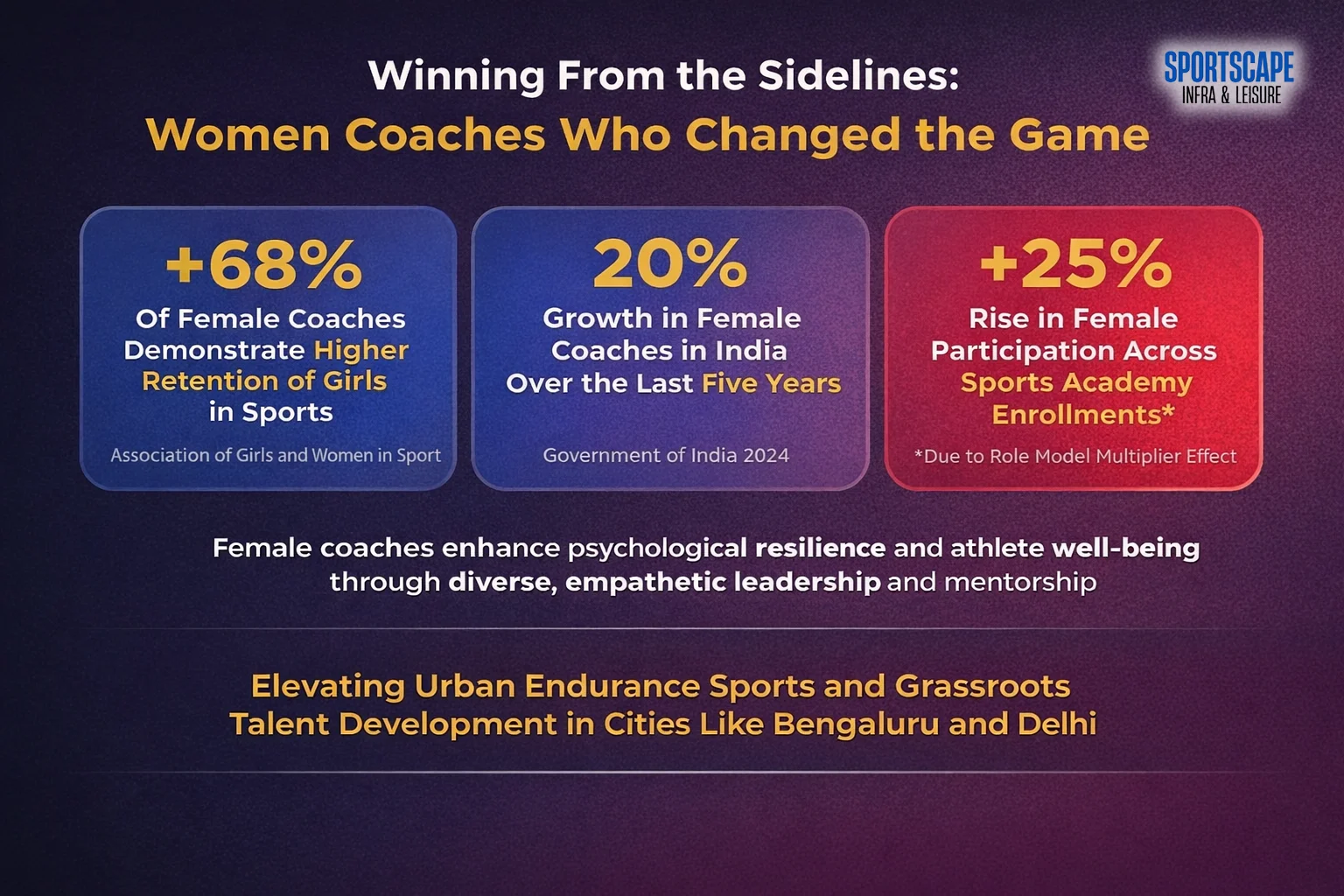
Despite systemic barriers, several women have demonstrated how powerful female leadership can be in coaching. Radhika Menon, through her work in athletics development and youth training programs, has helped guide young athletes from school tracks into competitive circuits. Similarly, Nisha Millet, an Olympian swimmer turned mentor, has been instrumental in building structured pathways for emerging swimmers, blending elite training with mentorship. Their work represents more than individual success; it reflects the slow construction of sporting ecosystems that nurture future talent. Research by the Association of Girls and Women in Sport indicates that women sports coaches often create environments where athletes, particularly girls, are more likely to remain engaged in sports and develop stronger confidence.
This dynamic, sometimes described as the “role model multiplier effect”, has broader implications for the sports economy. Higher participation rates expand grassroots programs, academies, and consumer markets tied to sports infrastructure and fitness culture.
The influence of women sports coaches is increasingly visible in India’s urban endurance communities as well. Reports examining the country’s running ecosystem highlight how female coaches are shaping training cultures in cities like Bengaluru and Delhi, mentoring first-time athletes and encouraging wider participation. There remains a significant record of women coaches significantly impacting psychological resilience and athlete well-being alongside performance metrics. In doing so, they challenge the old myth that elite coaching is inherently masculine, revealing instead that diverse leadership may be one of sport’s most overlooked competitive advantages.
Voices from the Field: Women Coaches Speak About Bias
Across locker rooms, training grounds, and Olympic corridors, women coaches often carry two roles at once: strategist on the field and pioneer beyond it. Their voices reveal not only triumph but also the quiet resistance required to remain in leadership positions long dominated by men. At the Paris 2024 Olympics, the progress was visible but incomplete. Women achieved gender parity as athletes, yet only about 13% of Olympic coaches were women, highlighting the enduring imbalance in leadership roles. Through the IOC’s Women in Sport High-Performance Pathway (WISH) programme, female coaches from dozens of countries have begun to build networks of mentorship and confidence. Irish athletics coach Noelle Morrissey described the shift in mindset after joining the programme: “After the first day, it was no longer ‘I can’t’, but ‘How can I?’” posing a quiet declaration of belonging in a space where women have historically been questioned.
Yet the pathway remains narrow. Many coaches describe a persistent sense that they must prove themselves more thoroughly than their male counterparts. This sentiment echoes in professional leagues as well. Speaking about the rise of women in franchise cricket, Lisa Keightley, head coach of the Mumbai Indians in the Women’s Premier League, noted that visibility is slowly changing perceptions: more former players now realise that becoming a head coach is possible, and “you’re going to see more and more female head coaches in franchise leagues.”
Representation itself carries symbolic weight. Sonia Raman, who made history as the first Indian-origin head coach in the WNBA, has spoken about the responsibility of being a “first.” For her, the role is not merely a professional achievement but a signal to the next generation that leadership in sport can look different. She has emphasised that she hopes she will not be the last, an acknowledgement that progress must extend beyond individual milestones. Together, these voices form a quiet chorus within global sport. They speak of bias that still lingers, but also of possibility. Each woman on the sideline, clipboard in hand, eyes fixed on the field, becomes more than a coach. She becomes proof that the boundaries of leadership in sport are slowly, inevitably expanding.
Why Women Coaches Matter for India’s Sports Economy
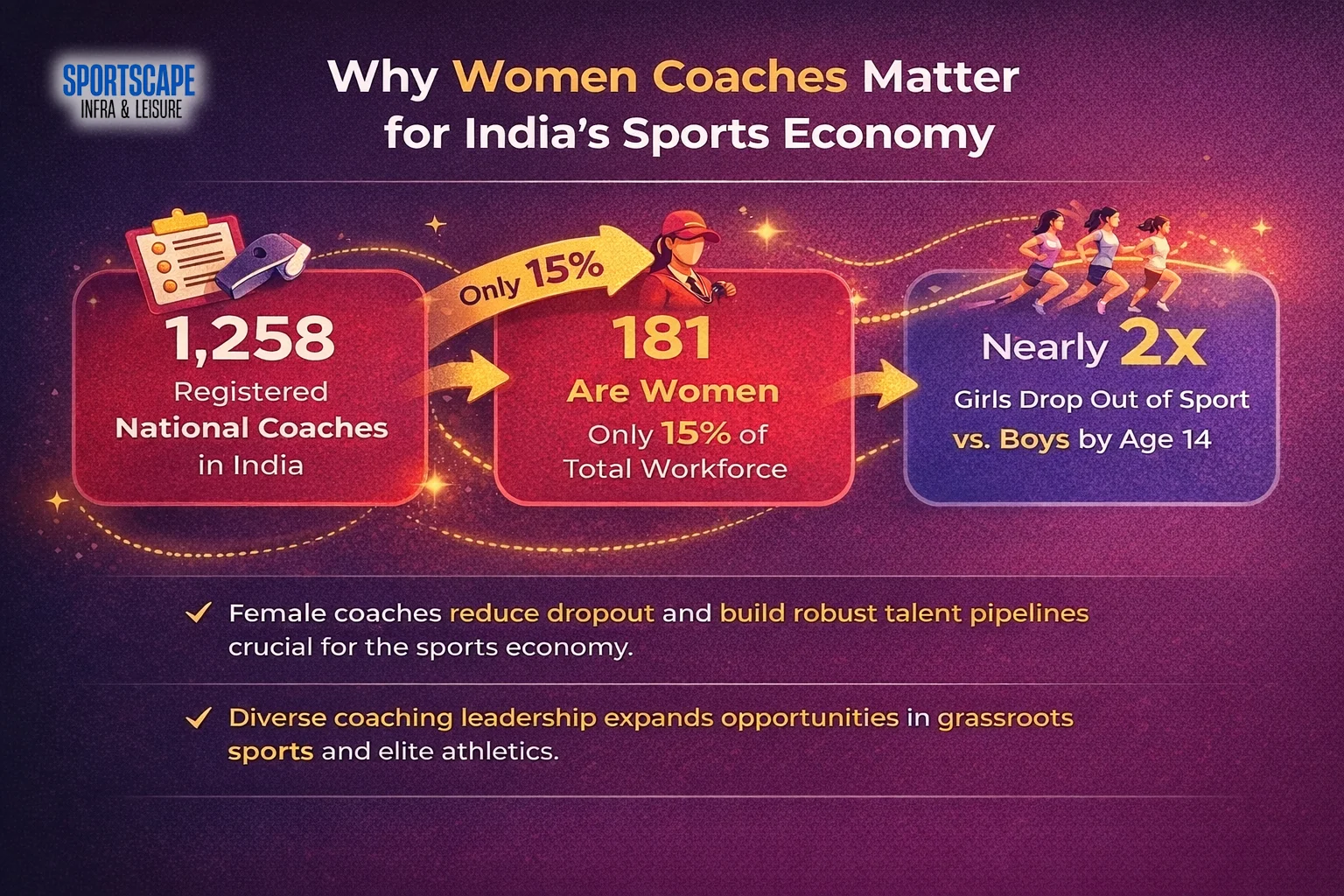
Indian sport today stands at a curious crossroads. Stadiums are filling with young athletes, fitness communities are expanding across cities, and Gen Z has turned sport into a lifestyle, something that lives not just in arenas but in running clubs, startup gyms, and digital training communities. Yet the leadership shaping this movement still looks remarkably one-sided. Out of 1,258 registered national coaches in India, only 181 are women, barely 15% of the total workforce.
This imbalance is not merely a question of representation; it is a structural limitation within the sports economy itself. Women coaches in India are the architects of talent pipelines. They design training cultures, nurture grassroots participation, and ultimately determine how many athletes reach elite levels. When women remain absent from these leadership roles, half the country’s experiential insight into sport, physiological, psychological, and social, is left out of the system.
Research suggests the consequences dig deeper. Studies cited in sports policy analysis show that girls drop out of sport at nearly twice the rate of boys by age fourteen, often due to lack of mentorship, role models, and supportive environments. Female coaches help reverse that trend, creating spaces where participation expands, and talent stays longer in the system.
The economic ripple is significant. More participation means more academies, more sports infrastructure, more investment in equipment, sports science, and training ecosystems. Recognising this, India’s Sports Ministry recently approved 320 new assistant coach positions across 25 disciplines, with over 50% of posts reserved for women, a move aimed at strengthening the grassroots coaching network ahead of future Olympic ambitions. In a sports economy increasingly shaped by innovation, entrepreneurship, and a generation that treats fitness as culture, women coaches are not simply a symbol of equality. They are catalysts of growth, quietly expanding the boundaries of who plays, who leads, and ultimately how India competes on the world stage.
Written by